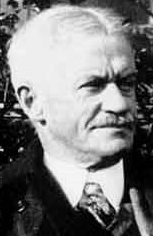
 Every government that has cheapened its currency has been knavishly false to a trust; so have those which, like ours, use public funds to subsidize large-scale gambling and swindling.
Categories
Every government that has cheapened its currency has been knavishly false to a trust; so have those which, like ours, use public funds to subsidize large-scale gambling and swindling.
April 16 marks the 1859 death of Alexis de Tocqueville, French historian and sociologist, author “Democracy in America.”
On April 16, 1945, the United States Army liberated Nazi high security prisoner-of-war camp Oflag IV-C (better known as Colditz).
Dr. Martin Luther King, Jr., penned his Letter from Birmingham Jail while incarcerated in Birmingham, Alabama, for protesting against segregation, on April 16, 1963.
If an email popped up offering free money, what would you do?
Delete it? And wonder how it got past your spam filter?
Me, too.
Well, some Washington wags — call them re-distribution professionals — say we’re crazy.
As are Republicans in the 19 states that have refused to expand their states’ Medicaid rolls as part of Obamacare, and in the five states — Indiana, New Hampshire, Tennessee, Utah and Virginia — still debating whether to do so.
Republicans are “rejecting what is more or less nearly free money from the federal government,” says a baffled Josh Barro of the New York Times.
Karen Finney, host of MSNBC’s Disrupt, sneers that these GOP-led states are “leaving money on the table.”
“It’s free money!” exclaims an exasperated Joan Walsh of Salon.com, adding that, “It’s stimulative money.”
Under Obamacare, the federal government first demanded and now urges states to expand the Medicaid rolls well beyond those at the poverty line, with our central government generously offering to pay the cost for the massive expansion fully for three years . . . and then 90 percent after that.
One local newspaper identified one major issue, trust: “The trademark of Obamacare is broken promises.”
Will the federal government keep paying nearly all the cost? In Virginia, before any expansion, Medicaid already accounts for nearly one out of every four dollars in state spending.
“This is another picture of how extreme this Republican Party has become,” according to Walsh, “that you had this organized backlash to taking money that once would have been a no-brainer.”
This is the new GOP extremism, refusing to be bought off?
It’s no vice.
This is Common Sense. I’m Paul Jacob.
We live in a time when the governing political party and the dominant strain in the major media constantly harp on two themes:
So, it is especially droll to witness the Food and Drug Administration pounce upon an age-old recycling practice between breweries and farms. In the name of “better regulation,” and “safety,” of course.
For well over a century beer brewers have disposed of their spent grain product — the non-beer product of the beer-making process — by giving or selling it cheaply to farmers, who feed it to livestock.
It would cost a lot to dispose of this in landfills, so brewers save money by letting farmers take the dregs off their hands.
But now the FDA, in a new set of proposed rules (proposed not by Congress, by the way), wants to protect cattle’s food supply by requiring brewers to dry the spent grain before shipping it off.
That’s a killer cost. One Oregonian brewer referred to it as an “enormous burden,” and warned that higher consumer prices would be the result.
I’m with Oregon Senator Ron Wyden (D), who demands that the agency go back to the drawing board.
“I don’t know everything about beer,” Wyden has been quoted, “but I do know when a federal agency acts like it has had one too many.”
For my part, I don’t see this as aberrant behavior from a federal agency. I see it as typical.
Typically drunk on power.
This is Common Sense. I’m Paul Jacob.
 I am aware that many object to the severity of my language; but is there not cause for severity? I will be as harsh as truth, and as uncompromising as justice. On this subject, I do not wish to think, or to speak, or write, with moderation. No! no! Tell a man whose house is on fire to give a moderate alarm; tell him to moderately rescue his wife from the hands of the ravisher; tell the mother to gradually extricate her babe from the fire into which it has fallen; — but urge me not to use moderation in a cause like the present.
It’s Tax Day tomorrow. Waiting till the last moment to file because you’ll have to write a check?
It hurts, but you must be financially better off than the federal government, which itself owes $17.5 trillion, all because Congress and the President refuse to balance budgets.
In the last ten years, according to a convenient Department of Treasury website, the federal government’s debt has not merely doubled, it has ballooned … by more than $10 trillion.
During the Reagan Administration, we were aghast at the idea of a “mere” one trillion dollar debt. I remember “No Trillion Dollar Debt” signs.
Waving signs didn’t help.
But something’s gotta give. As J. D. Tuccille writes, “you have to think that it’s going to occur to people that the United States government seems neither willing nor able to stop borrowing, and to start paying the sum down, even a little bit.”
Debts must be repaid, with interest. That goes for the last decade’s additional ten trillion tonnage of “bricks” now hanging over our heads.
Writing your check to the government isn’t made any more pleasant by pondering how paltry your payment is compared to what’s needed to make a dent in the debt. Moreover, even amid constant talk about “cuts,” federal government spending continues to increase. Thus, getting out of debt is not about writing checks to government. It’s about government writing fewer and smaller checks.
This is Common Sense. I’m Paul Jacob.
You can not possibly have a broader basis for government than that which includes all the people, with all their rights in their hands, and with an equal power to maintain their rights.
Two American freedom fighters share April 13 as their birth date: Thomas Jefferson, author of the Declaration of Independence, and Jane Jacob, my mother. Happy Birthday to you both, Tom and Mom!
There, you have read the ending to my current Townhall column. Why not read the rest of it? Click on over. Then come back here for more reading:
Campaign finance regulation is in the news. Today’s video of former FEC Commissioner Brad Smith speaking to a Cato Institute audience about the impact of the Citizens United and Speech Now decisions is not news (a year old), but it is an important message, too seldom heard.
Smith argues that these court decisions have “made races more fluid” because “it is possible to get money into a political race much more quickly than used to be the case.” He recognizes that “most incumbent politicians tend to view that as bad.”
He points out that since the FEC (Federal Election Commission) was created in 1974, the incumbent spending advantage over challengers has grown from 1.5 to 1 to a whopping 4 to 1.
Smith also urges ending restrictions on contributing to political parties, which happened last week with the Supreme Court decision in McCutcheon v. FEC.
Next, let’s end the limits on what an individual can contribute to an individual candidate.
We’ll be talking more about that — right here at Common Sense.
“It’s not enough for governments to simply be democratic,” Oxford professor Stein Ringen recently wrote in the Washington Post, “they must deliver or decay.”
Deliver what, you ask?
Ringen isn’t clear — surprise, surprise — but attacks “Thatcherite inequality” — though, he admits it’s worse today in Great Britain than when Margaret Thatcher was prime minister (1979-1990). Why no progress to his apparent ideal of economic equality? According to Ringen, “concentrations of economic power . . . have become unmanageable.”
He advances the same analysis of U.S. “democracy,” claiming that power has been “usurped by actors such as PACs, think tanks, media and lobbying organizations.”
Think tanks are a problem?
Ringen doesn’t explain how these additional voices serve to undercut “democracy.” Instead, he simply hurls broadsides against our “mega-expensive politics,” warning that, “When money is allowed to transgress from markets, where it belongs, to politics, where it has no business, those who control it gain power to decide who the successful candidates will be — those they wish to fund — and what they can decide once they are in office.”
There is generally money on both or numerous sides of any given policy question. There is certainly no monolithic “they” constituting “the rich” who decide our public policy over tea at the club. Pretending there is won’t help democracy.
“It is a misunderstanding to think that candidates chase money,” writes the professor from his ivory tower. “It is money that chases candidates.”
Really? Ringen can easily test his hypothesis: run for office and wait for all that money to chase him down.
This is Common Sense. I’m Paul Jacob.