Categories
initiative, referendum, and recall secession

Seceding from Chicago

Thirty-three rural Illinois counties have voted — count ’em, 33, with seven added just last November — to secede from their state.

Sort of.

The citizens of those counties have approved non-binding measures saying they wish to secede. In this case, the initiative and referendum process has been used as a form of petitioning.

They want a divorce. From Chicago and Cook County. 

The reasons? The age-old country-city divide: taxes, scope of government, a complete clash of values.

On the table are two counter-offers.

“Instead of seceding and forming a 51st state,” suggests Indiana’s Speaker of the House Todd Huston, “they should just join us.”

This is pretty much what the Oregon secessionists are trying to do with their “Greater Idaho,” as covered here in the past.

In February, the Indiana House passed a bill to create a bipartisan committee to explore the notion; it now heads to the Senate.

Indiana’s lieutenant governor said it would “Make Illinois Great Again.”

Illinois’s governor, on the other hand, dubbed it a “stunt.”

But District 109 State Representative Charlie Meier has taken those 33 expressions of extreme dissatisfaction seriously, offering an alternative: reconstruct the State Senate so that one senator would be elected from districts made up of three contiguous counties, rather than the cumbersome gerrymandered array that  has been legally challenged by Republicans — giving rural counties more say, more political oomph.

For that’s what it’s really about.

Note that two previous attempts to separate from Chicago and Cook County  — in 1925 and 1981 — hailed from the Windy City itself. 

Now it’s the rest of the state that wants out.

Interesting development in comparative power and grievance, no?

This is Common Sense. I’m Paul Jacob.


PDF for printing

Created with Krea and Firefly

See all recent commentary
(simplified and organized)
See recent popular posts

Categories
Thought

Rose Wilder Lane

Life is a thin narrowness of taken-for-granted, a plank over a canyon in a fog. There is something under our feet, the taken-for-granted. A table is a table, food is food, we are we—because we don’t question these things. And science is the enemy because it is the questioner. Faith saves our souls alive by giving us a universe of the taken-for-granted.

Rose Wilder Lane, journal entry (1923), as quoted in The Ghost in the Little House, ch. 7, by William V. Holtz (1993).
Categories
Today

Rockingham

On March 27, 1782, the Second Rockingham ministry assumed office in Great Britain and began negotiations to end the American War of Independence. On 1794 on this day of the month, the United States Government established a permanent navy and authorized the building of six frigates.

Categories
election law Voting

Trump to Save Elections?

“Election fraud,” said the president. “You’ve heard the term? This will end it, hopefully.” 

The “This” being an Executive Order dated March 25, 2025, entitled “Preserving and Protecting the Integrity of American Elections.”

Interestingly, the opening unfavorably compares the American ways of voting with foreign nations. 

“In tabulating votes, Germany and Canada require use of paper ballots  counted in public by local officials,” the order explains, “which substantially reduces the number of disputes as compared to the American patchwork of voting methods that can lead to basic chain-of-custody problems.” The document adds that “countries like Denmark and Sweden sensibly limit mail-in voting to those unable to vote in person and do not count late-arriving votes.”

“It is the policy of my Administration to enforce [2 U.S.C. 7 and 3 U.S.C. 1] and require that votes be cast and received by the election date established in law,” Trump’s order states.

Well, California might have to start reporting the results of congressional races in under a month.

More consequently, the EO directs “the Secretary of Homeland Security” and “the Secretary of State” to “ensure that State and local officials have . . . access to appropriate systems for verifying the citizenship or immigration status of individuals registering to vote or who are already registered.”

The exact opposite policy from Biden’s refusal to help those seeking to enforce citizen-only voting policies.

In full disclosure, as chairman of Americans for Citizen Voting, I helped eight states pass Citizen Only Voting Amendments last November — and six states previously. This year, South Dakota’s legislature has already placed an amendment on the 2026 ballot and, yesterday, Kansas did likewise. 

Democrats continue to push for non-citizen voting, which liberal courts in California and Vermont have upheld for cities, and to oppose these state amendments. But last week, New York State’s highest (and quite liberal) court struck down New York City’s noncitizen voting ordinance.

This is Common Sense. I’m Paul Jacob. 


PDF for printing

Illustration created with Krea and Fireflly

See all recent commentary
(simplified and organized)
See recent popular posts

Categories
Thought

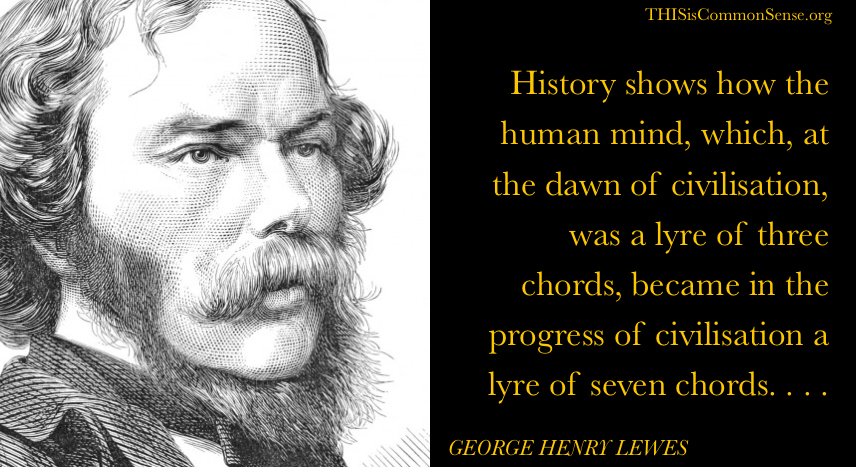
George H. Lewes

History shows how the human mind, which, at the dawn of civilisation, was a lyre of three chords, became in the progress of civilisation a lyre of seven chords. . . .

G. H. Lewes, Problems of Life and Mind (Third Series) Problem the First — The Study of Psychology: Its Object, Scope, and Method (1879), p. 157.
Categories
Today

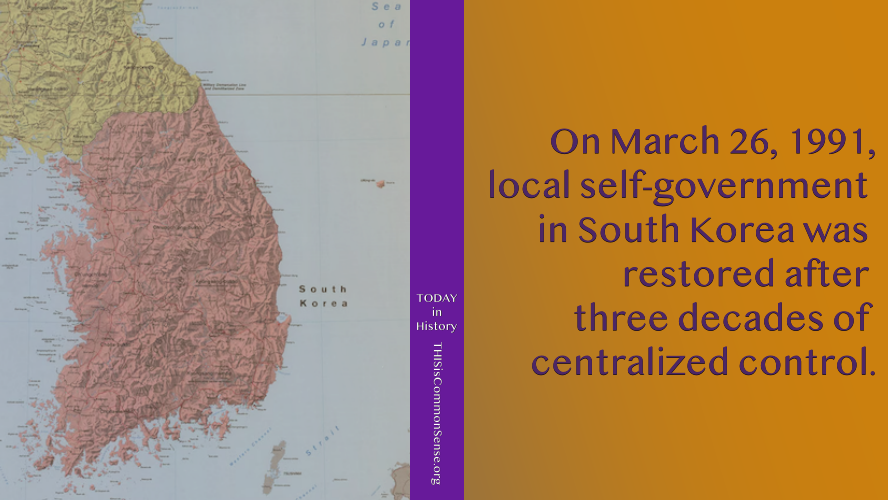
South Korea

On March 26, 1991, local self-government in South Korea was restored after three decades of centralized control.

Categories
subsidy tax policy

Oh, SNAP!

It appears that recipients of “food stamps” (the Supplemental Nutrition Assistance Program, or SNAP) “often have lower diet quality and higher rates of diet-related health issues compared to non-participants,” according to an article in healthjournalism.org

“While it’s unclear whether SNAP directly causes these outcomes or if other factors are at play, some argue that the program, at minimum, sustains unhealthy eating habits by not restricting purchases of nutritionally poor foods.”

Among the “some” who argue for restrictions is Robert Kennedy, Jr., head of Health and Human Services. He promises to purge unhealthy foods from the subsidy list.

Currently, the taxpayer-funded “benefit” may “be used for ‘any food or food product intended for human consumption,’ except alcohol, tobacco and hot foods, including those prepared for immediate consumption. Critics argue that SNAP’s allowance for purchasing sugary snacks, soda and junk food promotes unhealthy eating habits, which can lead to obesity and other related health issues.”

The critics are undoubtedly correct; indeed, the proposed limitations will almost certainly be too tame. 

If the program must exist, it should do good without enabling demonstrable harm. So instead of a cumbersome and extensive list of prohibited food items, there should be a concise list of allowed categories:

  • uncooked meats and dairy products without added sugars
  • fresh, frozen, dried, and canned beans, fruits and vegetables
  • staple ingredients of traditional meals, such as flour, spices, and oils

Some rail against any idea of restricted benefits, but government handouts are not there to expand the “freedoms” of the poor; they are provided to help folks weather hard times. 

The freedoms of taxpayers have already been sacrificed for their sake. Forcing taxpayers to watch SNAP’s EBT card users in the grocery line buying candy and sodas adds insult to the benefactors while injuring the beneficiaries.

This is Common Sense. I’m Paul Jacob.


PDF for printing

Illustration created with Krea and Fireflly

See all recent commentary
(simplified and organized)
See recent popular posts

Categories
Thought

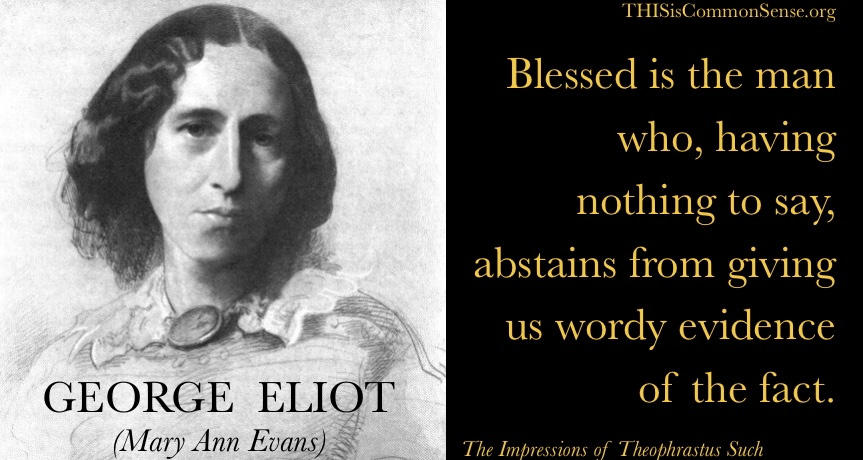
George Eliot

Blessed is the man who, having nothing to say, abstains from giving us wordy evidence of the fact.

George Eliot, the nom de plume of Mary Ann Evans (1819-1880), Impressions of Theophrastus Such, Ch. 4 (1879).
Categories
Today

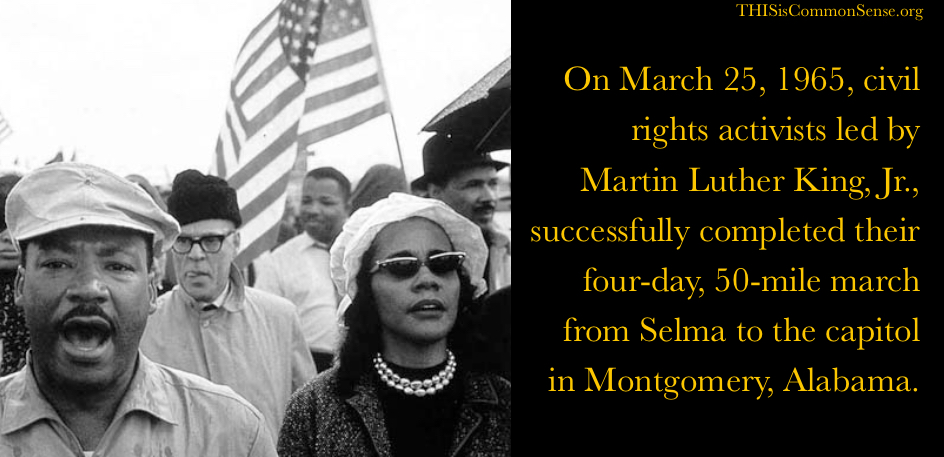
To the Capitol

On March 25, 1965, civil rights activists led by Martin Luther King, Jr., successfully completed their four-day, 50-mile march from Selma to the capitol in Montgomery, Alabama.

Categories
Accountability too much government

Federal Self-Service

Even government agencies that perform an identifiable function should be eliminated if they are not performing a proper function of government.

But what about an agency that exists primarily “to provide luxurious lifestyles for its employees”?

The Federal Mediation and Conciliation Service is one of the agencies getting the ax under the Trump administration, at least until some judge tries to resurrect it.

Nominally, FMCS existed to serve as a voluntary mediator between unions and businesses. But aside from doling out grants to unions and applicants with a tenuous connection to unions, its overriding purpose was to enable employees to splurge on themselves at the expense of taxpayers.

That’s what Luke Rosiak discovered during a year-long investigation.

One FMCS official pretended to take a years-long “business trip” so that taxpayers would foot the bill for his living expenses.

Employees unblocked government credit cards to circumvent protections against abuse, then used them to fund personal expenses. One leased a BMW with the card.

Junkets to resort locations supposedly to drum up interest in the pointless agency were really just a way of enjoying government-funded vacations.

One employee told Rosiak: “Personally, the reason that I’ve stayed is that I just don’t feel like working that hard, plus the location on K Street is great, plus we all have these oversized offices with windows, plus management doesn’t seem to care if we stay out at lunch a long time. Can you blame me?”

Yes, we can.

This is Common Sense. I’m Paul Jacob.


PDF for printing

Illustration created with Krea and Firefly

See all recent commentary
(simplified and organized)
See recent popular posts