 Socialist policy is a permanent menace to the liberty and security of citizens, and cannot therefore be the policy of any government, the primary duty of which is to exact respect for internal and external security.
Categories
Socialist policy is a permanent menace to the liberty and security of citizens, and cannot therefore be the policy of any government, the primary duty of which is to exact respect for internal and external security.
“Metro has a reputation for shoddy service and a history of not learning from its mistakes,” Aaron Wiener admitted in a column for The Washington Post. But this extremist zealot’s basic argument for government-run, taxpayer-subsidized mass transit might best be understood by its headline: “Metro’s a mess. All the more reason to ride it.”
A woman died last week riding the city’s subway system. She was overcome when train cars became stuck in a tunnel filling with smoke. Another 84 riders were hospitalized, two in critical condition.
 DC Fire was so woefully slow in response — victims say more than 30 minutes — that afterwards no public official was willing to say precisely how slow. Not the new mayor; not the Chairman of Washington’s Metro board. The latter provided an excuse, claiming he “cannot speak to it” because of the investigation by the National Transportation Safety Administration.
Upon arrival, the rescuers’ radios didn’t work. “[D]espite hundreds of millions of dollars in upgrades and new training and safety protocols at the transit agency,” The Washington Post reported, “a critical piece of infrastructure — emergency communications — remains a significant problem.”
This isn’t Metro’s first accident, either. Six years ago, nine people died when two Metro trains collided.
Without profits, and run “politically” as a public entity, there just isn’t the same incentive to make the necessary investment in infrastructure required to run the subways safely. A private company with Metro’s record of accidents and failure in addressing safety concerns would likely be shut down.
Sadly, Metro faces no such threat.
But the transit agency faces a different one: ridership has fallen to the lowest point in a decade. People are voting with their feet.
This is Common Sense. I’m Paul Jacob.
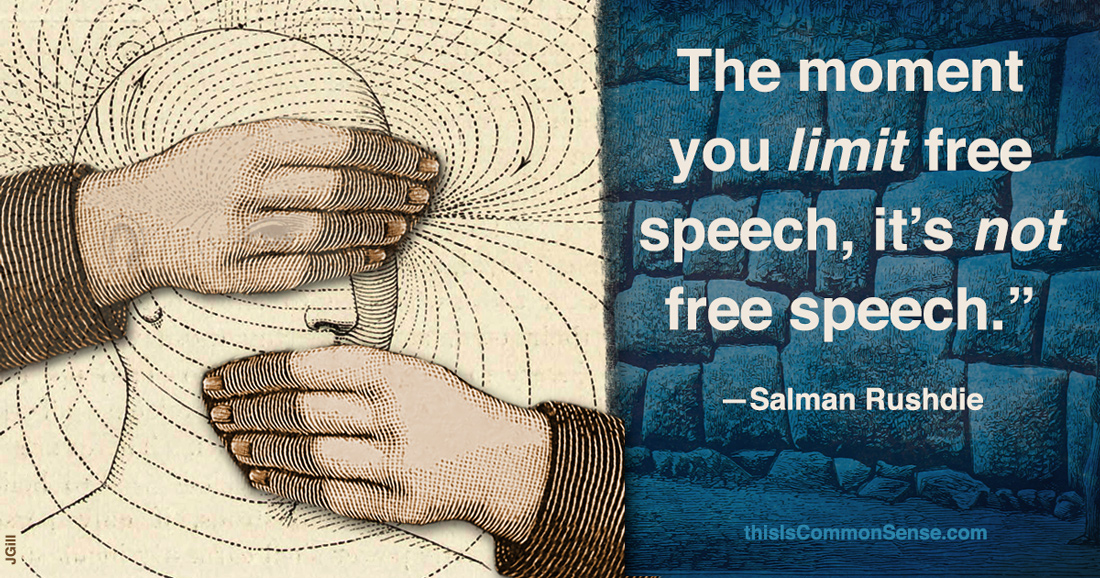
“The moment you limit free speech, it’s not free speech.”
—Salman Rushdie

To download the full-size version of this image, click above.
On January 21, 1950, Alger Hiss was convicted of perjury, with Whittaker Chambers being the main witness in Hiss’s prosecution. Chambers confessed to having been a Soviet spy, and accused Hiss as an accomplice, which Hiss denied to his dying day. Chambers wrote a fascinating memoir about all this in “Witness.”
Today is economist Tyler Cowen’s birthday. Happy Birthday, Tyler.
[C]apital does not increase automatically by means of compound interest, as Socialists are pleased to assert. . . .
Civilization is a choice, a habit, a line in the . . . sand.
For modern, prosperous society to progress, to grow more healthy and wealthy and wise, most of us have to agree on a small set of principles. Mostly, we must agree not to rush to violence at the merest provocation.
There has to be a lot of negotiation to get anything done. At least, in a free and open civilized society.
Terrorism is the repudiation of this principle.
 The main perpetrators of terrorism these days hail from Muslim peoples. But there are non-Muslim terrorists, too. Many of the “school shootings” and similar violent acts in America and even in Europe rarely get listed as terrorism, though they certainly look terroristic. And most don’t have anything to do with Islam.
Even when Muslims are the ones committing the terrorism, their victims are often also Muslim.
Some folks estimate that as many as 95 out of a hundred terrorist victims are Muslim. Why? Because so much of this violence goes on in countries like Iraq, Pakistan, and Afghanistan.
While this estimate is probably too high, the fact that Muslims themselves are the most common victims of Muslim violence suggests that the underlying problem is the lack of institutions in those lands that hold to the choice — the habit — of civilization.
So, yes: tyranny is at the root of the problem.
Americans, if we want fewer terrorists, might want to restrain our governments from propping up or closely allying ourselves to “Muslim” dictatorships, then.
This is something we can control.
This is Common Sense. I’m Paul Jacob.
On January 20, 1920, the American Civil Liberties Union was founded.
 [T]he moment you limit free speech, it’s not free speech.
It used to be called “the Blue Flu.”
Cops, in the course of union negotiations, would deliberately slack on the job, or falsely call in sick (the “flu”) . . . just to get more moolah out of union contract negotiations.
Betraying a not wholly dissimilar epidemiology, New York’s finest have cut back on citations and arrests. According to a New York Times report, for “two consecutive weeks, New York City police officers have seemed to sit back, ignoring minor offenses and parking transgressions so completely that only 347 criminal summonses were written in the seven days through Sunday, down from 4,077 in the same period a year ago.”
 This doesn’t seem union-directed, but a spontaneous result of the brutal police shootings that followed mass protests against police abuse . . . and seeming support for the protester’s critique from true-blue, left-leaning Mayor Bill de Blasio.
There is much apprehension about the police laggardness, of course.
But there is some jubilation, too, as folks receive fewer parking tickets. It’s mighty difficult to park in the Big Apple; a lot of folks appreciate the reprieve, however temporary.
The rap on the NYPD — and for that matter, police across the country — has regarded over-policing: enforcing the rulebook so aggressively that it becomes harassment. That sort of policing is counter-productive, leading to the current unrest, for instance.
Maybe we can learn something from this experiment in less policing.* We might discover that, in a lot of neighborhoods, less can be more.
This is Common Sense. I’m Paul Jacob.
* According to recent reports, city government and police officials are trying to crack down on the breakout of police restraint. Regardless of future efficacy of these efforts, inquiry into the results of the inadvertent experiment remain worthwhile.
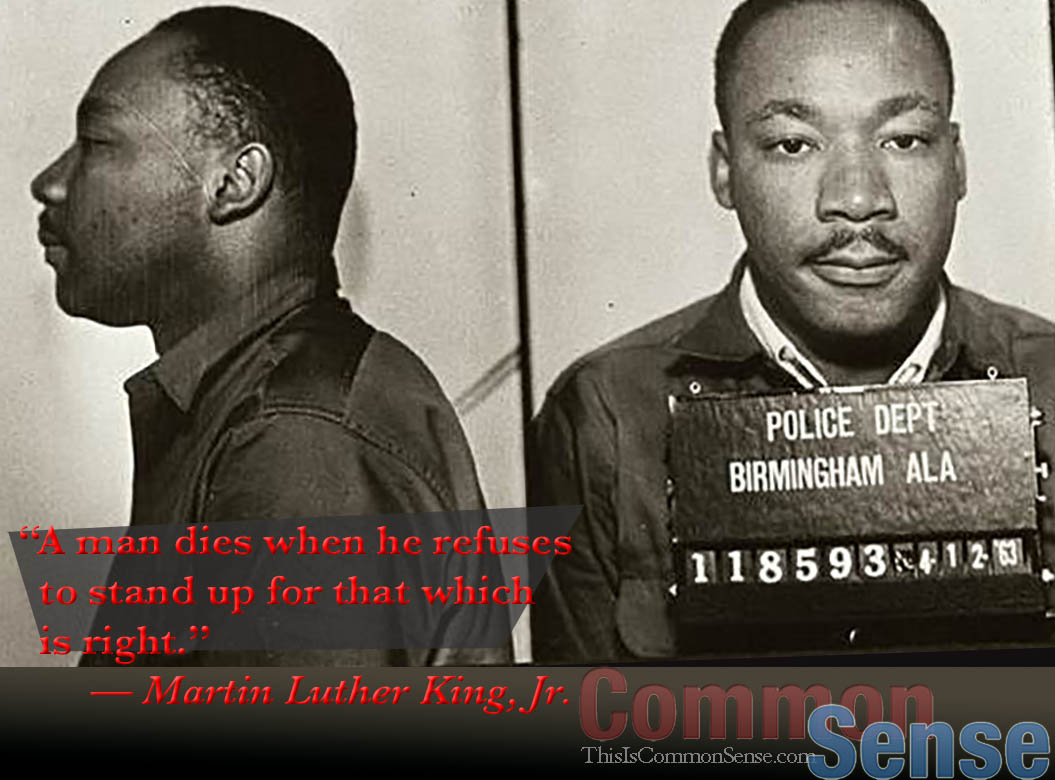
“A man dies when he refuses to do that which is right.”
—Martin Luther King, Jr.

To download the full-size version of this image, click above.