Categories
general freedom local leaders

Cancel Freedom?

Los Angeles Mayor Eric Garcetti’s message “couldn’t be simpler,” he offered last week: “It’s time to cancel everything.”

Gee whiz, that is simple.

The mayor’s order “prohibits public and private gatherings of people from more than one household and states that all businesses in the city that require people to work on location must stop operations. Walking, driving, travel on public transport, bikes, motorcycles and scooters are prohibited, other than for those undertaking essential activities,” Fortune reports

Walking alone; riding a bike — really?* 

Thankfully, folks are still permitted to play golf, tennis and pickleball. But . . . unless the course or the court is in your back yard, wouldn’t it remain illegal to travel there? Or to play with someone not living with you already?

Governor Gavin Newsom made similar demands, only over even more folks — and with less credibility — after flouting his own previous mandates. His regional order affected “some 33 million Californians, representing 84% of the state’s population,” to be locked down in their homes until after Christmas.

Restaurant owners are going to court to challenge the constitutionality of the governor’s lockdown. “We can’t close our businesses,” restaurant owner Angela Marsden told Fox news’ Neil Cavuto. “We need to stay open to survive this.”

And what about “following ‘the science’”? 

“For the second time in five days,” explained SFGATE.com, “California Gov. Gavin Newsom did not provide evidence that businesses ordered to close during the state’s new stay-at-home order are actively contributing to the spread of the coronavirus.”

Lacking legal authority and defying science provide more than enough reason for outright defiance. “At least seven counties say they won’t enforce the mandates,” NBC Nightly News informed. “The Riverside County Sheriff’s Department will not be blackmailed, bullied or used as muscle against Riverside County residents,” announced Sheriff Chad Bianco.

Defying tyranny is simple, too.

This is Common Sense. I’m Paul Jacob.


* As I noted months ago, the scientific data correlate Vitamin D deficiency with serious and deadly cases of COVID-19. Therefore, telling people to stay inside, thereby avoiding sunshine, a major source of the vitamin, is not good advice. As an order with threats of enforcement, it is something even worse.

PDF for printing

See all recent commentary
(simplified and organized)
See recent popular posts
Categories
Thought

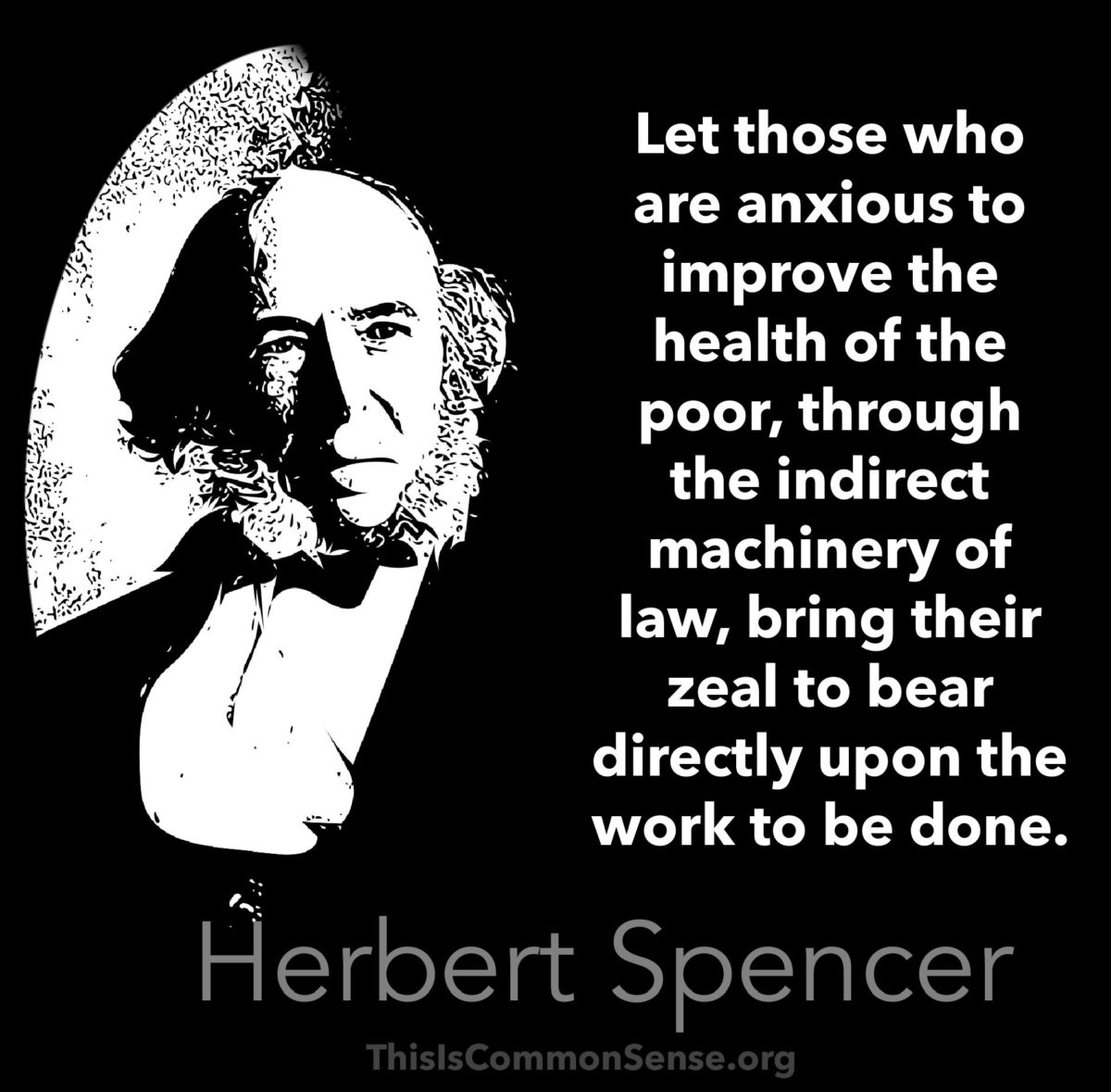
Herbert Spencer

Let those who are anxious to improve the health of the poor, through the indirect machinery of law, bring their zeal to bear directly upon the work to be done. Let them appeal to men’s sympathies, and again to their interests. Let them prove to people of property that the making of these reforms will pay. Let them show that the productive powers of the labourer will be increased by bettering his health, whilst the poors’-rates will be diminished. Above all, let them demand the removal of those obstacles which existing legislation puts in the way of sanitary improvements. Their efforts thus directed will really promote progress. Whereas their efforts as now directed are either needless or injurious.  

Herbert Spencer, “Sanitary Supervision,” Social Statics (1851); as quoted in Phillip W. Magness, “Herbert Spencer’s Critique of the Board of Health in 1851” (December 7, 2020).
Categories
Thought

Walter E. Williams

We all proposition our grocer in the following fashion: “We’re not going to tell you when we’re going to shop; we’re not going to tell you what we’re going to buy; we’re not going to tell you the quantity we’re going to buy — but we will fire you if you don’t have what we want when we do come into the store.”

Walter E. Williams (March 31, 1936 – December 2, 2020), Bradley Prize Winner 2017, was John M. Olin Professor of Economics at George Mason University.
Categories
Today

Cold War Ends

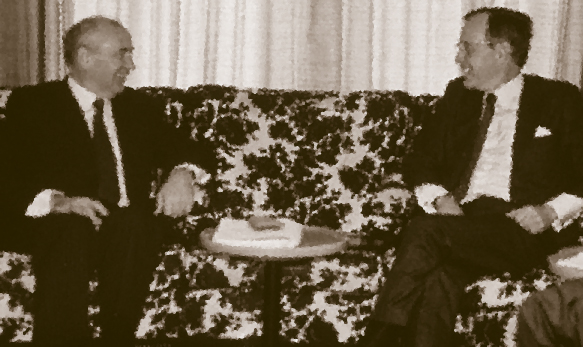
On December 3, 1989, the leaders of the two world superpowers, the United States of America and the Union of Soviet Socialist Republics, declared an end to the Cold War, at a summit in Malta. A little over two years later not only had the Cold War ended, the Soviet Union was itself dissolved.

Categories
Today

The “Stolen Election”

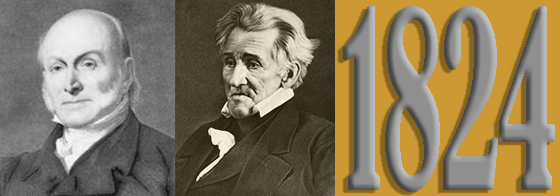
On December 1, 1824, with neither John Quincy Adams nor Andrew Jackson receiving a majority of votes in the Electoral College, the United States House of Representatives was given the task of deciding the winner in accordance with the Twelfth Amendment to the United States Constitution.

The House selected Adams. Jackson and his supporters felt deeply aggrieved, and immediately set about preparing for the next election, which Jackson won handily. Jacksonian supporters referred to the election of 1824 as “the Stolen Election,” in no small part because Jackson had received more popular votes.

Categories
Thought

Ernest Bramah

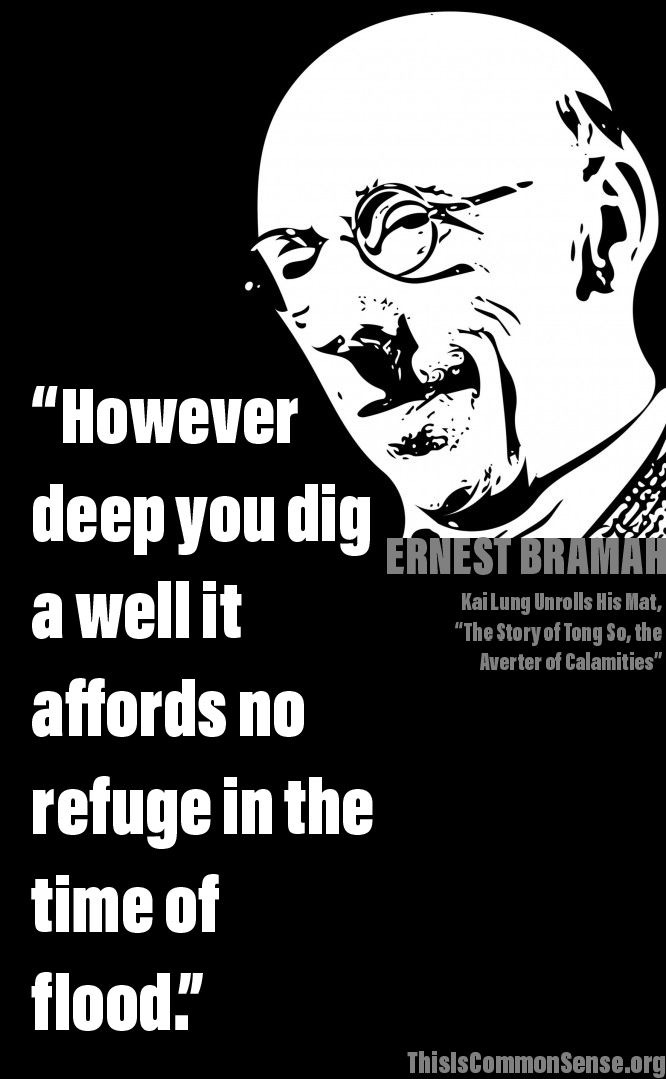
However deep you dig a well it affords no refuge in the time of flood.

Ernest Bramah, Kai Lung Unrolls His Mat, “The Story of Tong So, the Averter of Calamities” (1928).
Categories
initiative, referendum, and recall

Seeing What’s There

“One can squint and see ballot measures as a kind of super-survey of the electorate, with much larger samples and actual stakes,” wrote Sasha Issenberg over the weekend in The Washington Post. “The results then can be interpreted as a pure representation of voter preferences on discrete issues, without the vexing overlay of partisan polarization, incumbency, candidate personalities, scandal or gaffes.”*

Which “can be seductive,” he warns in an essay entitled, “Ballot measures don’t tell us anything about what voters really want.”

Nothing

Mr. Issenberg is willing to toss out these results because “ballot measure contests operate within a framework so different from elections for public office — with few financial limits”** and “lopsided spending.”

He cites Florida’s Amendment 2, pushing the state’s minimum-wage up to $15, where the yes-side spent nearly 10 times as much as the no-side. And California’s victorious Proposition 22, which he argues “declined to protect gig workers” even though that is exactly what it does, and where supporters also outspent opponents roughly ten to one. 

Issenberg also points to marijuana-related issues passing while widely outspending opponents. “In New Jersey, where more than two-thirds of voters said yes to legalization,” he explains, “supporters spent 65 times more than the leading opposition committee . . .” 

But that only amounts to proponents spending half-a-million, which doesn’t go very far in Jersey. 

While Issenberg, the author, journalist, and UCLA political science teacher, acknowledges that “a higher minimum wage and marijuana legalization are broadly popular” and don’t require greater spending, he argues that lopsided “multiples” of spending, like in New Jersey, “are unimaginable in the world of people running for office.” 

Really?

Just try. Numerous candidates for office run without any opposition at all or completely token competition. Take Illinois’s 4th congressional district, where incumbent Democrat Jesús Garcia outspent his Republican challenger by a margin of 704 to one — $593,219 to $843.

Look at the ballot measures decided weeks ago. Don’t squint; put your glasses on, if you need them. And unlike Issenberg, believe your eyes.

This is Common Sense. I’m Paul Jacob.


* Initiatives can suffer from the “personalities, scandal or gaffes” of their proponents. Still, there is clearly far less partisanship and no incumbent, per se.

** Actually, ballot measures have no limits at all. The federal courts have ruled that campaign contributions can corrupt candidates receiving them, but since ballot initiatives are written down in black-and-white and cannot be changed after the election, financial contributions cannot corrupt a ballot measure. 

PDF for printing

See all recent commentary
(simplified and organized)
See recent popular posts
Categories
Today

Chase and Clemens

On November 30, 1804, the United States House of Representatives began impeachment hearings against Supreme Court Justice Samuel Chase. The House thought he was too partisan, too “Federalist.”

The Senate later acquitted Chase.

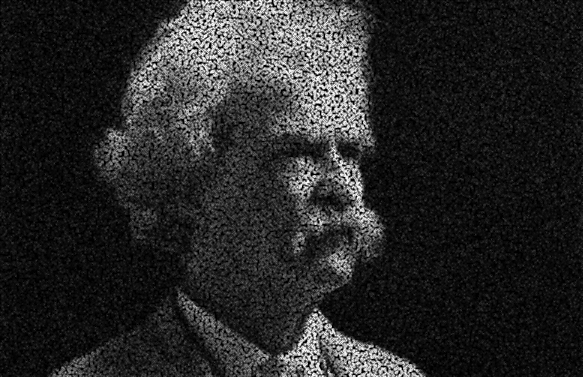
On 1835 on this date, Samuel Clemens was born, later to achieve world fame as author and humorist Mark Twain (pictured above). His most beloved books include The Adventures of Tom Sawyer (1876) and his masterpiece, Adventures of Huckleberry Finn (1885). He died in 1910.

Categories
Today

C. S. Lewis

Irish-English medievalist, theologian, and novelist Clive Staples Lewis was born on November 29, 1898. Among his best known works are Out of the Silent Planet, The Problem of Pain, Miracles, and the “Narnia” fantasies for children. His novelistic retelling of the Psyche myth, Till We Have Faces, and political essays such as “The Humanitarian Theory of Punishment” and The Abolition of Man, will almost certainly stand the test of time.

Categories
Today

Henry Hazlitt

In 1894, on November 28, economics journalist Henry Hazlitt was born. Halitt went on to write Economics in One Lesson, Time Will Run Back, and several books criticizing Keynesianism. He was the main proponent of the work of Ludwig von Mises and F.A. Hayek in America during the 1940s and 1950s.

Exactly one year earlier, women voted in a national election for the first time . . . in New Zealand. On the same date in 1917, the Estonian Provincial Assembly declared itself the sovereign power of Estonia. November 28 also marks the independence of Mauritania from France (1960), and East Timor from Portugal.