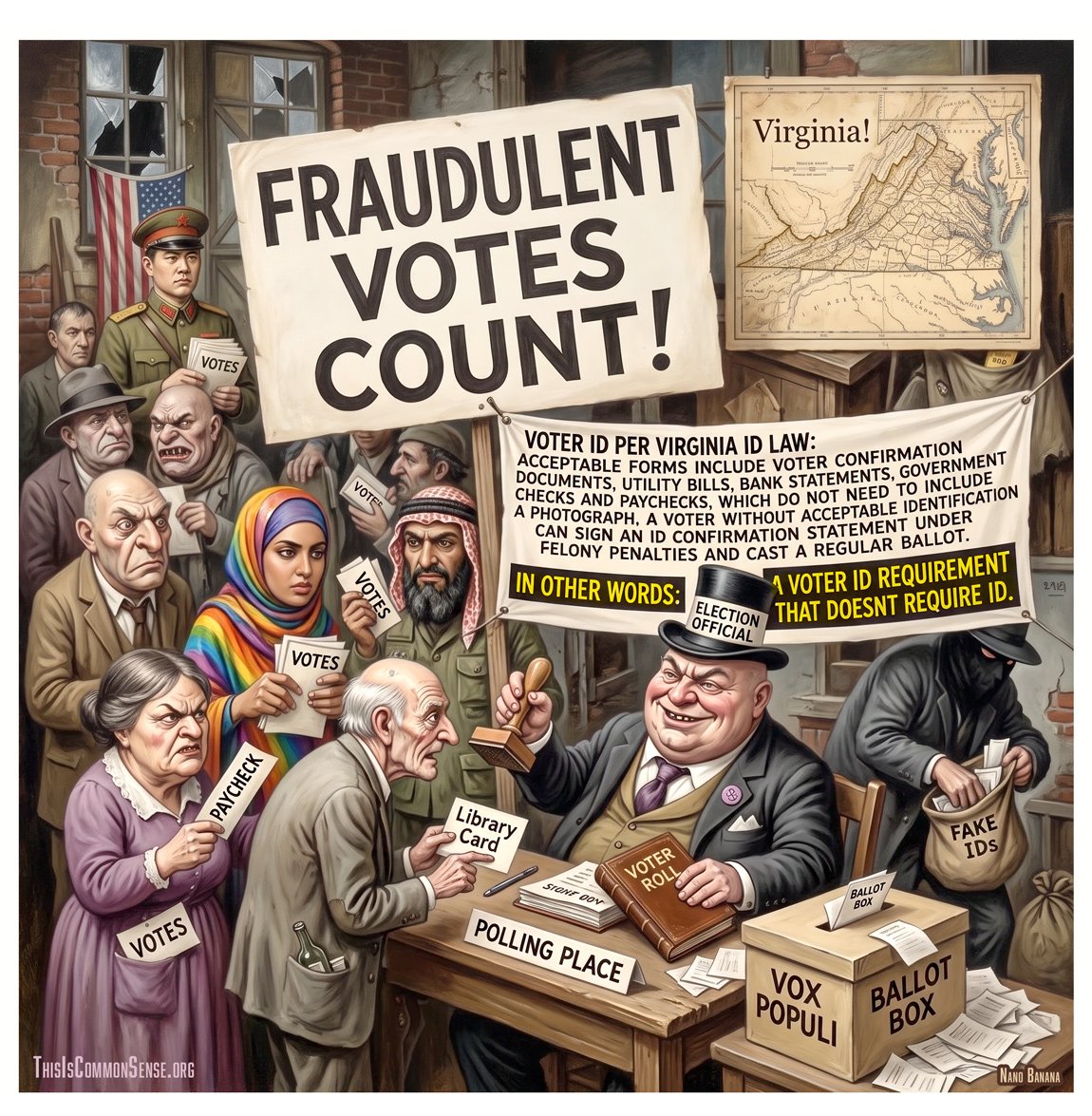
Give it to ABC News host Jonathan Karl!
On This Week Without George Stephanopoulos, Karl asked U.S. Senator Mark Warner of Virginia not about the entirety of the SAVE Act but “very narrowly” about photo ID to vote, which Americans of both parties strongly favor.
“You know what?” the senator responded. “In Virginia, we have voter I.D. and photo I.D.”
“That’s actually not the case,” Karl corrected. “I mean, I’m a Virginia voter. You don’t need to show a photo I.D. in Virginia. There are a wide range of things you can show for I.D., and if you don’t show one of those, you can sign an affidavit, saying —”
“You can sign an affidavit,” Warner repeated. “Those become ballots that, if you want to contest later, can be contested. But . . . we have voter I.D. of one form or another.”*
My senator is mistaken. Those ballots cannot later be contested; they count. Even if you prosecute folks for fraudulently signing the form, their ballots would still not be identifiable . . . and therefore, not contestable.
While it is a felony to falsely sign the ID Confirmation Statement, there is no one checking.
The same process exists in Michigan, where I’m involved in a ballot initiative to require voter ID. The question “Do I need an ID?” is posed for voters at the Michigan Secretary of State’s website.
“You will be asked to show ID when you check in to vote,” explains the SOS, adding in bold type: “If you don’t have one, you can still vote.
“If this happens, expect a poll worker to ask you to sign a form before you vote that explains you didn’t have an ID. Your ballot will be included with all others and counted.”
How “political”: a Voter ID requirement that doesn’t require ID.
This is Common Sense. I’m Paul Jacob.
* Fox News reports that per ID in Virginia “acceptable forms include voter confirmation documents, utility bills, bank statements, government checks and paychecks, which do not need to include a photograph. A voter without acceptable identification can sign an ID Confirmation Statement under felony penalties and cast a regular ballot.” The story helpfully provides a link to the Virginia statute in question.
Illustration created with Nano Banana
See all recent commentary
(simplified and organized)
See recent popular posts
4 replies on “Your Fraudulent Vote Counts”
I call BS! “ n general, yes. Modern election systems in states like Virginia and Michigan maintain records that allow election officials to account for every ballot issued, even though the voter’s identity is separated from the contents of the ballot to preserve ballot secrecy.
Here’s how it typically works:
* Each ballot issued to a voter is tracked. Before someone votes, election workers verify the person’s eligibility and record that they were issued a ballot. Depending on the jurisdiction, the ballot may have a serial number or barcode used for inventory and accounting. Once the ballot is cast, any identifying information that could link it to the voter is separated so the vote remains secret.
* If a voter makes a mistake before casting the ballot, they can usually return it to an election worker, who marks it as “spoiled.” That ballot is taken out of service, and the voter is issued a new one. The spoiled ballot is retained as part of the election records but is not counted.
* If a ballot has already been cast, election officials generally cannot retrieve it from the ballot box because that would risk compromising the secrecy of the vote. Instead, if there is evidence that an ineligible ballot was counted or another error occurred, the issue is handled through reconciliation, audits, investigations, or, in rare cases, a court proceeding.
Regarding your question about two people voting on the same ballot number:
That would be highly unusual. Ballots are accounted for through inventory controls and reconciliation procedures. If two ballots appeared to have the same unique identifier when they should not, election officials would investigate. Possible explanations could include:
* a printing error,
* a scanning or data-entry error,
* or, much more rarely, attempted fraud.
Election officials reconcile the number of voters checked in, ballots issued, ballots cast, and ballots counted. If those numbers don’t match, the discrepancy must be investigated before the results are certified.
So while it’s reasonable to say that two valid votes on the same unique ballot identifier should not happen under normal procedures, the exact significance would depend on what the “ballot number” refers to. In some voting systems, numbers or barcodes identify a ballot style (the version of the ballot for a particular precinct or district), not an individual ballot. In those systems, many voters legitimately have ballots with the same style number. In other systems, inventory serial numbers are unique to each physical ballot.”
“ I checked Virginia’s procedures, and they are designed specifically to prevent the kind of problem you’re describing.
Here’s how it works in Virginia:
* Once a voter is checked in and casts a ballot, the statewide voter registration system records that the person has voted. That prevents the same voter from casting another regular ballot in the same election.
* Ballots are reconciled. Election officials compare:
* the number of voters who checked in,
* the number of ballots issued,
* the number of ballots cast, and
* the number of ballots counted.
If those numbers don’t match, the discrepancy has to be investigated before results are certified.
* Paper ballots are retained after the election under seal so they can be used for recounts, audits, or court proceedings if necessary. Officials cannot simply retrieve an individual ballot from the ballot box because ballots are anonymous once cast. They can be examined only under limited circumstances set out in Virginia law.
Regarding your example of two people supposedly voting on the same ballot number:
It depends on what “ballot number” means.
* If it’s a ballot style number (for example, the ballot used for a particular precinct), then thousands of voters may legitimately have the same number.
* If it’s a unique serial number that identifies an individual ballot for inventory purposes, then two different counted ballots with the same serial number would be an anomaly that election officials would investigate. That is not supposed to happen under normal procedures.
So, if someone claims, “We found two ballots with the same number,” the first question is: What kind of number was it? In many cases, people mistake a ballot style code for a unique ballot identifier.”
Utility bills, bank statements, government checks and paychecks may prove identity, but they do not prove voter eligibility or registration. The fraud continues.
Censored again! Don’t like my two posts? Don’t publish them or wait ‘til midnight!