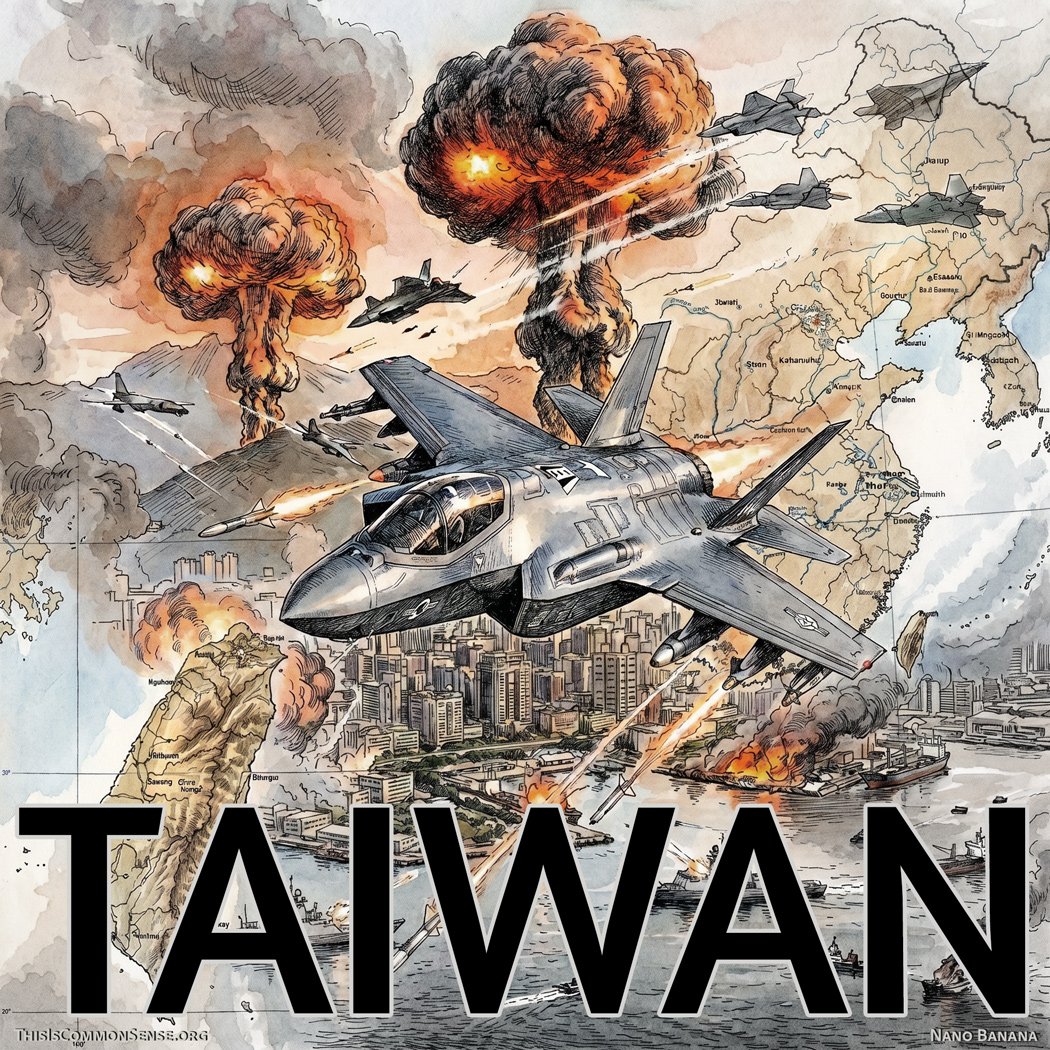
“I think the last thing we need right now is a war that’s 9,500 miles away.”
Just place a period after the word “war” in President Trump’s comments to reporters, after last week’s summit with Chinese ruler Xi Jinping and discussion about China’s democratic neighbor, Taiwan, the Republic of China.
Which raises the question: How best to avoid war over Taiwan?
U.S. military policy requires being capable in this very theater. The Taiwan Strait (7,900 miles from Washington, not 9,500) is closer to the U.S. than is the Philippines, with whom we have a military defense treaty, and not much farther than Japan and South Korea, also treaty-entitled to our defense. One Japanese island sits less than 70 miles from Taiwan.
Communist China, the People’s Republic of China (PRC), claims Taiwan as a province, demanding “reunification” — by force as soon as they can get away with it. Yet, the PRC has never governed one inch of Taiwan.
As Ambassador Alexander Yui, Taiwan’s representative to the U.S., explained on Face the Nation yesterday: “We’re not the ones creating all this trouble.”
The People’s Liberation Navy — now the world’s largest — has sunk Vietnamese boats and regularly harasses Filipino ships. Though Xi had promised President Obama that China would not militarize islands in the South China Sea, the PRC now boasts 10,000 Chinese soldiers on 27 illegal military outposts.
In the wake of the summit, where Xi sought to talk Trump out of completing a $14 billion dollar arms sale to Taiwan, our president must determine if placating the Chinese will make them behave peacefully.
Or will strength, specifically military strength, better serve the cause of peace?
Taiwan’s and ours.
This is Common Sense. I’m Paul Jacob.
Illustration created with Nano Banana
See all recent commentary
(simplified and organized)
See recent popular posts
2 replies on “Last Thing Needed”
I still don’t know the principles according to which the people of one jurisdiction should be prepared to go to war on behalf of the people of another, beyond the proposition that if a war will eventually reach one’s home jurisdiction then one should try to choose some least costly stage at which to fight.
Many folk will insist that the denizens of New York should not go to war for the sake of the people of Taiwan, but should do so for the sake of the people of California. When I have asked why the one and not the other, I have been met only with silence or with insult.
Officials of the PRC have suggested that the Pacific should be divided at Hawai’i West and Hawai’i East, indicating that their territorial ambitions include Guam and some of the Hawai’ian Islands. So perhaps my question should be of why the denizens of New York should go to war for the sake of parts of Hawai’i, but not of Taiwan.
In any case, I think that if the PRC does not collapse internally and is not forceably stopped, then it will expand indefinitely, and that the reasonable calculation is of when fighting them will come at the least cost.
Being forceably stopped doesn’t necessarily mean being met violently on the battlefield; sometimes it means merely being persuaded that a opponent has an ability and willingness to bring violence to bear. The reason that the PRC has funded and otherwise pursued activities corrosive to the Western social order is exactly to undermine the ability and will to fight.
Since people have been known to comment eristically to this ‘blog, let me note that, when I refer to cost, I am not referring only or even primarily to pecuniary cost. I am rather more concerned about immiseration and death of people who will be victims of any war, and I am concerned about the potential of war to bring further ruin to what remains of American liberalism.
It’s true that Taiwan is not and never has been part of the People’s Republic of China (in fact, the last time it was ruled from mainland China, Cuba and the Philippines were still ruled from Spain).
It’s also true that Taiwan’s defense is the Taiwanese regime’s, not the US regime’s, business.
And, finally, it’s true that the PRC regime probably isn’t stupid enough to get into its own Vietnam/Afghanistan/Ukraine situation that would likely be even worse than those US/Russian fiascos, as Taiwan is a mutually beneficial trading partner.
The main function of Taiwan from the PRC regime’s point of view is to be something it can rattle sabers, and threaten to throw itself on the floor and hold its breath until it turns blue, about.