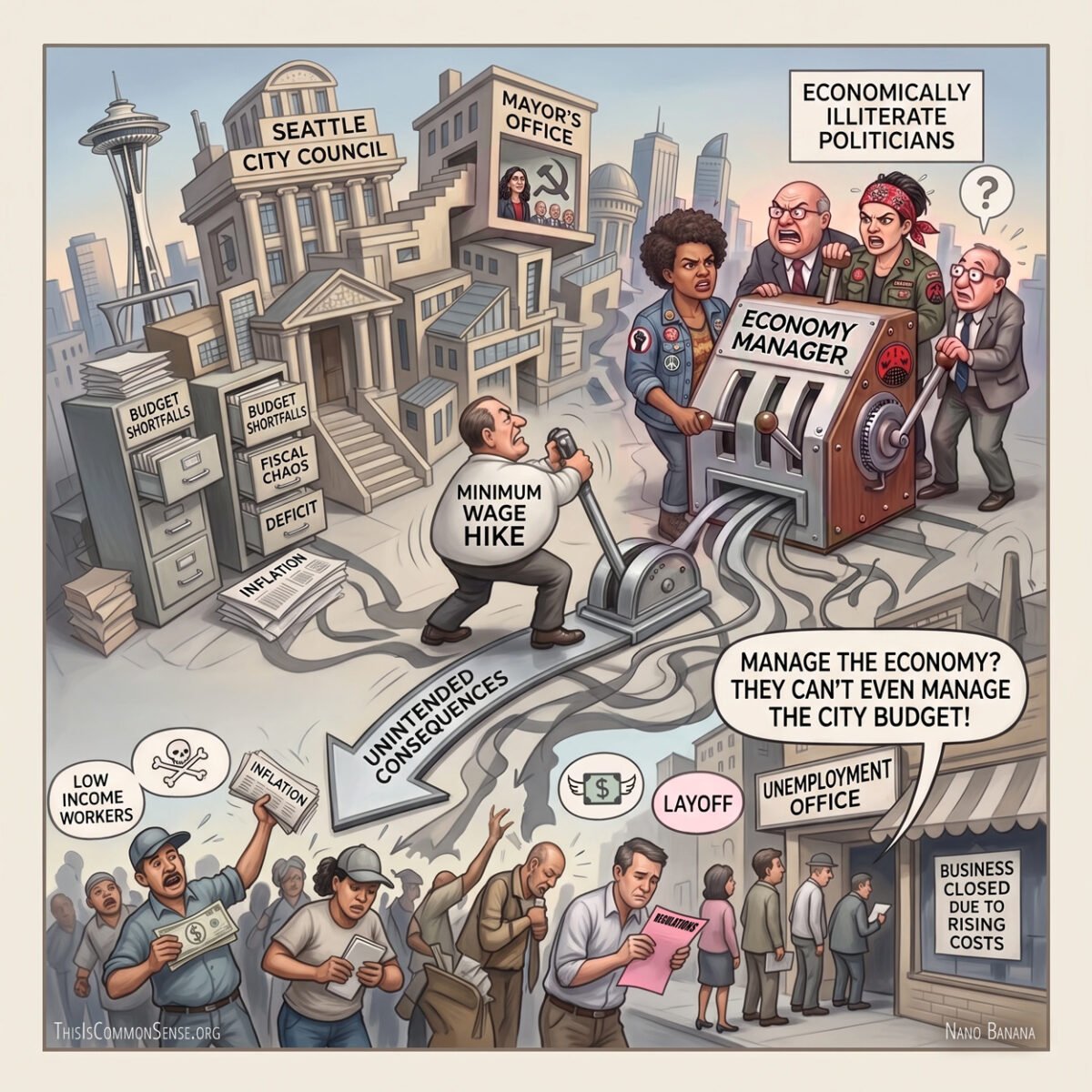
A few years ago, Seattle imposed what amounted to a $26 an hour minimum wage for persons who deliver food for app-based services like DoorDash. Unfortunately for drivers, they don’t get paid this wage while waiting for the next order they can deliver.
Thanks to the new costs, customers say things like “I ordered a $12 sandwich. $12 grew to $32! I just deleted the app.”
Drivers say things like “Work has become slow because of the new law.” DoorDash reports 1.7 million fewer orders in Seattle in 2024. The new law took effect in January of that year.
“These are unimaginably complicated markets where the company’s main job is interfacing between restaurants and delivery workers and customers,” explains economist and Manhattan Institute research director Judge Glock. “Then you have an economically illiterate city council or mayor who thinks, basically by looking at an industry through reading the news, they can appropriately regulate the exact wage.”
A former president of Seattle’s city council, Sara Nelson, says politicians caused a problem that must be fixed. By letting the market function? No, by “better” central planning, by fine-tuning the regulatory mechanism: “If we had gotten the minimum pay standard right, we would not see the decline in the revenue.”
The market did get it right.
People who wanted flexible gig work got the work and got tips. Customers got the deliveries and gave tips. And companies had more freedom to adjust to changing markets.
If Seattle wants to return to that happy situation, it must repeal the law.
This is Common Sense. I’m Paul Jacob.
Illustration created with Nano Banana
See all recent commentary
(simplified and organized)
See recent popular posts
2 replies on “Gigless in Seattle”
Some advocates of statutory wage minima genuinely imagine that these minima will lead to higher pay with little or no decrease in employment. These advocates embrace a model of the economy in which production is determined by technical considerations which little relation to allocation, and allocation is determined by political power. The model doesn’t make sense under careful analysis, but supporters avoid such examination. The model doesn’t work in practice, but supporters stretch for alternate explanations.
Other supporters of these minima are simply opportunists. They know that people who lack good work histories — new workers or workers struggling with the consequences of past poor behavior — will be hurt, but these supporters have union jobs or political jobs and will profit from the law.
But a really dark motivation is found amongst some of the socialists, who are out to crush the gig economy as such. The theory of economic development from people such as Marx extrapolated from 19th-Century industrializing Europe to imagine workers increasingly concentrated in institutions such as factories. The concentration would facilitate the organization of workers into groups that would then become socialistic battalions. Opportunities instead to work gigs subvert this prospect. Even when gig-workers assemble, they do so on a transitory basis.
I wouldn’t know whether a particular socialist claiming that different price controls could revive the gig economy were sincere, or just trying to buy time.
They know best. What to break and who to blame when the the situation becomes irreparable.