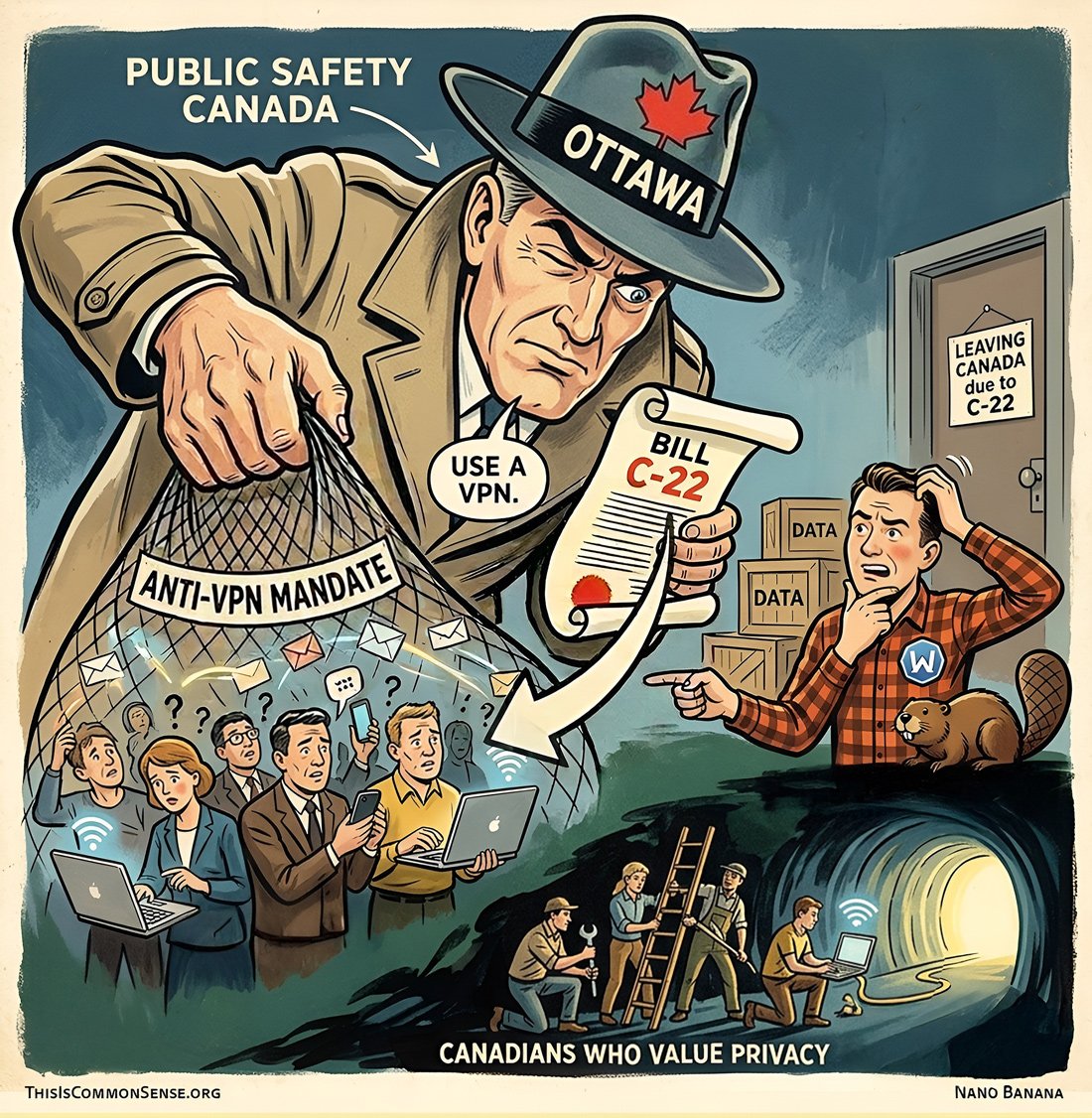
Public Safety Canada, an agency responsible for safety, security, emergency preparedness and this kind of thing, recently urged Canadians to protect themselves when using public Wi-Fi by also using a VPN.
“Using a VPN protects your data,” the agency said.
True.
Unless — unless others in the government succeed in requiring VPN companies to uniformly sabotage the privacy of their customers.
The mechanism for crippling VPN’s? That would be the pending legislation to force VPN providers to retain personal data which users expect them not to retain, in this way killing these companies’ very reason for being as well as Canadian Internet users’ reasons to employ these companies.
We netizens want some security. A VPN required to track and store information on customers seeking security is, ipso facto, insecure.
Bill C-22, or the Lawful Access Act, introduced by the Minister of Public Safety and Emergency Preparedness in March, would require customers’ data to be retained for a year. Everybody’s data, mind you, not just the data of persons suspected of a crime.
“Oh this is just rich,” says Windscribe, a VPN provider based in Toronto. “Bill C-22 is driving VPN businesses like ours out of Canada because of the required user logging. And in the same breath you tell people to secure their data with VPNs.”
If things go on like this, Ottawa’s impulse to destroy or try to destroy online privacy will override any contrary impulse to help people preserve online privacy. Thereby obliging Canadians who do value it to figure out a way to override the override.
This is Common Sense. I’m Paul Jacob.
Illustration created with Nano Banana
See all recent commentary
(simplified and organized)
See recent popular posts
4 replies on “Driving VPNs South”
Justin Trudeau once declared “There is no core identity, no mainstream in Canada.” He was wrong.
I’d noticed much earlier that, whenever Canadians would argue about social policy, eventually one side or both would accuse the other of wanting to do things the American way, whereäs Canada was “not the United States”. And, when one thinks back to how Canada comprised those British North American colonies that did not declare themselves independent in 1776, and that colonists from America who wanted to remain in the British Empire emigrated during or after the American Revolution, the argument can be understood.
The core identity of Canada is that it is not America. That’s a sad state-of-affairs; the closest thing to it that we’ve seen in America was when many on the political right tried defining America in terms of how it was different from the Soviet Union. A nation should have a positive identity.
In any case, since Canada is Not-America, we can better understand Canada if we find the core identity of America. And that core — albeït very much damaged — is its liberalism.
Personally, when I use a VPN, I use one based in Switzerland, which has pretty strong Internet privacy protections (the US government has to get a real warrant, and then get a Swiss court to approve that warrant, for the company to be legally obligated to hand over data — even if it keeps that data).
My son uses a VPN located in Scandinavia (Sweden, I think), and pays them in cash by mail. The mail includes his preferred username/password and nothing else (except the cash — but not his name or address or anything like that). The company activates that username and password for the amount of time paid for, and claims that it destroys the physical mail AND doesn’t keep user logs at all.
Personally, I would recommend that for VPNs and other services that are practical, one pick a provider in a country other than the country where one lives. That might not completely block one’s own rulers from accessing the data involved, but should at least slow them down.
Sometimes, you get what you vote for. How many Canadians support the government that wants to take their rights away? Alberta is scheduling a fall referendum on whether to separate from the rest of Canada.
Even if Alberta passes it do you really believe Canada will actually let them go?