
Veronique de Rugy, at Reason, asks a good question: who will pay for the war? Or, how will it be paid for?
The Pentagon has requested $200 billion to fund the campaign. While circumstances could change the price tag, interest payments on that much debt would add $87 billion over 10 years. So that’s roughly $300 billion.
Defense Secretary Pete Hegseth, asked about this number, offered a memorable contribution to the fiscal debate: “Obviously, it takes money to kill bad guys.” That’s true. It’s also true that the money must come from somewhere.
Veronique de Rugy, “How Will Congress Fund a $300 Billion War With Iran?,” Reason (March 26, 2026).
De Rugy mentions two obvious tax-and-spend choices, a supplemental appropriations bill and a budget reconciliation bill. But she goes on to make an interesting point:
Congress used to offset its emergency spending. It doesn’t anymore. Research by Dominik Lett at the Cato Institute shows that since 1991, Congress has passed $12.5 trillion in emergency spending for wars, disasters, pandemics, financial crises, and in some cases things that were emergencies in name only, like $450 million for space exploration. Almost none of it was offset. If you add $2.5 trillion in interest to the spending, the total amounts to one-third of today’s debt.
Which brings to mind a recurring theme at ThisIsCommonSense.org: the federal debt. So here is a current update on the general government’s most obvious but least talked-about (elsewhere) problem:
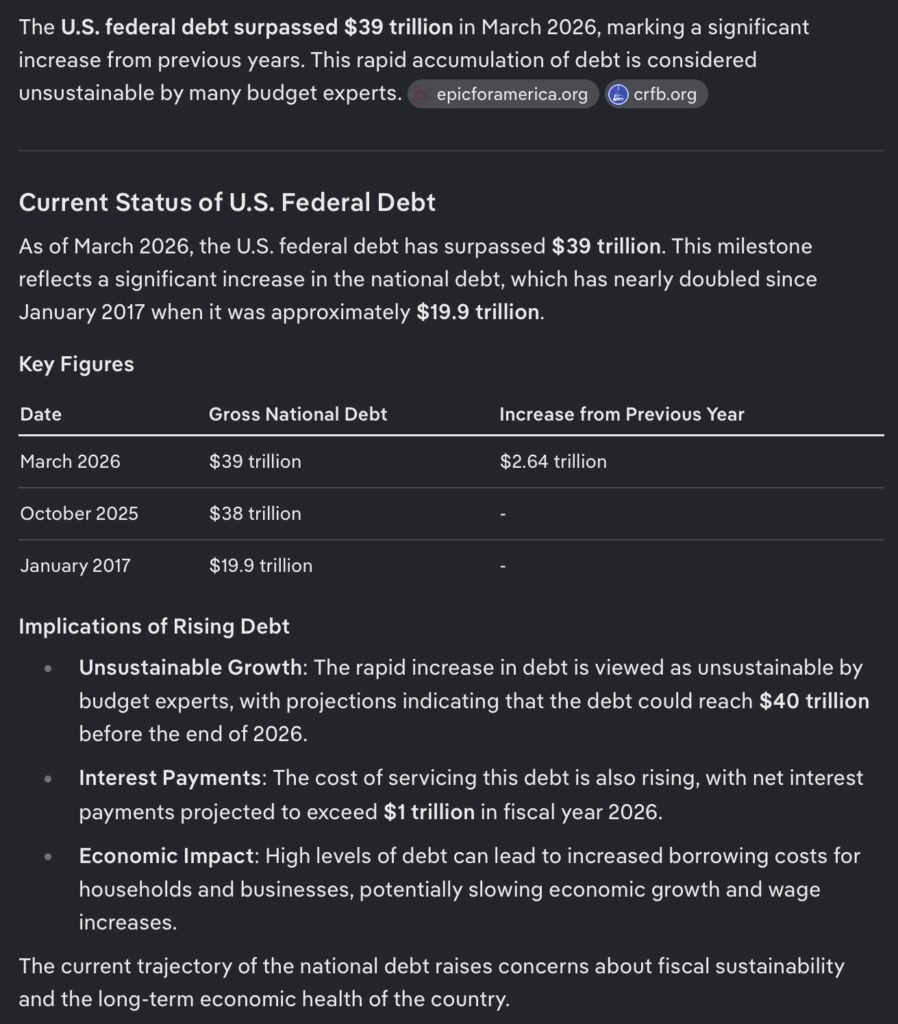
Note that, as reported here in November, the Congressional Budget Office had predicted hitting the $39 trillion level of debt some time after mid-year. Hey, we are ahead of schedule! Let’s celebrate?
One reply on “Paying for War”
When the subject of balanced-budget amendments is discussed, conservatives want to except emergencies and in particular wars. Such exception incentivizes emergencies; an exception for war incentivizes war. In fact, requiring that the budget be balanced in time of war is economically efficient and drives home the cost of war to the public.