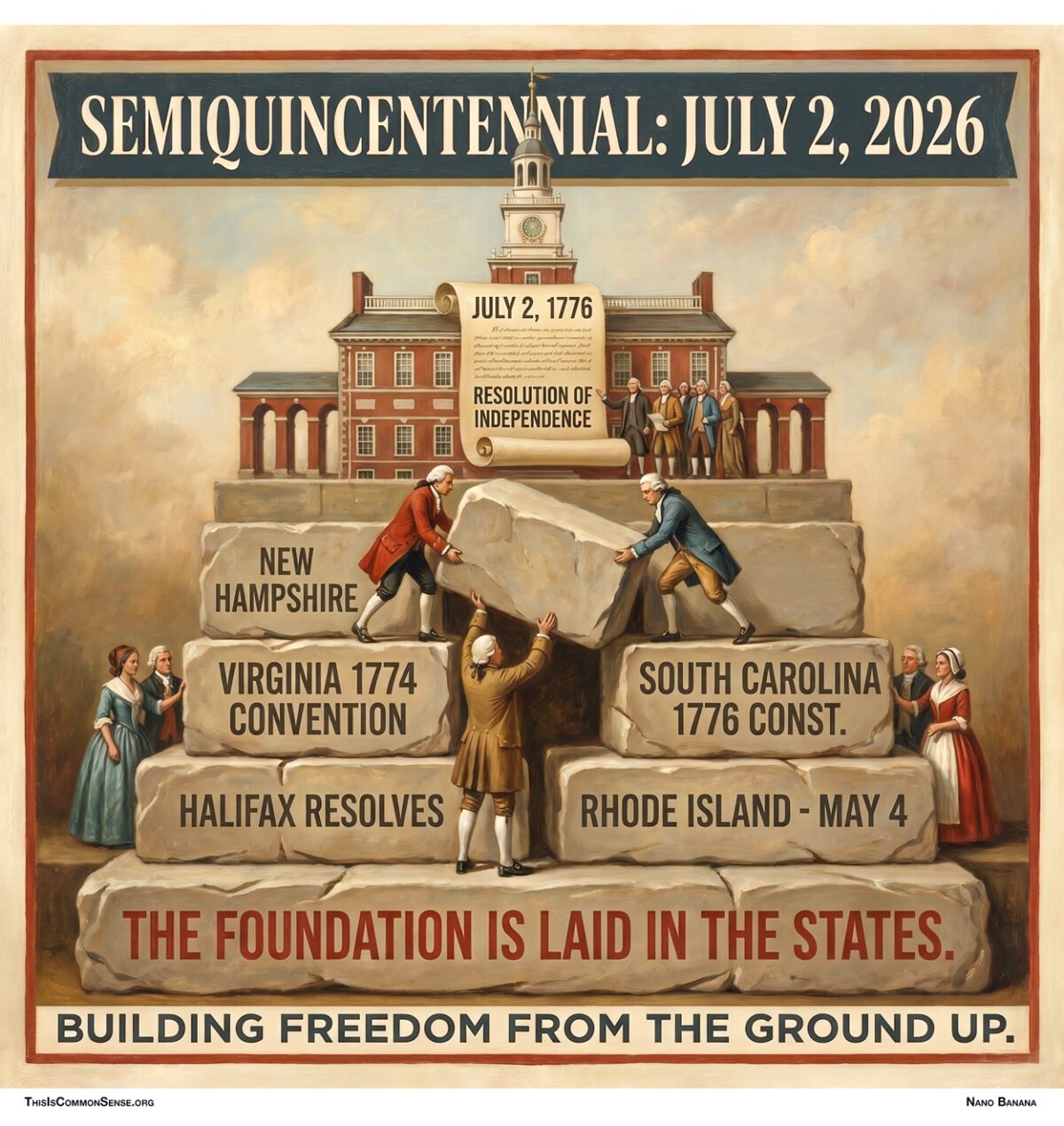
The semiquincentennial of the United States could be celebrated today, July 2, 2026.
It was on the Second of July in A.D. 1776 that the Continental Congress decided to remove itself from the sovereignty of the king in Great Britain, George III. The representatives from the breakaway colonies did this in the affirmative with Richard Henry Lee’s “Resolution of Independence.” Congress appointed a “Committee of Five” to draft a Declaration, which was accepted on July Fourth — the day we have come to celebrate Independence Day.
But independence was not mere congressional fiat. It had been brewing in the states; at least six of the colonies’ royal governors had fled or been sent packing in the revolutionary summer of 1775.
In 1775, most colonies possessed
- functioning legislative bodies making domestic policy decisions;
- militias organized without royal direction;
- courts operating with locally appointed judges;
- trade regulation occurred despite Parliamentary acts.
And some colonies even raised taxes and spent money sans royal approval.
By late 1775, several colonies had taken major steps toward self-government. Virginians had created a new form of government, the “constituent convention,” independent of the Crown, in 1774. Colonial New Hampshire became the first to adopt a written constitution. South Carolina had adopted an interim constitution in March 1776. Weeks later, the Halifax Resolves explicitly authorized a vote for independence. On the Fourth of May, Rhode Island publicly rejected the King.
There’s a lesson here. The groundwork was not laid in Congress — much of it conceived and brought to fruition by men and women who are not in the history books.
If we want to Make America Free Again, we have to lay a foundation.
In the states.
This is Common Sense. I’m Paul Jacob.
Illustration created with Nano Banana
See all recent commentary
(simplified and organized)
See recent popular posts