
Categories
ideological culture national politics & policies too much government

Count to Ten

Yesterday I argued that the Ten Commandments can and should be promoted — privately. Promoting one’s religion is expected . . . outside of government. But do that as a government official and suddenly what most folks consider good common sense morality sows discord.

Why? Simple. Your religion is yours. But the government is ours. It’s supposed to be. But since we don’t all share the same religion, your monument on public property or public commemoration seems nothing more than you shoving yours at us.

With the Decalogue, it’s even trickier. The Ten Commandments aren’t numbered as such in either Exodus or Deuteronomy. Jews, Catholics, and various Protestant denominations differ on ordering them. What one group calls the Fifth Commandment another calls the Fourth. What most American Protestants call the Tenth Commandment is numbered as the Ninth and Tenth by Catholics. And so on.

So any enumerated Decalogue is not merely Judeo-Christian-centric, likely to make Buddhists, Hindus, Yazidis and Sikhs at the very least uncomfortable. It would necessarily be denominationally preferential.

I bet most Ten Commandment listings promoted by American politicians are not the ones Catholics have memorized, by order — or Jews, or even Lutherans and Episcopalians.

These differences usually appear quite small, of course, especially in light of the overwhelming similarities. Accordingly, any disagreements about the Ten Commandments remain friendly, and will likely stay that way — unless government chooses one version over another.

In politics, the doctrine of enumerated powers is divisive enough. Add in multiple, competing enumerations of the Ten Commandments? Too much to divide us.

This is Common Sense. I’m Paul Jacob.


Printable PDF

Counting the Commandments


Categories
Common Sense folly media and media people national politics & policies

Cruz Country

The cultural differences between left and right may be stronger than the political.

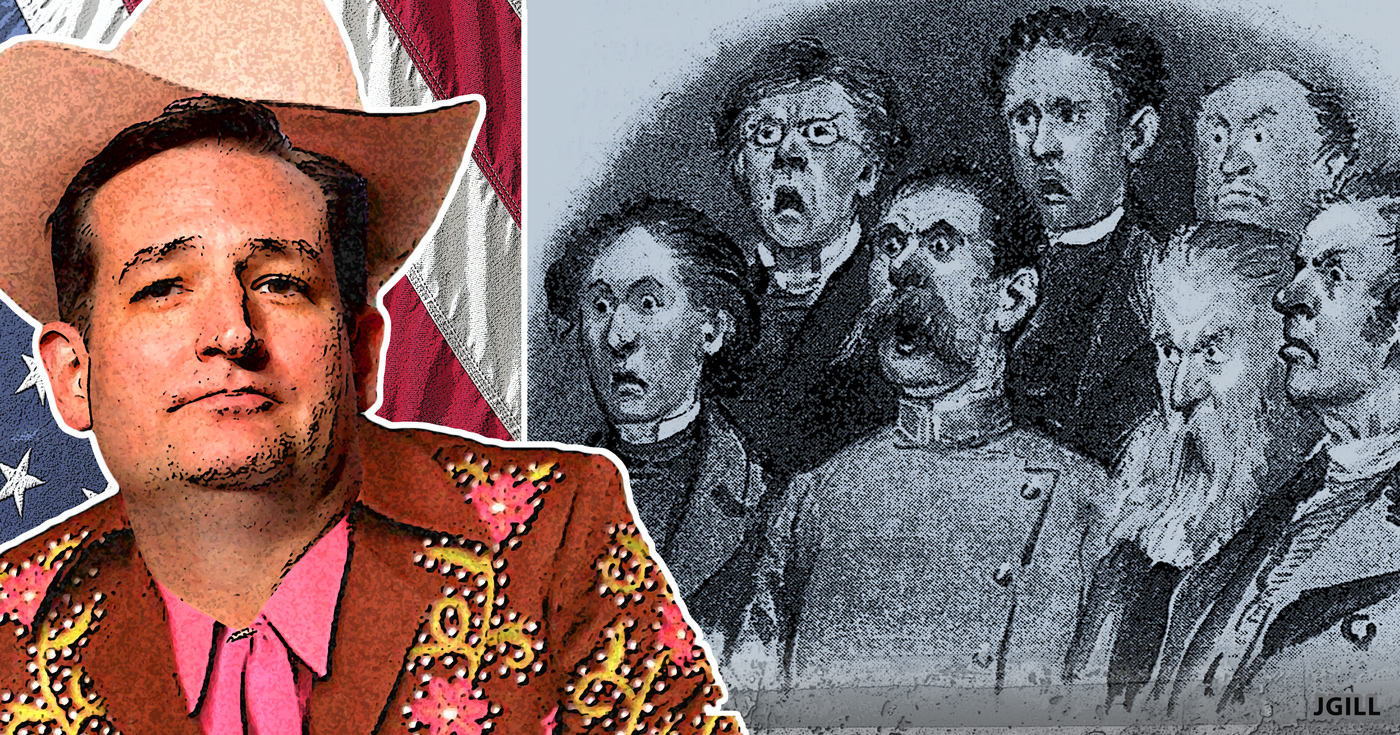
When Sen. Ted Cruz answered a question about his musical taste posed by a CBS news correspondent, and he announced that his preference switched after 2001, 9/11, the leftosphere fell of its rocker and into convulsions.

Why?

He said he switched from listening to classic rock to country, and did so because the country music culture responded to the 9/11 atrocity so much better than did rock-and-roll culture.

Confession: my musical tastes lean toward classic rock. But there’s no way I would get upset about a politician’s musical choices — unless he started listening to Wagner while reviving an interest in National Socialism.

But boy, on the left there was a lot of outrage and indignation. At least, Matt Welch of Reason quoted a good spattering of it, and I found more on Twitter and elsewhere. On Slate? Snark. A YouTuber tubed Cruz’s change as “pandering.” And in New York magazine, Jonathan Chait identified Cruz’s professed change-of-taste “an incredible testament to his personal willpower.”

Huh?

You may or may not like country music, or appreciate the last 30 years of it, or its origins, or its commercialization, or the twang, but that stuff’s really not that important.

A conservative found political reasons to change his listening habits. Wow. A matter  of self-definition? Whatever. It neither builds up nor undermines his philosophy or program.

Though certainly Conway Twitty’s “It’s Only Make Believe” provides more than a cultural context for understanding much of what happens in Washington.

This is Common Sense. I’m Paul Jacob.

Printable PDF

Categories
initiative, referendum, and recall

Trading One Right for Another

Trades are not unheard of in politics, but somehow they rarely exhibit the up-front honesty and clarity of the trades that make up the bulk of our economic life. When I go to the super-market, or the record store, or Wal-Mart, I pretty much know what I’m getting and what I’m giving up.

Not so clear, though, in politics.

Take Arizona’s “Hunting and Fishing Amendment,” Proposition 109 on this November’s ballot. Much has been made of the first element of the ballot’s title, establishing a “constitutional right” to hunt and fish. Outdoorsmen love it.

But a second element gives to the state legislature “Exclusive authority” to regulate hunting and fishing, which may grant regulatory power to various wildlife commissions.

It basically disallows Arizona’s citizens from future influence through the initiative and referendum. That’s what citizens trade away for the first part. Citizens get a “right” to hunt and fish “lawfully,” a right they already have, but give up their current rights to influence what that “lawfully” means, via the ballot.

Prop 109 also declares that hunting and fishing would be the preferred means of controlling wildlife, and it says that “no law shall be enacted” that “unreasonably restricts” hunting and fishing, etc.

Of course, constitutions can say “no law” all they want. History shows legislatures don’t abide by that prohibition. Neither do courts.

Just read the First Amendment to the U.S. Constitution, and consider . . . and cringe.

This is Common Sense. I’m Paul Jacob.

Categories
national politics & policies

They Lie!

Honor amongst thieves. It’s a great literary concept, explored in The Glass Key and Miller’s Crossing. In real life, actual thieves, when organized, can’t go to the police for adjudication. So the old, tribal concept of “honor” often serves.

It sure serves Congress. Mark Twain quipped that “It could probably be shown by facts and figures that there is no distinctly native American criminal class except Congress.” Very funny — but you don’t need statistics. All you need is the Constitution and the latest issue of the Congressional Record.

Still, Congress has its honor. Even the lies of any particular politician are not supposed to be called out by another politician. Fellow pols are supposed to say “The Honorable So-and-So surely errs” — not “lies.”

And legislators are certainly not supposed to interrupt a president’s speech before Congress to shout “You lie!” Hear that, Mr. Wilson? How indecent of you! How . . . dishonorable.

But never once in mainstream reporting on Joe Wilson’s “You lie!” challenge did I hear anyone actually address the alleged fact of the challenge: did the president lie?

Well, I don’t like to use that word, but he was talking about health care reform. You could almost blindfold yourself and throw a dart at reform rhetoric and still hit a whopper with each throw.

That people were more disturbed by the outburst than the likelihood of lying says a whole lot about politics today.

This is Common Sense. I’m Paul Jacob.