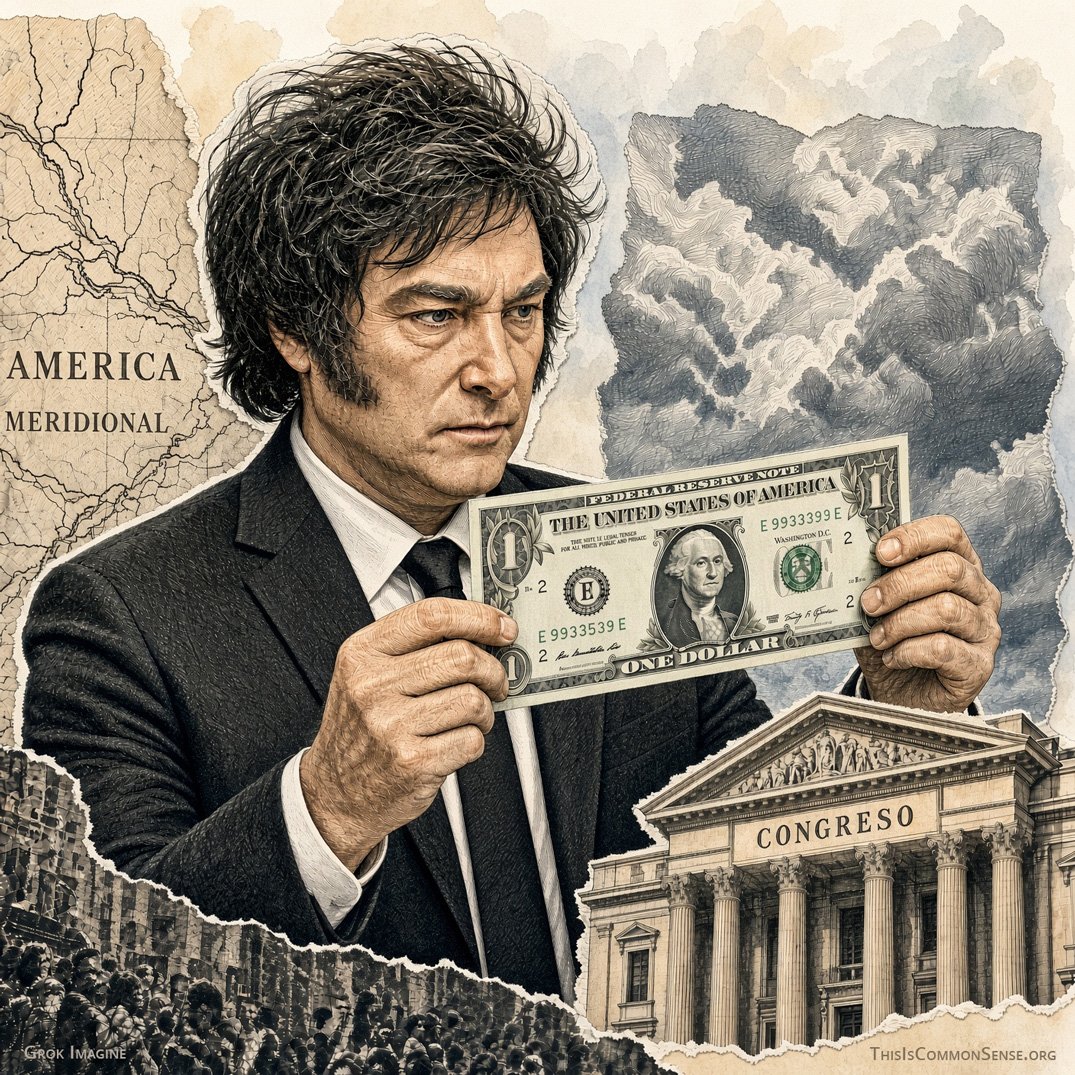
As recent years have again reminded us, the dollar, like other currencies, is subject to inflationary weakening of its value.
But some currencies are more at risk than others. That being the case, a few countries’ governments, seeking to end the risk of hyperinflation, have resorted to dollarization.
That’s the replacing of a more inflationary currency with
Though not as good as gold, the dollar is much more value-retaining than a peso that can be easily eroded the next time an irresponsible administration crowbars itself into power.
When running for president, libertarian-leaning economist Javier Milei promoted dollarization of Argentina. But, notes another economist, Nicolas Cachonosky, talk of this dramatic reform receded after Milei became president. Why?
“In a 2025 interview, Economy Minister Luis Caputo said dollarization had been ruled out because Argentina lacked enough dollars.”
But countries like Ecuador and El Salvador that have largely switched to the dollar didn’t do so on day one. “Physical currency was exchanged gradually . . . while bank deposits and tax payments were redenominated into dollars almost immediately. In Ecuador, the central bank’s own dollar reserves grew during the transition rather than shrank.”
Cachonosky makes a good case that Milei’s government should emulate them. “Two good years, even four, are no substitute for a lasting solution.” Temporary stabilization of the peso may only be “a preface to the next crisis.” It would be harder to reverse a fully effected switch to dollars.
Dollarization is advantageous because it puts the base money outside the country’s banks and outside the reach of fiddling by the country’s politicians.
Unfortunately, in the U.S., we have no other foreign currency to peg our dollar onto. So our banks and pols remain free enough to mess it up.
This is Common Sense. I’m Paul Jacob.
Illustration created with Grok Imagine
See all recent commentary
(simplified and organized)
See recent popular posts
