Soyez résolus à ne plus servir, et vous voilà libres. Je ne vous demande pas de le pousser, de l’ébranler, mais seulement de ne plus le soutenir,et vous le verrez, tel un grand colosse dont on a brisé la base, fondre sous son poids et se rompre.
Resolve to serve no more, and you are at once freed. I do not ask that you place hands upon the tyrant to topple him over, but simply that you support him no longer; then you will behold him, like a great Colossus whose pedestal has been pulled away, fall of his own weight and break in pieces.
Étienne de La Boétie, Discourse on Voluntary Servitude (1548).
Today is the 33rd of the federal government shutdown, caused by a failure of Congress to pass a Continuing Resolution (CR) to carry on funding the Leviathan.
On Halloween, returning from Florida, President Trump again urged Senate Republicans to “end the filibuster,” calling Democratic blocks a “ransom” for “illegal alien healthcare.” In a Truth Social post, Trump wrote: “It is now time for the Republicans to play their ‘TRUMP CARD,’ and go for what is called the Nuclear Option — Get rid of the Filibuster, and get rid of it, NOW!”
Vice President J.D. Vance echoed this after a Capitol GOP lunch, confirming that military pay continues despite shutdown.
But SNAP benefits do not. And the failure of Obamacare looms.
Now, what Trump is advising, here, has been in the past called “the nuclear option,” defying Senate tradition by allowing a simple majority to rush through the CR to re-open the government despite Democratic demands that the party gets nearly everything it wants, all in this CR and not in separate bills. This includes re-upping Obama-era subsidies (tax credits) under the Affordable Care Act as well as re-legislating (as opposed to re-litigating) their defeat in the Big Beautiful Bill this summer, which did indeed cut some of their key projects overseas.
If the Senate went “nuclear,” it wouldn’t be the first time. The 60-vote threshold has been established through repeated bipartisan understandings and incremental changes:
In 1975, Democrats lowered the cloture threshold from 67 to 60 votes, a compromise to curb abuse while preserving minority rights.
The Senate has already partially nixed the supermajority multiple times via majority vote, often in partisan fights:
2013: Democrats eliminated it for most nominations (under Majority Leader Harry Reid) to confirm judges.
2017: Republicans extended this to Supreme Court justices (under Mitch McConnell) for Trump’s picks like Neil Gorsuch.
2025: Republicans themselves invoked it twice earlier this year for Trump cabinet confirmations and budget reconciliation tweaks.
These changes didn’t fully end the filibuster but carved out exceptions, demonstrating that it is indeed alterable by simple majority.
Trump’s advice would go further: a full elimination for legislation (beyond nominations), potentially via a Senate parliamentarian ruling or direct vote change. Critics like Sen. John Thune (R-SD) call it a “bulwark against bad things,” fearing Democrats could later ram through statehood for D.C./Puerto Rico or court-packing. Moderates like Sen. Lisa Murkowski (R-AK) warn it would “inflict lasting harm” on the Senate’s deliberative role.
Note that this Sixty Percent requirement is a supermajority requirement, a republican tradition that alters the democratic element of our politics away from simple majoritarianism to a more reserved procedural practice. In effect, this means sometimes there will be stalemates, at least when the two contending parties each play the role of intransigent.
In other words, the game is Chicken!
Though some might notice a resemblance to MAD: Mutually Assured Destruction.
On Monday — Day 34 — the Senate reconvenes at 10 a.m. (ET), and could feature a 14th vote on H.R. 5371 (the CR), but Democrats signal continued blocks without ACA concessions, and without restoration of cuts made in July 2025 (OBBBA) and legal clarity that contingency funds can be used during a shutdown.
If you are thinking that both of these could best be handled outside a stop-gap CR, you are probably right — and that is what most Senate Republicans are thinking — but Democrats are negotiating from a position of weakness. So they threaten to halt the whole process. It’s all they can do to grasp some victory from 2024’s electoral defeats.
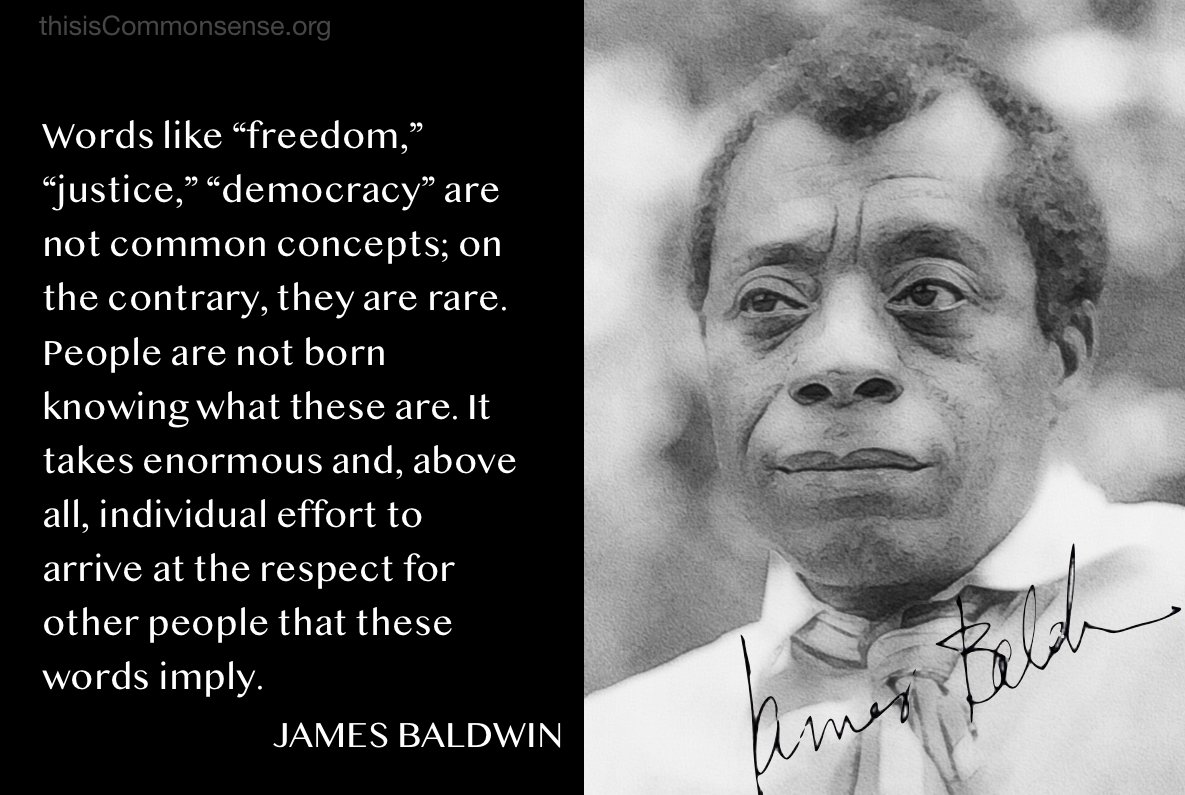
Words like “freedom,” “justice,” “democracy” are not common concepts; on the contrary, they are rare. People are not born knowing what these are. It takes enormous and, above all, individual effort to arrive at the respect for other people that these words imply.
James Baldwin, “The Crusade of Indignation,” The Nation (New York, July 7, 1956), also in The Price of the Ticket (1985).
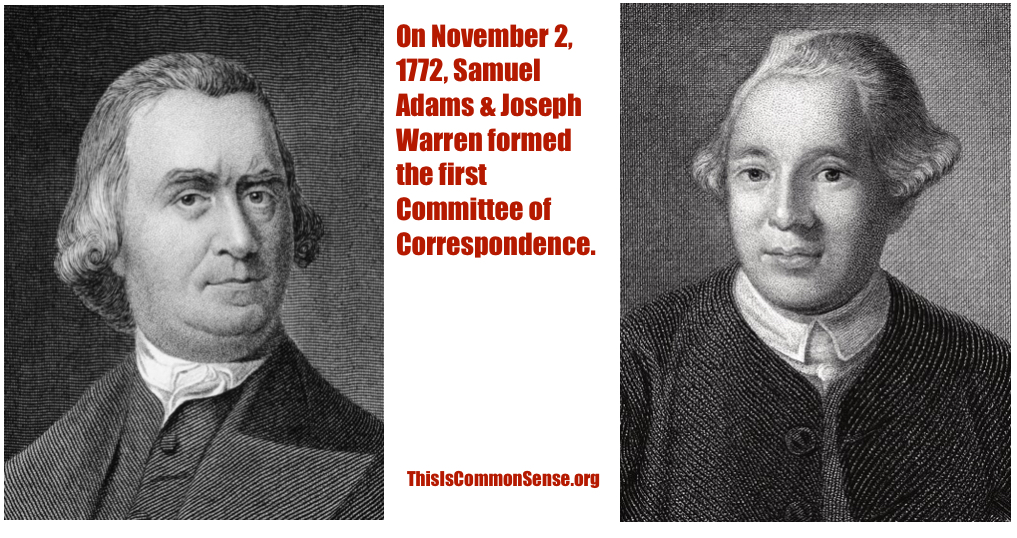
On November 2, 1772, Samuel Adams and Joseph Warren formed the first Committee of Correspondence, which were instrumental in preparing the colonies from their 1776 breakaway from the British Empire of George III.
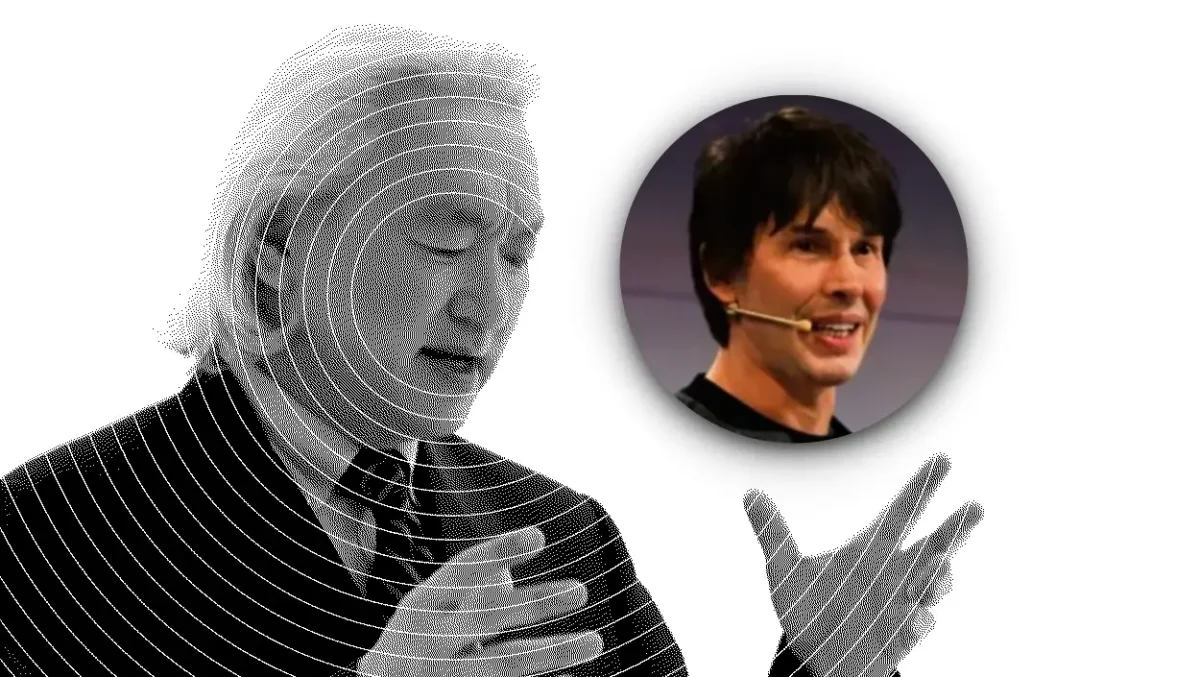
Physicist Brian Cox is more than a little annoyed. He keeps seeing online videos of “himself” saying things that he has never said. And he complained on X:
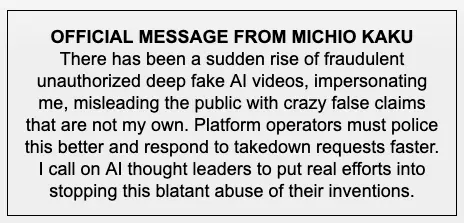
Michio Kaku has even more cause for complaint: false video of him yammering on about 3I/ATLAS appears to have been more numerous. And he, too, protests. See for yourself on his website:
But how much misleading of the public is going on? Isn’t the standard reaction to do a double take the first time you see one of these fakeries, and then spot it out for what it is within half a minute?
AI is not quite that convincing. Yet. There are tells.
And the fact that the videos show these scientists saying outrageous things about our solar system’s third official interstellar visitor is a pretty big clue. (Though it is worth noting that Michio Kaku has scientifically studied UFOs, and may not be quite as negative to “believers” as is Brian Cox.)
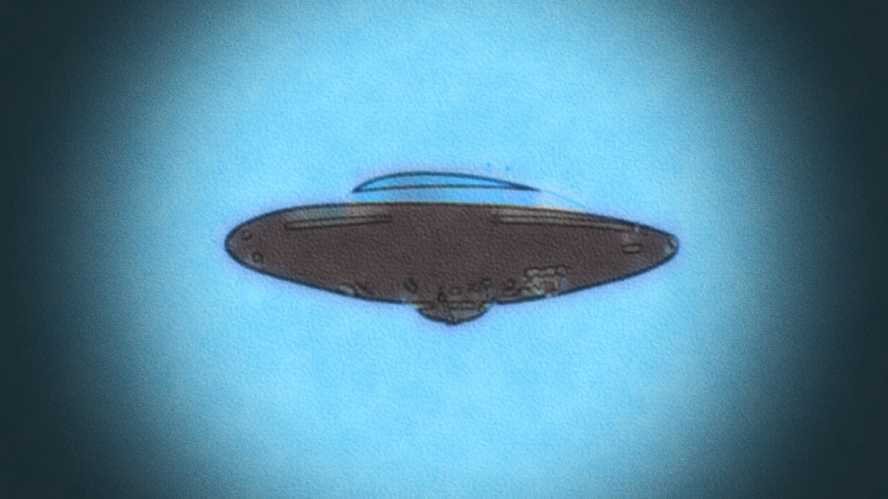
Meanwhile, 3I/ATLAS continues to surprise scientists. Just be a bit cautious with media reports. You do not have to use AI or thrill over every UFO rumor to pass for a “nobber.”
Take the New York Post’s recent story by Ben Cost: “Possible alien spacecraft 3I/ATLAS makes unusual shift while hurtling towards the Sun.” Terrible title, for it suggests that, before perihelion, the putative comet was heading towards the Sun. It wasn’t. And isn’t.
“Manhattan-sized comet 3I/ATLAS allegedly executed an unusual maneuver while approaching the Sun earlier this week, fueling theories that it could be an extraterrestrial spacecraft.” Astounding! But is it true?
Oh. That word “allegedly” — who alleges?
Not Harvard astrophysicist Avi Loeb. He writes about the “First Evidence for a Non-Gravitational Acceleration of 3I/ATLAS at Perihelion.”
The non-gravitational acceleration was measured at the perihelion distance of 1.36 times the Earth-Sun separation (defined as an astronomical unit or `au’), equivalent to 203 million kilometers. It had two components in the orbital plane of 3I/ATLAS:
· A radial acceleration away from the Sun of 135 kilometers (=9×10^{-7}au) per day squared.
· A transverse acceleration relative to the Sun’s direction of 60 kilometers (=4×10^{-7}au) per day squared.
If 3I/ATLAS is propelled by the rocket effect of ejected gas, then momentum conservation implies that the object would lose half its mass over a characteristic timescale equal to the ejection speed divided by the measured non-gravitational acceleration.
Ben Cost’s word “maneuver” suggests (to this reader) a purposive act rather than a mere alteration of physical behavior. But that is not what Loeb . . . “alleges.”
We have to have a wait-and-see attitude — which is what Loeb insists upon and what he has been saying all along, even as he also insisted that we must consider the possibility that this ninth-degree anomalous object is artificial in origin.
For the record, these appear to be the list of Avi Loeb’s observed 3I/ATLAS anomalies:
Ecliptic Alignment: Trajectory aligned within 5° of the solar system’s ecliptic plane (0.2% likelihood by chance).
Sunward Jet (Anti-Tail): A persistent forward-pointing jet toward the Sun, not an optical illusion as in typical comets.
Extreme Mass: ~1 million times heavier than ‘Oumuamua and 1,000 times heavier than Borisov (>5 km diameter, ~33 billion tons), while moving faster (<0.1% likelihood).
Fine-Tuned Flybys: Arrival timing optimized for close passes by Mars, Venus, and Jupiter (~tens of millions km), unobservable from Earth at perihelion (0.005% likelihood).
Nickel-Rich Composition: Gas plume shows excess nickel over iron (resembling industrial alloys) and high nickel-to-cyanide ratio, unlike any known comet (<1% likelihood).
Low Water Content: Gas plume only 4% water by mass, far below typical comets (which are water-dominated).
Extreme Negative Polarization: Light shows unprecedented -2.7% negative polarization at small phase angles, unseen in comets or asteroids (<1% likelihood).
Wow! Signal Coincidence: Arrival direction within 9° of the 1977 “Wow!” radio signal origin (0.6% likelihood).
Blue Spectral Surge at Perihelion: Unexpected blue glow (bluer than the Sun), defying dust-reddening in comets; possibly from ionized CO or a “hot engine” source.
Which would make the current observation of trajectory alteration the tenth, wouldn’t it?
Loeb has emphasized that these low-probability coincidences (cumulative odds <1 in 10¹⁶) warrant further scrutiny, though he rates natural origins as most likely. These contribute to its “4/10” ranking on his Loeb Scale (0 = natural; 10 = technological).
But in yesterday’s post, Loeb added the information about course alteration. According to observations, 3I/ATLAS experienced
· A radial acceleration away from the Sun of 135 kilometers (=9×10^{-7}au) per day squared. · A transverse acceleration relative to the Sun’s direction of 60 kilometers (=4×10^{-7}au) per day squared.
This means, in layman’s language:
3I/ATLAS has demonstrated an extra “push” directly outward, away from the Sun, beyond what gravity alone would cause. (Which means that the pre-perihelion trajectory, which was scheduled to reach its perihelion — closest-to-Sol — point in late October, would now move further outward and definitely not be “hurtling towards towards the Sun.”)
3I/ATLAS has also demonstrated an extra “push” forward as it swings around the Sun, again due to non-gravitational effects (e.g., asymmetric outgassing).
Meanwhile, UFO enthusiasts/nobbers are upset that NASA hasn’t released any recent images of the object. They aren’t buying the “government shutdown” excuse. The complaint seems to be that the summaries of data so far distributed require more editorial work than merely relaying some data. How hard is it to put the most recent photos up on NASA.gov?
Apparently harder than getting an AI to fake videos of Brian Cox and Michio Kaku.
Men accept servility in order to acquire wealth; as if they could acquire anything of their own when they cannot even assert that they belong to themselves.
Étienne de La Boétie, Discourse on Voluntary Servitude (1548).
On November 1, 1790, Edmund Burke published his Reflections on the Revolution in France, predicting that the French Revolution would end in disaster. Though many have disputed his premises and reasoning, few dispute his prophecy, which proved spot on.
Paige Lambermont reminds us that Germany’s phase-out of nuclear power has its reasons.
Construction, transport, and other processes involved in making and maintaining a nuclear power plant emit carbon dioxide. But nuclear power itself does not emit carbon dioxide, which is supposed to be terrible for climate and planet. So, “What would prompt a country seeking to sharply reduce CO2 emissions to get rid of its largest source of carbon-free energy?”
Lambermont, a policy associate at the Institute for Energy Research, reviews the history of anti-nuclear sentiments, going back to the 1970s, and various news-driven decisions by the German government. A tsunami in Japan didn’t help, though safety measures were strengthened at the affected nuclear power plant.
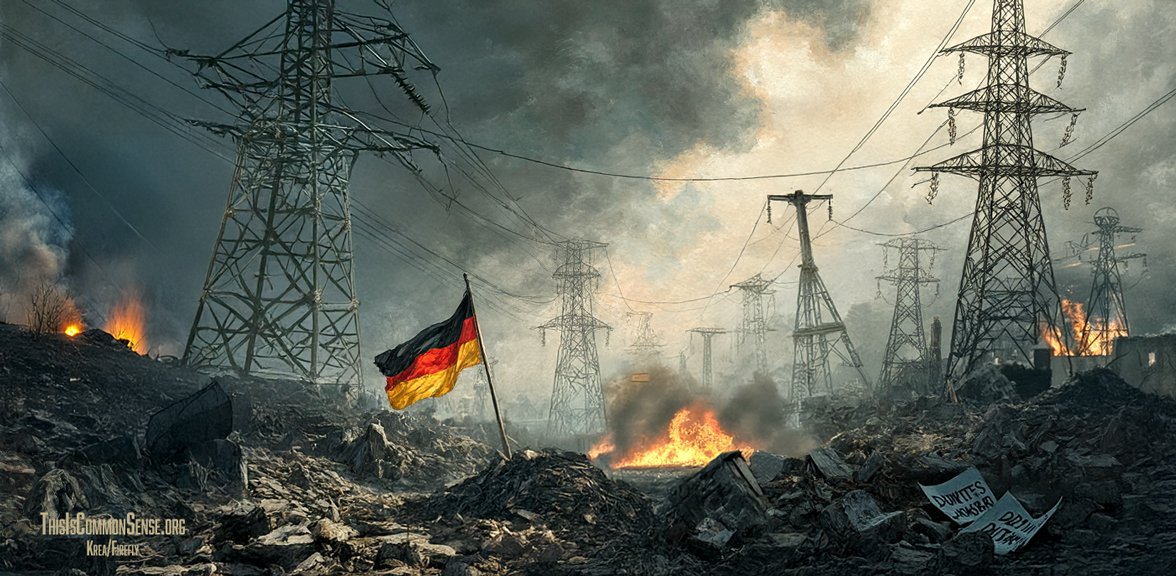
Now we seem to be nearing the end of the line. German pubs host “demolition viewing parties” as the country self-destructively continues to destroy another nuclear power plant, specifically the part consisting of two giant cooling towers.
A controlled demolition caused 56,000 tons of concrete to collapse in seconds. The speed is misleading, for the job is far from finished. Further work dismantling the Bavaria-based plant is expected to continue until 2040. Of course, the useful life of the plant is already over.
It’s all part of the plan, the German government’s energy-transition plan called Energiewende. The energy has to become “renewable,” a word meaning — in effect — unreliable (wind, solar). Also, Germans must drastically reduce their consumption of energy.
Maybe they should call the plan Götterdämmerung — twilight of the gods or, in this case, of industrial civilization.
When the publisher steps out of his legitimate function as a packager and forwarder, he cures people by the millions of the habit of reading books, just as real schoolmarms make windrows of brats permanently allergic to literature by cracking them over the head with the worst of it.
Jack Woodford, The Loud Literary Lamas of New York (1950), p. 47.