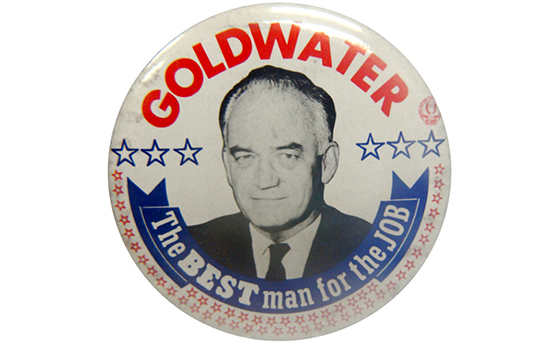
On October 27, 1964, Ronald Reagan delivered a speech on behalf of Republican candidate for president, Barry Goldwater, thereby launching Reagan’s political career. The speech came to be known as “A Time for Choosing.”
Reagan and Goldwater
On October 27, 1964, Ronald Reagan delivered a speech on behalf of Republican candidate for president, Barry Goldwater, thereby launching Reagan’s political career. The speech came to be known as “A Time for Choosing.”
These United States are approaching a crisis. Mounting debt seems increasingly unpayable. Sovereign default and financial chaos are “in the offing” — drifting from the (future) horizon to the (present) shore.
The costs of our debt load have been accommodated as astute economists predicted, with the weakest recovery in American history.
Seven years ago I wrote:
According to increasing numbers of Americans, it’s the level of spending by government that must decrease. We must balance budgets. Soon.
One could play sloganeer and say “It’s the spending, stupid”; or, twist that, to say “It’s the stupid spending.” But however you formulate the problem, what the new Republican House must do is find a way to cut spending.
They haven’t. Is there any reason, even with super-duper businessman Donald Trump riding herd, that they will make net cuts?
We can expect gross spending to increase and the debt to balloon even bigger.
Why?
Well, we are trapped.
Even the politicians themselves feel trapped.
You see, once the government begins a program, a constituency comes to depend upon it, and resists being “betrayed.” And the media supplies a steady stream of sob stories about the brutality of “austerity.” Politicians fear the passion of voters reacting to a specific hyped human need more than the general desire for less spending. So politicians increase the stupid spending.
Well, if the politicians are trapped, release them. Free them.
How? Term limits.
Congressional term limits would un-trap not just the pols — it’d free the voters, too. Let’s end the pretense that sending the same politicians to Washington term after term can produce local prosperity. Oh, the power of incumbency may lavish benefits on career congressmen, but it doesn’t pay off for the rest if us.
This is Common Sense. I’m Paul Jacob.
* It was President Harry Truman who said that term limits would “help to cure senility and seniority — both terrible legislative diseases.”
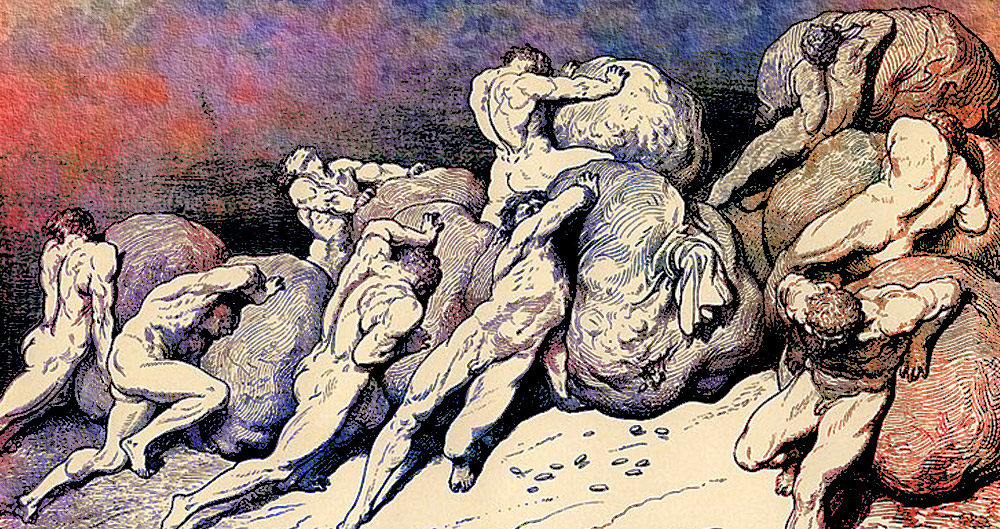
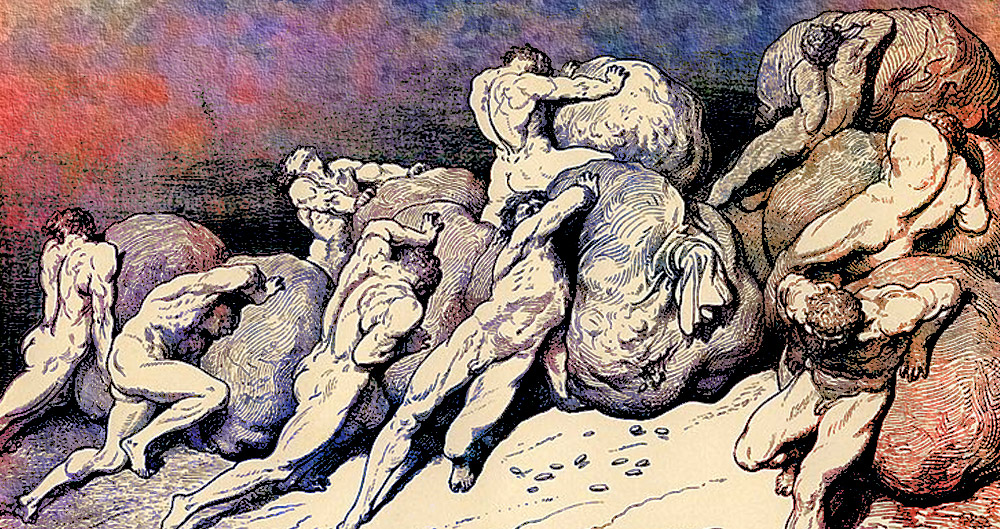
Illustration: Gustave Doré, “Avaricious and Prodigal”
I do not develop man, nor as man, but, as I, I develop — myself.
On October 26, 1774, the first Continental Congress adjourned in Philadelphia, Pennsylvania. Exactly one year later, King George III of Great Britain went before Parliament to declare the American colonies in rebellion. And one year later yet, to the day, in 1776, septuagenerian Benjamin Franklin departed from America for France, seeking financial support for the American Revolution.
Yesterday, a major American politician gave up.
Sort of.
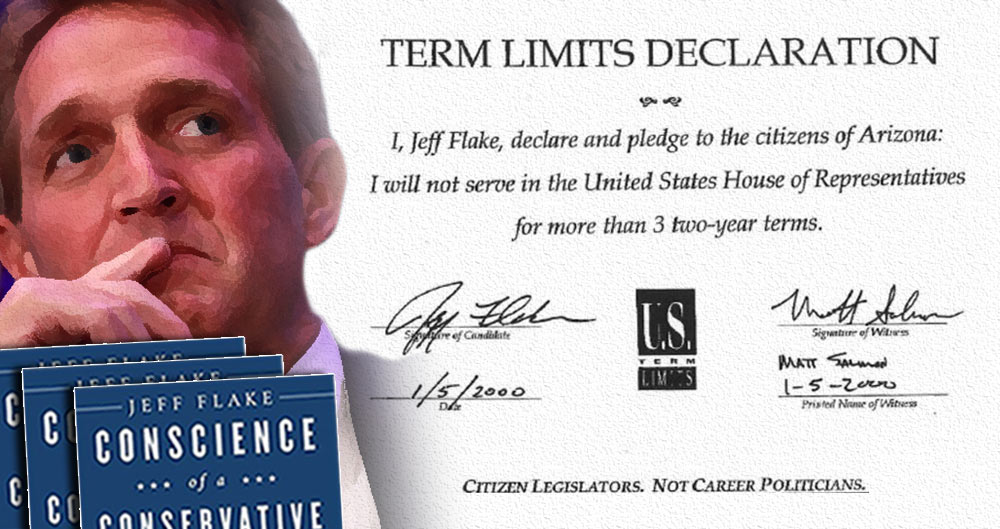
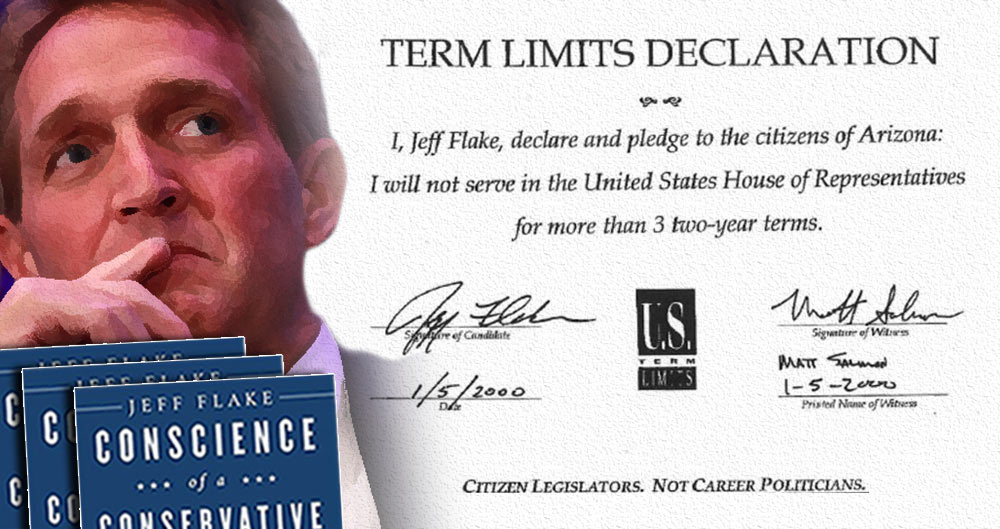
Senator Jeff Flake, the junior member of the upper chamber from the State of Arizona, took to the Senate floor to announce that his “service in the Senate will conclude at the end of my term in early January, 2019.”
Actually, most of the speech was an appeal to President Trump.
Or a lambasting.
In either case, he was echoing his recent book, Conscience of a Conservative: A Rejection of Destructive Politics and a Return to Principle, which columnist David Brooks has described as a “thoughtful defense of traditional conservatism and a thorough assault on the way Donald Trump is betraying it.”
In the Age of Trump, anti-Trumpian manifestos are . . . controversial in GOP ranks. And his opposition has cost him. All bets were against him winning re-election.
“I believe that there are limits to what government can and should do,” Flake wrote in a letter to supporters, going on to say “that there are some problems that government cannot solve, and that human initiative is best when left unfettered, free from government interference or coercion.”
Solid principles. Principles I share. But how principled was Flake? He began his career promising to limit his own terms, in accordance with . . . conservative principles. And yet the man from Snowflake, Arizona, broke that promise in 2006, holding on to his House seat for three more terms.
For his remaining 14 months in the Senate, Flake can return to the principle he reminded himself of in yesterday’s speech: “Sustained incumbency is certainly not the point of seeking office.”
There’s life after Congress. And Jeff Flake can do good things in the real world.
This is Common Sense. I’m Paul Jacob.
Herbert Spencer, “The New Toryism,” The Man Versus the State (1884).
If men use their liberty in such a way as to surrender their liberty, are they thereafter any the less slaves?
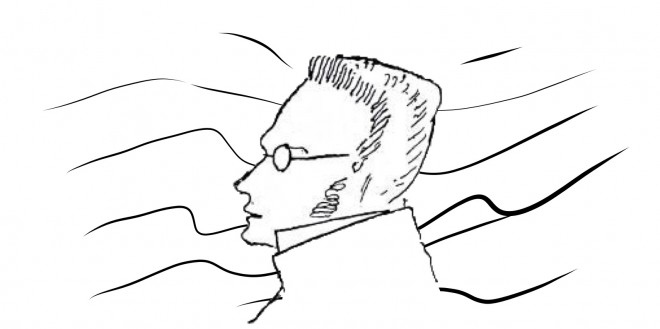
On October 25, 1806, the German philosopher Max Stirner was born. Stirner was known for his radical individualism, which under the name of “egoism” became culturally chic in the late 19th and early 20th centuries. In addition to Der Einzige und sein Eigentum, a major work that was famously attacked by Karl Marx, he translated Adam Smith’s Wealth of Nations and J.-B. Say’s A Treatise on Political Economy into German.
One downside to jumping to the wrong conclusion is that the failure to even look for the correct, accurate conclusion inevitably follows.
This sleepy odd-year campaign for governor of Virginia has recently been riled by charges of racism. Democratic Party gubernatorial nominee Frank Northam made the “mistake” of “omitting” the party’s candidate for Lt. Governor, Justin Fairfax, from a small printing of literature for union members about the Democrats’ statewide slate.
Northam is white and Fairfax is black.
“[A] slap in the face to Justin and to black voters,” is what Quentin James, who runs a PAC working to elect black candidates, called the removal of Fairfax from the literature. He added that it “reeks of subtle racism” and “sends a signal across the state, that we, as black voters, are expendable.”
Noting that black voters make up 20 percent of the state’s electorate, Think Progress dubbed Fairfax’s deletion: “mindboggling.”
Was this a “dis” and did it really have anything to do with Fairfax being black?
Well, Fairfax labeled it a “mistake,” but his exclusion from the flyer was certainly not inadvertent. It was by clear-eyed design.
The Laborers’ International Union of North America (LiUNA), a $600,000 donor to the coordinated state Democratic campaign, requested that Fairfax be removed from literature their members will distribute. The union is at odds with Fairfax over his opposition to two state pipeline projects the union favors.
So, Northam didn’t throw Fairfax under the bus because Fairfax is black. No sirree. Northam threw Fairfax under the bus to placate a powerful, well-heeled special interest group.
Northam isn’t a racist. He’s just a self-interested, disloyal politician.
This is Common Sense. I’m Paul Jacob.
Whoever will be free must make himself free. Freedom is no fairy gift to fall into a man’s lap. What is freedom? To have the will to be responsible for one’s self.
On October 24, 1648, the Peace of Westphalia was signed, marking the end of the Thirty Years’ War.