The United States Congress held its first session in Washington, D.C., on November 17, 1800.
Categories
A First in Washington
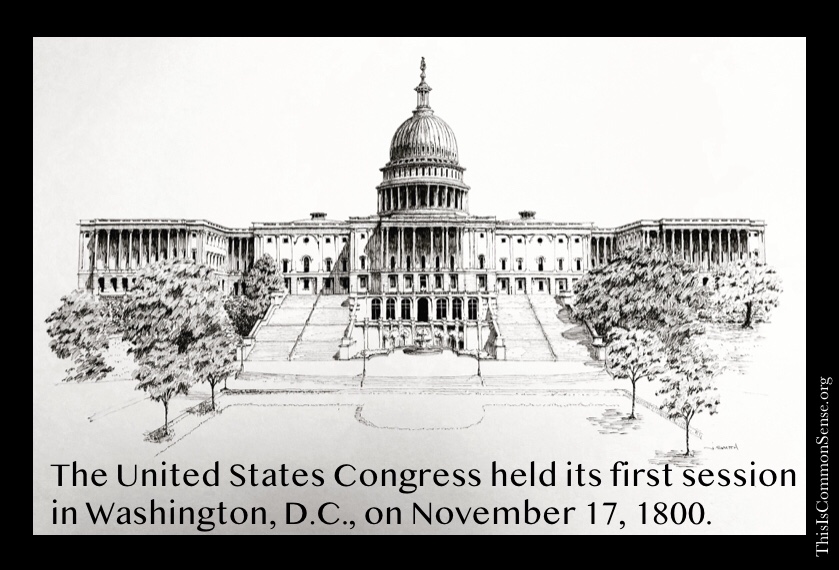
The United States Congress held its first session in Washington, D.C., on November 17, 1800.
So, what’s happening with Obamacare?
President Donald Trump this week elaborated more on how he would deal with health care subsidies and the Affordable Care Act (ACA), suggesting an account for citizens where payments can be made for health-related issues. Trump wrote in a Nov. 8 post on Truth Social that Senate Republicans should direct hundreds of billions in funding away from insurance companies and into people’s accounts, allowing them to purchase their own health insurance.
“Trump Proposes ‘Trumpcare’ Alternative to Obamacare; Sec. Rollins Says SNAP Benefits to Be Restored by Monday,” NTD News at The Epoch Times (November 16, 2025).
If this sounds awfully familiar — like the gist if not the wording of Bush Era medical-financial reforms — we may have to wait and see. But Obamacare long ago betrayed its promise of reducing healthcare costs overall. Might there be hope?
There will be more to come on this, here, but for now: what has the president actually said?
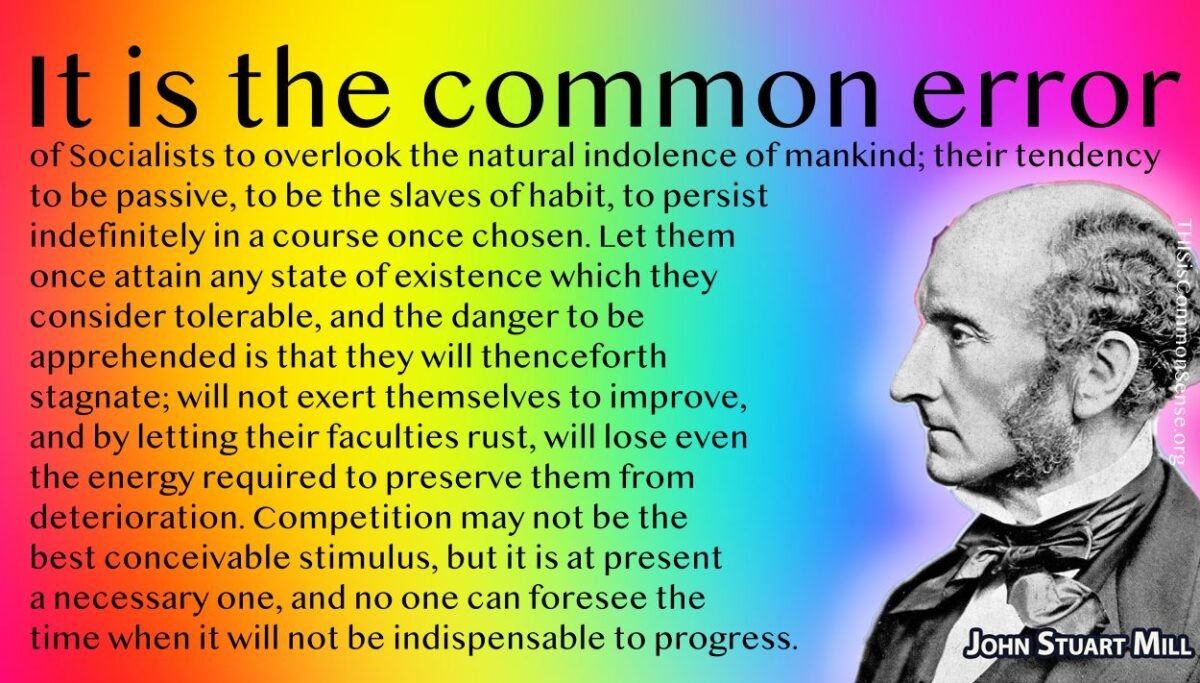
It is the common error of Socialists to overlook the natural indolence of mankind; their tendency to be passive, to be the slaves of habit, to persist indefinitely in a course once chosen. Let them once attain any state of existence which they consider tolerable, and the danger to be apprehended is that they will thenceforth stagnate; will not exert themselves to improve, and by letting their faculties rust, will lose even the energy required to preserve them from deterioration. Competition may not be the best conceivable stimulus, but it is at present a necessary one, and no one can foresee the time when it will not be indispensable to progress.
John Stuart Mill, Principles of Political Economy (1848; 1871), Volume II, Book IV, Chapter 7.
On November 16, 1914, the Federal Reserve Bank of the United States officially opened.
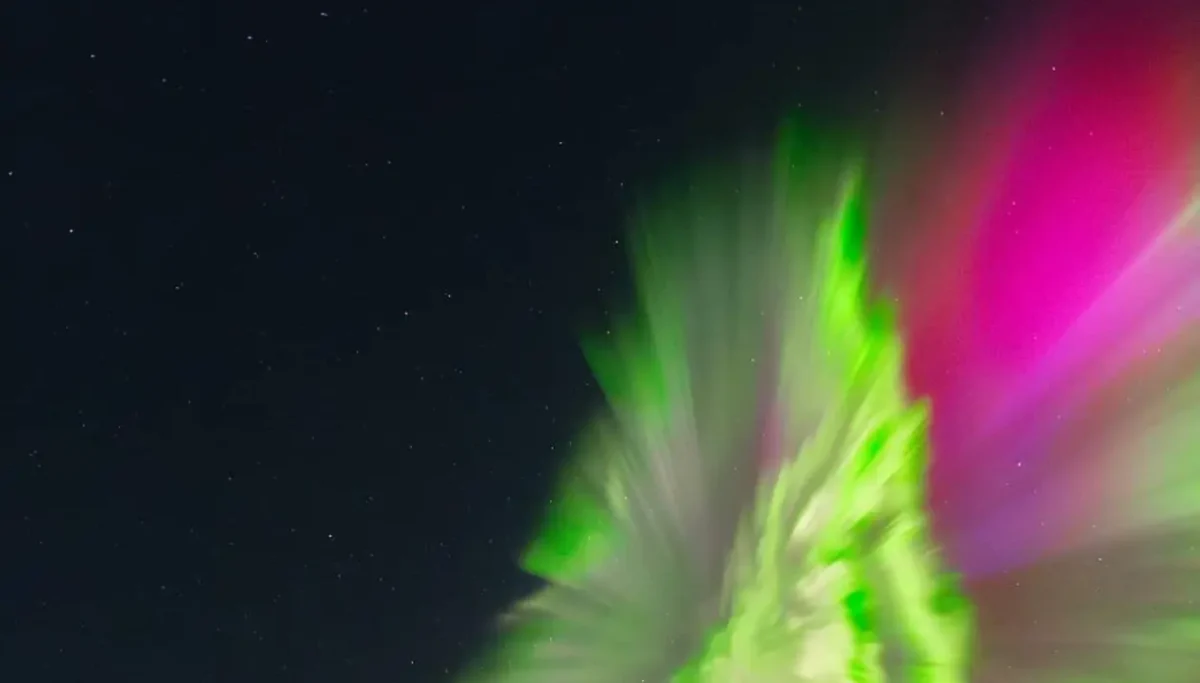
Maybe you saw the lights. Or maybe you just caught the news on Tim Pool’s show. It was an important story: a big solar storm that, had it been just a tad more intense could’ve taken down computers (which are in your watch and toaster) as well as the electric grid.
Why, yes, it could have ended our civilization, which is now utterly dependent on easily-overloaded electrical circuits and electronic components.
Actually, it was two sets of solar storms. And they had nothing to do with manmade global warming or MAGA politics or the death of Hollywood:
A severe (G4) geomagnetic storm lit up skies across the Northern Hemisphere overnight (Nov. 11-12), with vivid northern lights visible across Canada, the U.S, and as far south as Mexico.
The incredible display followed the arrival of multiple coronal mass ejections (CMEs) — eruptions of magnetic field and plasma from the sun — launched by sunspot AR4274, one of the most energetic sunspot groups of the current solar cycle. The ongoing storm ranks among the strongest of Solar Cycle 25 and last night’s peak at G4 clocked in as the third strongest geomagnetic storm this solar cycle. The first two CMEs struck in quick succession last night, compressing Earth’s magnetic field and unleashing spectacular aurora shows that lasted well into the night.
Daisy Dobrijevic, “Severe geomagnetic storm sparks northern lights across North America and as far south as Mexico,” Space.com (November 12, 2025).
This was a set of real events that took place this past week. Thankfully, we live on to talk about manmade global warming, MAGA politics, and the death of Hollywood.
As Rona Barrett likes to say, keep thinking the good thoughts.
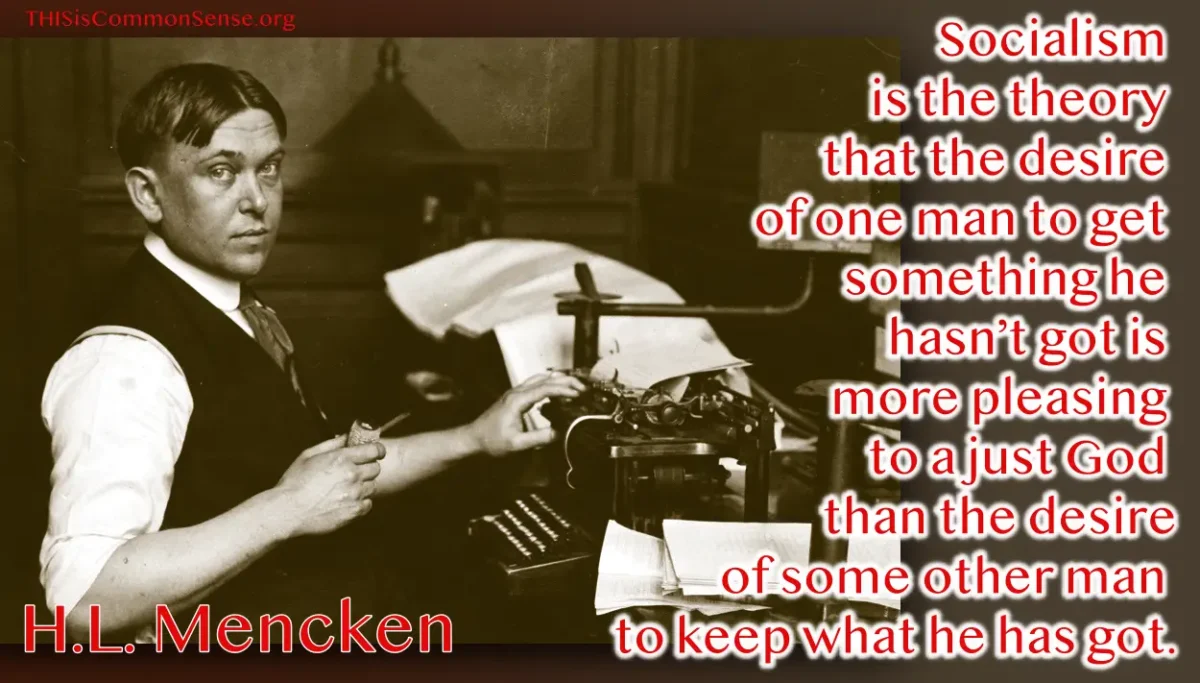
Socialism is the theory that the desire of one man to get something he hasn’t got is more pleasing to a just God than the desire of some other man to keep what he has got.
H.L. Mencken, A Little Book in C Major (1916) p. 51.
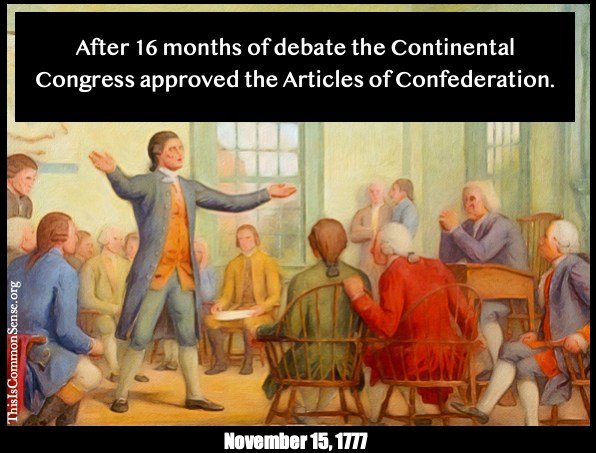
On November 15, 1777, after 16 months of debate, the Continental Congress approved the Articles of Confederation.

B-but — some people are allergic!
And we must protect them.
Under the Food Allergen Labeling and Consumer Protection Act (FALCPA) of 2004, milk is one of nine major allergens that must be explicitly declared — either in parentheses after the ingredient (e.g., “cream (milk)”) or in a separate “Contains: Milk” statement.
Which is why Costco had to recall 79,200 pounds of butter. A labeling oversight meant that perfectly good and safe butter was placed on the big box store’s shelves without the explicit warning that butter contains milk. The FDA issued a Class II recall, and Costco began the process on October 11.
“Voluntarily,” we’re told.
No doubt “voluntary” because neither Costco nor the bulk of its customers wants to get into arguments about government regulation designed to protect people with cows’ milk allergies.
In a world run by common sense and not a federal bureaucracy, however, even the most litigious lawyers would surely be satisfied by extra signage at point of sale — something like
ALL BUTTER IS MADE FROM MILK.
PEOPLE WITH ALLERGIES KNOW THIS.
THIS BUTTER IS NO EXCEPTION.
USE WITH CUSTOMARY CAUTION!
But even this may strike us as bending too far backward for people whose responsibility is to know what the stuff they ingest is made from. They must protect themselves. If milk makes you ill, you’ll forswear all butter and reach for some good oil, or even margarine.
Something like I Can’t Believe It’s Not Butter . . . but only in its original spray and vegan versions . . . all others contain milk!
I can’t believe this isn’t Common Sense. I’m Paul Jacob.
Illustration created with Krea and Firefly
See all recent commentary
(simplified and organized)
See recent popular posts
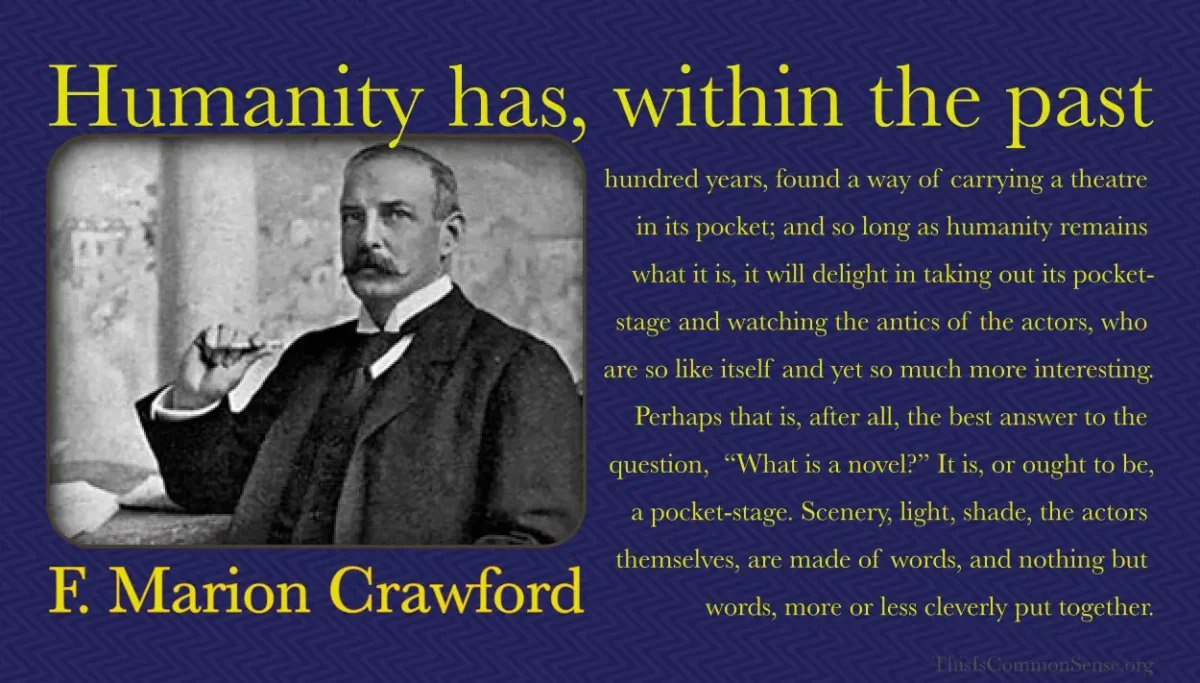
It may fairly be claimed that humanity has, within the past hundred years, found a way of carrying a theatre in its pocket; and so long as humanity remains what it is, it will delight in taking out its pocket-stage and watching the antics of the actors, who are so like itself and yet so much more interesting. Perhaps that is, after all, the best answer to the question, “What is a novel?” It is, or ought to be, a pocket-stage. Scenery, light, shade, the actors themselves, are made of words, and nothing but words, more or less cleverly put together. A play is good in proportion as it represents the more dramatic, passionate, romantic, or humorous sides of real life. A novel is excellent according to the degree in which it produces the illusions of a good play — but it must not be forgotten that the play is the thing, and that illusion is eminently necessary to success.
Francis Marion Crawford, The Novel: What It Is (1882), Chapter VIII.
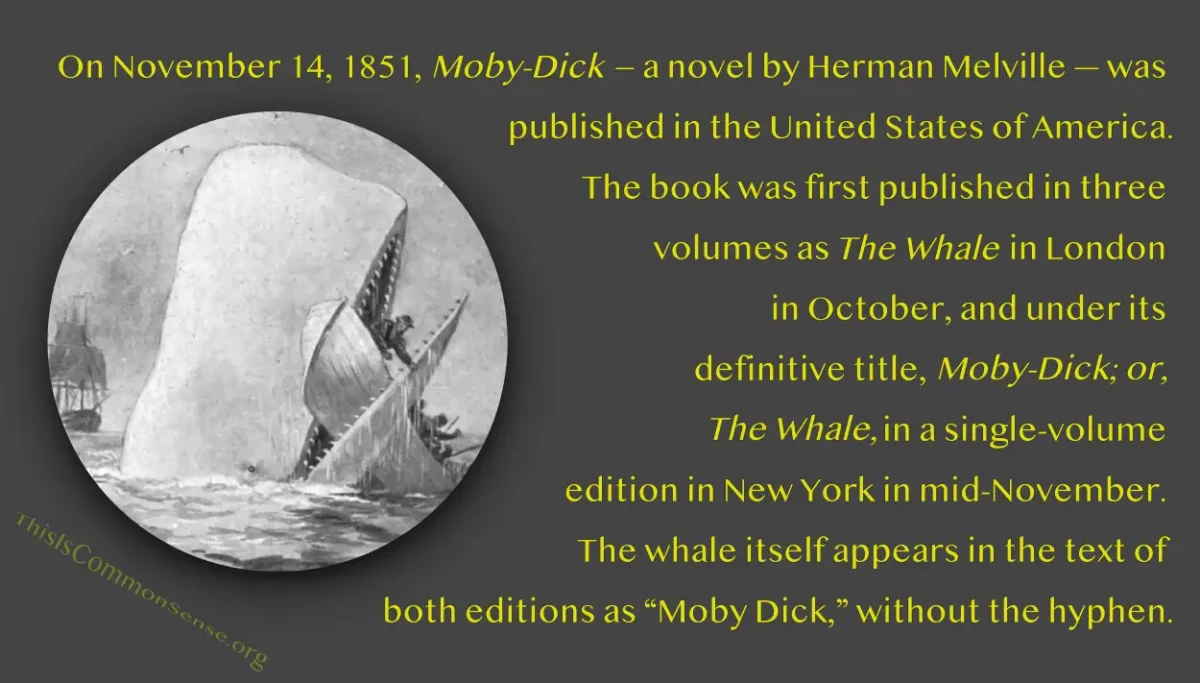
On November 14, 1851 — Moby-Dick, a novel by Herman Melville — was published in the United States of America. The book was first published in three volumes as The Whale in London in October, and under its definitive title, Moby-Dick; or, The Whale, in a single-volume edition in New York in mid-November. The London publisher, Richard Bentley, censored or changed sensitive passages; Melville made revisions as well, including a last-minute change of the title for the New York edition. The whale itself appears in the text of both editions as “Moby Dick,” without the hyphen.