Categories
Today

Bangorian Controversy

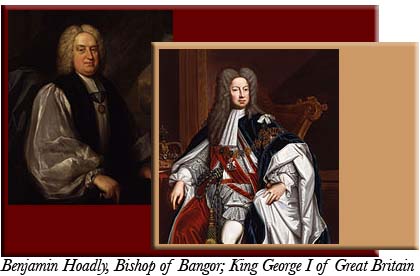
On March 31, 1717, a sermon on “The Nature of the Kingdom of Christ,” by Benjamin Hoadly, the Bishop of Bangor, provoked the Bangorian Controversy.

The sermon’s text was John 18:36, “My kingdom is not of this world,” and from that Hoadly deduced — supposedly at the request of King George I himself, who was present in the assembly — that there was no Biblical justification for any church government. Hoadly identified the church with the kingdom of Heaven, noting that Christ had not delegated His authority to any representative.

King George’s preference for the Whig Party, and for latitudinarianism in ecclesiastical policy, is widely thought to have been a strategic maneuver to degrade church power in political government.

Categories
Thought

Sen. Mitch McConnell

I think we’ve worked our way through the education process of making sure everybody understands this is really a different plant.

Categories
Accountability general freedom ideological culture media and media people moral hazard nannyism responsibility too much government U.S. Constitution

The Abortionists’ Cartoon Advice

Let it not be said that Planned Parenthood lacks for principles.

When Donald Trump offered a deal, last year, to fund Planned Parenthood only if the organization would stop doing abortions, the company immediately clarified the situation. “Offering money to Planned Parenthood to abandon our patients and our values is not a deal that we will ever accept,” said the outfit’s executive vice president. “Providing critical health care services for millions of American women is nonnegotiable.”

And, for Planned Parenthood, abortion is indeed critical. “The Trump administration needs to stop playing political games that would put access to the full range of safe reproductive care at risk,” said Senator Kirsten E. Gillibrand (D-NY), “or they will get the fight of their lives.”

Well, that fight was won by Planned Parenthood. The politician who once said he would “shut down the government” over the abortionist enterprise has caved after various roadblocks. Trump signed a stopgap omnibus spending bill, last week, which continues to funnel $500 million towards the outfit.

So, as if to celebrate, a Pennsylvania branch of the abortion mill — er, “reproductive care” service — engaged in a bit of ebullience, a “light-hearted” tweet:

We need a disney princess who’s had an abortion

We need a disney princess who’s pro-choice

We need a disney princess who’s an undocumented immigrant

We need a disney princess who’s actually a union worker

We need a disney princess who’s trans

This caused a firestorm.* And not because its Disney obsession was silly. The problem? The tweet showed that Planned Parenthood is really, really committed to valorizing the killing of fetuses. And that its agenda is far, far left.

The outfit should be left without taxpayer funds.

This is Common Sense. I’m Paul Jacob.


* The Tweet was quickly removed.


Printable PDF
 

Categories
Today

Economic vs. Political Means

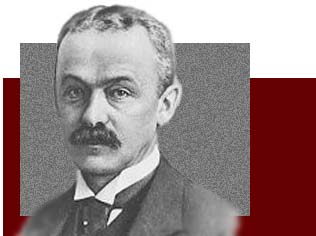
On March 30, 1864, German sociologist and economist Franz Oppenheimer was born. This sociologist is most famous for his 1908 book The State, in which he elaborated some consequences of two means for acquiring wealth, the “economic means,” by which he meant private production or by trade, and the “political means,” by which he meant forcible extraction from one group or person by another person or group. Oppenheimer taught in Palestine in the mid-1930s, and fled the Nazis to the United States, via Japan in 1938. In 1941 he became a founder of The American Journal of Economics and Sociology, and died two years later.

Categories
Thought

Sir Henry James Sumner Maine

The tendency to look not to the past but to the future for types of perfection was brought into the world by Christianity. Ancient literature gives few or no hints of a belief that the progress of society is necessarily from worse to better.

Categories
crime and punishment free trade & free markets general freedom moral hazard national politics & policies too much government U.S. Constitution

High on Hemp?

Hemp is not marijuana.

And yet it is.

Earlier this week, Senate Majority Leader Mitch McConnell announced he will introduce legislation to legalize industrial hemp.

He is not concerning himself with marijuana, which is what we call the plant Cannabis sativa when cultivated for its Tetrahydrocannabinol (THC) content, the principal chemical in the plant that makes it ideal for “recreational” uses. Industrial hemp is Cannabis sativa, too, just with minuscule THC.

Hemp products are actually legal to buy and sell in the United States.

Sort of.

But growing it is murky, considering that ingestible hemp is a Schedule 1 drug no matter how little THC it has — despite the fact that Congress has allowed states to regulate the growth of low-THC hemp for “industrial” purposes.  

A complicating factor is that industrial hemp contains an oil, Cannabidiol (CBD), which is neither an ecstatic nor a hallucinogenic drug, but is widely believed to have many therapeutic powers. And is widely sold all over the country, wherever states have allowed for medical marijuana.

Nevertheless the DEA objects to it as much as to THC, saying that all ingestible forms of hemp are illegal.

Because of all this murkiness, McConnell’s bill might seem to be welcome step towards clarity.

Trouble is, since industrial hemp is indistinguishable from cannabis with THC — to look at; to smell; to touch — officials hoping to crack down on marijuana-as-a-psychoactive-drug would be much hampered were industrial hemp commonly and legally grown.

What a mess. The only real solution is to de-list all forms of Cannabis sativa from the War on Drug’s Schedule of Drugs It Unconstitutionally Proscribes.

This is Common Sense. I’m Paul Jacob.


PDF for printing


Categories
Today

Hyphen War

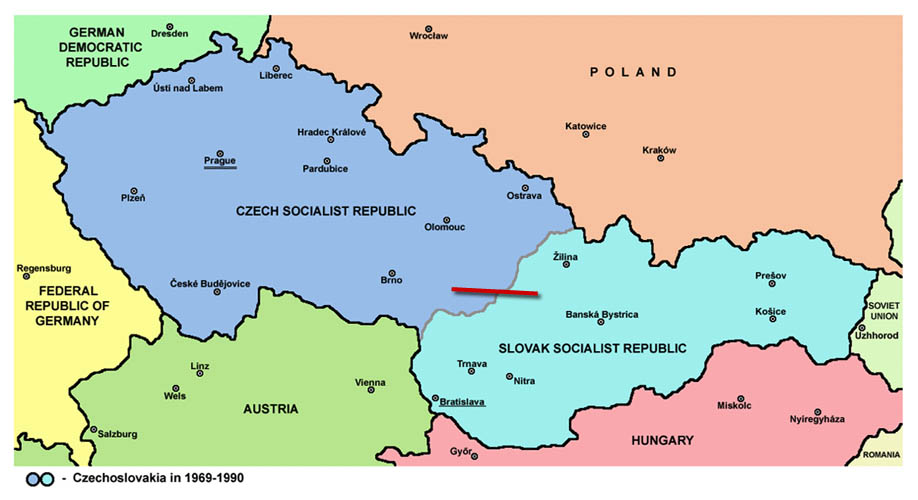
On March 29, 1990, the Czechoslovak parliament proved unable to reach an agreement on what to call the country after the “Velvet Revolution” — in which the Communist Party was booted from sole power. This sparked the “Hyphen War,” a tongue-in-cheek moniker for the dispute between Czechs and Slovaks about official recognition of the two nations’ equal status. (The Slovak representatives wanted to insert a hyphen into the name, to make the Slovak part stand out.) Eventually, the dispute was resolved with the “Velvet Divorce,” in which the two countries split up, on New Year’s Day, 1993.

Categories
Thought

Voltairine de Cleyre

Note the difference between a right and a privilege. A right, in the abstract, is a fact; it is not a thing to be given, established, or conferred; it is. Of the exercise of a right power may deprive me; of the right itself, never. Privilege, in the abstract, does not exist; there is no such thing. Rights recognized, privilege is destroyed.

Categories
Accountability folly free trade & free markets general freedom government transparency local leaders moral hazard nannyism porkbarrel politics responsibility too much government

Bailing on Mass Transit

Around the country, our major metropolitan transit systems have hit the skids. “Between 2016 and 2017, ridership fell in each of the seven largest transit markets,” the Washington Post informs.

You might guess that the reason for declines in ridership might have something to do with bad planning and poor service. Washington, D.C.’s Metro system, with which I am all-too familiar, is a horror . . . run by people I wouldn’t trust to sweep your driveway much less mine, and certainly not to manage how I get between those (or any other) two locations.

But the Post quotes an urban planning scholar who attributes the decline (in part) “to increased car ownership, particularly among low-income and immigrant populations, who were in a better position to afford cars following the Great Recession.”

This puts planners in a pickle since, he explains, if “low-income people are doing better, getting the ability to move around like everyone else, it’s hard to say that what we should do is get them to remove themselves from their cars and back on trains and buses.”

Shockingly sensible — especially coming from a planning specialist. “Transit systems should deliver quality service to low-income people,” he insists. “But low-income people do not owe us a transit system.”

Well, maybe that’s the problem, this notion that governments “owe” this service to “low-income people.”

After all, web-based services like Uber and Lyft have shown how market innovations provide the best ways to move millions.

This is Common Sense. I’m Paul Jacob.


PDF for printing


Categories
Today

Vargas and Vaughn

On March 28, 1936, Peruvian author Mario Vargas Llosa was born. This recipient of the 2010 Nobel Prize in Literature ran, in 1990, for the presidency of Peru, but lost to Alberto Fujimori. His novels include La casa verde (The Green House), La guerra del fin del mundo (The War of the End of the World), La fiesta del chivo (The Feast of the Goat), and Aunt Julia and the Scriptwriter, which was filmed as Tune in Tomorrow.

On the same date in 1970, Vince Vaughn, American actor, producer, and screenwriter, was born.VinceVaughn

Vaughn is one of a small minority of non-left-leaning Hollywood stars; his ideas on politics and economic policy were greatly influenced by Ron Paul.