Reason is like an open secret that can become known to anyone at any time; it is the quiet space into which everyone can enter through his own thought.
Categories
Karl Jaspers
Reason is like an open secret that can become known to anyone at any time; it is the quiet space into which everyone can enter through his own thought.

Time sure flies when you’re having fun.
Today is my birthday. I am 60, and thus begin my 61st year on this planet.
For the last four decades — my entire adult life — I’ve worked in politics. That might not seem like much fun. Politics is a constant struggle, a slog. But working for freedom — in one crusade or another — has been both fulfilling and fun.
Maybe it’s because, as a friend once accused, I’m a pathological optimist. Maybe it’s a whole lot more than that.
I’ve worked through nights, bleary-eyed, peering at voter registration lists. I’ve circulated petitions in 100-degree heat and freezing temperatures. I’ve been vilified in the press — oh, and lionized, too. I’ve been both hounded and praised. I’ve been imprisoned — and threatened with more of the same.
What was I thinking?
I guess I thought, and indeed still think, that we are called upon to do what we believe is right — come what may. Freedom isn’t free.

It’s been hard sometimes. I was in prison for five and a half months when my oldest was only a year old. I was there for refusing to register for the draft.
What was I thinking?
In the words of then-presidential candidate Ronald Reagan, I thought: “The draft or draft registration destroys the very values our society is committed to defending.” I could not stand idly by while those cherished values were destroyed, nor certainly be any party to it.
My re-education in federal custody fortunately didn’t take. And the road I took has made all the difference.
For instance, I met Ron Paul when, as a slightly younger congressman, he testified at my trial. Three years later, in 1988, I nominated him to run for president on the Libertarian Party ticket.
At a meeting in April of that year, the task of putting Congressman Paul on the ballot for president was handed to me. The next morning I was awakened by a phone call on the home line — at 6:00 am! And for the next six months the phone never stopped ringing.
I remember my wife calling me at the office to tell me our new home phone number — and urging me not to give it out to people! She’s a lot smarter than I am.
Working with wonderful people across the country, we successfully placed Ron on the ballot in 47 states and the District of Columbia. And Guam. Believe me, it took a lot of hours, daylight and late night.
What was I thinking?
I was thinking that given a choice, people would choose greater freedom, limited government and personal responsibility. We didn’t win, of course. But we weren’t through trying.
Howie Rich and Eric O’Keefe noticed my work on the petition drives and offered me a job running the Tax Accountability Amendment in Illinois. Half a million voters signed petitions to put the measure on the ballot. Then, at 77 percent in the polls, the Illinois Supreme Court took it off the ballot. (The same thing happened again four years later with a term limits petition.)
But, suddenly, freedom was breaking out around the world. The Berlin Wall came down. Czechs poured into the streets. Estonians were singing. We watched with inspiration and then horror as students rallied for weeks in Tiananmen Square only for the Butchers of Beijing to crush the peaceful protest with deadly force. The Chinese people’s dream was our dream; the desire for freedom — and the citizen control of government needed to preserve it — was universal.
The end of the Cold War allowed Americans to finally cast a full glance at city hall, at the state capitol, at Washington, D.C. We did not like what we saw.
Along came term limits.
In 1992, I was hired to run U.S. Term Limits. We were able to help activists in 14 states get on the ballot — the most states to ever vote on a single issue on a single day. All 14 states passed term limits, including my home state of Arkansas.
The issue continued to win at the ballot box in the states and in hundreds of cities and counties — from Wyoming to New York City. Politicians sued. Speaker of the House Tom Foley was one.
In 1994, Republicans swept to a majority in the U.S. House for the first time in 40 years, in no small part as a result of their embrace of term limitation. One of the biggest upsets was Foley, the only Speaker defeated for re-election since the Civil War, a victim of his own lawsuit to overturn his state’s voters.
And term limits — a case from Arkansas, not Foley’s — went to the Supreme Court. Unfortunately, in a narrow 5 to 4 decision, the court struck down Arkansas’s term limits law, and by implication laws enacted in 22 other states.
What was I thinking?
On the steps of the Supreme Court, I told reporters:
All over Washington today, the politicians and the power brokers are happy. You can hear the sound of champagne corks popping. I have a simple message to them. Drink up; you’re outnumbered.
Term limits went nowhere in Congress, of course. There were a few principled supporters, but most wanted a career of perks and power. It’s very seductive.
I was on the wrong side of an 80/20 issue. I was with the 80 percent of Americans for term limits.
What an amazing situation: Our representatives refuse to do what 80 percent of the people want. In essence, they refuse to give back the power we’ve loaned to them.
The issue won’t go away. A decade ago, if you went to a Tea Party event, you would see the homemade two-word signs: Term Limits! And then-President Barack Obama insisted on the importance of term limits for Congress and for executives in foreign countries, and he regarded it as a matter of course: it’s tyranny without them.
Now, a very different president, Donald Trump, has repeated the importance of legislative term limits. It was one reason many people voted for him. And best for republican governance.
Though, a lot of people in power sure pretend to think the opposite.

The battle has not been lost or abandoned. I still sit on the board of directors of U.S. Term Limits and help out where I can in a very aggressive national campaign to bypass Congress by garnering 34 states to call a convention (under Article V of the Constitution) to propose a constitutional amendment for ratification by the states.
Frankly, the only negative result of term limits sweeping those states with initiative and referendum has been the backlash. Legislators and their favored special interests have launched concerted attacks on the initiative process for enabling the people to do such a thing in the first place.
What was I thinking?
The initiative process is the most effective protection we citizens have from government gone wild.
Regular readers of Common Sense know my more recent work in helping citizens across the country petition to put initiatives on the ballot to protect homes and small businesses from being taken through eminent domain abuse, enact state spending limits, defeat ever-increasing gas taxes, protect citizen-only voting and enact criminal justice reform in places like Ferguson, Missouri.
A decade ago, in the spirit of “no good deed goes unpunished” and in the cesspool that has become our politics, Oklahoma Attorney General Drew Edmondson indicted three of us, The Oklahoma Three, for “conspiracy to defraud the state” over a 2006 initiative there.
What was I thinking?
The Oklahoma powers-that-be were scared. And they did not want us taking a limit on government spending to a public vote.
And perhaps, for a moment or two, I may have thought “I’m getting too old for this.”
We were innocent of the charge and we fought back. After more than a year and a half with a possible ten-year prison term hanging over our heads, the charges were dismissed. The AG had campaigned in the press that we were guilty, but he had repeatedly blocked our case from going before a judge for a preliminary hearing to determine if there was enough evidence to even go to a trial.
No such hearing was ever completed. Meanwhile, the state’s petition law was struck down as unconstitutional in federal court.
The AG thought he could threaten us into submission. He had offered my co-defendant Susan Johnson a deal: plead guilty and all she’d get would be a small slap on the wrist.
Like so many unsung patriots in this country, she told him to stuff it.
What was she thinking?
All that is necessary for the triumph of good is for the majority of people — who are indeed good at heart — to stand up and be counted. The people are not the problem. They are the solution to the problem.
When government becomes Goliath, the initiative is the people’s slingshot.
In my recent travels around the world in support of freedom-centered democracy — citizen-controlled government — I’ve encountered truly courageous people in Hong Kong, Taiwan, and elsewhere. Everywhere the message is becoming clearer, at least to folks like you, advancing the cause.
Times are strange. Even scary. But I’ve never had more hope for the future. Together, I’m convinced we can leave our kids and grandkids an insurance policy. Not one that pays out money when we’re gone, but something they’ll need even more:
Freedom.
The key to restoring and protecting freedom? Give the intrinsic decency and the common sense of the American people a chance to prevail.
That’s what the initiative and referendum process is all about: an opportunity to place some measure of common sense on the public agenda, and when needed, to check the power of the high and mighty.
As I look back on my five decades, I’m thinking how proud and how lucky I am to serve as president of Citizens in Charge and Citizens in Charge Foundation, the only national organizations committed to protecting the right of citizens to initiative and referendum, and to lead the Liberty Initiative Fund, an organization that helps liberty-minded people advance ballot measures that expand liberty and constrain government.
Many times through the years I’ve asked you to make a sacrifice to support our mutual cause. Your generosity has made the difference. Again today, I ask for your help.
Please support this online voice.
For 20 years, this daily Common Sense commentary hasn’t skipped a weekday, and now our brand spanking new, This Week in Common Sense video/audio podcast is also at thisiscommonsense.com. This has been the hub of my political activism since 1999. Here I keep the lines of communication open with freedom-minded folk everywhere, and when I notice an opportunity, from where I explain how we can best advance our cause.
But a website and daily commentary — and now a weekly podcast — take not only time, but money. To keep it going, and even expand our reach on social media, your help now would be just that: Help. Now. For the future.
Don’t donate $60 to This Is Common Sense just because I’m turning 60. If that were the only motivation, I’d want you to give $59 or $33 or $21. I’d feel younger.
Give whatever you can afford — $60 or $6 or $600 — because your liberty and mine, as well as freedom for our loved ones, is worth every penny.
And right now I can help increase the bang of your bucks. A generous donor has promised to match, dollar for dollar, your donation — up to $15,000. So whether your donation is a 6 followed by one zero, two, or three, you’ll know that the effect will be doubled.
What a deal!
I urge you to not put this aside. No matter what you contribute, please do it right now. After all, we’re not getting any younger.
As a lover of freedom and not omnipotent government, you are already way ahead of the crowd! What are you thinking?
I hope you’re thinking that you will join me by supporting Common Sense, to restore liberty, to put freedom first.
This is Common Sense. And I’m seventh-decade-advancing* Paul Jacob.

P.S. When you make a financial gift, your spouse, your friends, your neighbors and co-workers may ask you: What were you thinking?
So tell them. Freedom needs not only your support, but theirs.
* If my seventh-decade (!) reality inspires you to increase your donation from $60 to $70 — or from $600 to $700 — the whole idea of moving forward would add just an extra bit of pizazz.
See all recent commentary
(simplified and organized)
See recent popular posts
Those who seek absolute power, even though they seek it to do what they regard as good, are simply demanding the right to enforce their own version of heaven on earth. And let me remind you, they are the very ones who always create the most hellish tyrannies. Absolute power does corrupt, and those who seek it must be suspect and must be opposed. Their mistaken course stems from false notions of equality, ladies and gentlemen. Equality, rightly understood, as our founding fathers understood it, leads to liberty and to the emancipation of creative differences. Wrongly understood, as it has been so tragically in our time, it leads first to conformity and then to despotism.

On March 6, 1967, Soviet Premiere Joseph Stalin’s only daughter, Svetlana Alliluyeva, defected to the United States. She later took the name Lana Peters, upon marriage to William Wesley Peters. The marriage was short-lived.
The March 6 date also marks term limits advocate and initiative organizer Paul Jacob’s birthday. He was born on the anniversary of the births of Michaelangelo, Cryano de Bergerac, and Alan Greenspan. He is also, obviously, the reason this site, ThisIsCommonSense.com, exists. (It continues, however, only through the continued support of readers like you.)

The Democratic Insider Machine’s pushing of sorta senile Biden against socialist Sanders is quite breathtaking.
But that isn’t even the entirety of the Machine’s anti-democratic agenda.
“The establishment narrative warfare against [Representative Tulsi] Gabbard’s campaign dwarfs anything we’ve seen against Sanders,” writes Caitlin Johnstone on her popular blog, “and the loathing and dismissal they’ve been able to generate have severely hamstrung her run.”
No kidding. But why would the Machine prefer Sanders over Gabbard?
“It turns out that a presidential candidate can get away with talking about economic justice and plutocracy when it comes to domestic policy,” Ms. Johnstone goes on, “and some light dissent on matters of foreign policy will be tolerated, but aggressively attacking the heart of the actual bipartisan foreign policy consensus will get you shut down, smeared and shunned like nothing else.”
This pro-war, anti-Tulsi agenda was seen right after SuperTuesday.
You see, Representative Gabbard got a delegate, from American Samoa (where Michael Bloomberg’s vast fortune also nabbed a delegate). And, by the rules that have been followed so far, a delegate gets you onto the big debate stage.
But almost immediately, word from the Democratic National Committee hit the Twittersphere: “We have two more debates — of course the threshold will go up. By the time we have the March debate, almost 2,000 delegates will be allocated. The threshold will reflect where we are in the race, as it always has.”
The DNC — the Machine — is rewriting the rules.
Tulsi must not speak.
Even if her competence and ecumenical appeal might actually save the Democratic Party, were her name to replace Biden and Sanders in the second or third voting round of a contested convention.
Such a fierce opponent of regime-change wars is obviously unacceptable to the Machine.
This is Common Sense. I’m Paul Jacob.

See all recent commentary
(simplified and organized)
See recent popular posts

The market is like a lake agitated by the wind, where the water is incessantly seeking its level without ever reaching it.

On March 5, 1616, Nicolaus Copernicus’s book, De revolutionibus orbium coelestium, was placed on the Catholic Church’s Index of Forbidden Books. This censorship notwithstanding, the Earth continued to revolve around the Sun. The book had been first published in 1543 in Nuremberg.
| In 1770, the Boston Massacre took place on March 5.
| Joseph Stalin, the longest serving leader of the Soviet Union, died at his Volynskoe dacha in Moscow on this date in 1953, after a cerebral hemorrhage.
| March 5 is magician Penn Jillette’s birthday. He turns 64 today, beginning his 65th year of life.

Lord Acton’s Law of Power states the chief problem of government: “Power tends to corrupt and absolute power corrupts absolutely.”
It has broad application.
Take traffic lights. They are there to prevent accidents and make navigating roads a better experience for all. The basic idea is to establish and enforce a few basic rules and then let civilization proceed at the pace set by the people themselves. It won’t be perfect, but it won’t be tyranny, either.
But controlling traffic lights is a kind of power.
And thus open to corruption.
Just ask Mats Järlström. After his wife got a “running a red light ticket” in Beaverton, Oregon — a town characterized on the show Veronica Mars as completely wholesome and innocent of guile — Mr. Järlström researched the yellow light timing system.
Using a sophisticated “extended kinematic equation,” obtained from his work background in Sweden, he sought to right the wrong that led to his wife’s ticket and found himself mired in government overreach.
You see, the Oregon Board of Examiners for Engineering and Land Surveying objected to his practicing engineering without a license.
The board sought to bury his findings about how yellow lights have been calibrated in Oregon — which he had shown encouraged behavior that would allow governments to maximize revenue . . . not safety.
That’s corruption. The intersection lights’ setup turned a safety measure into a means to fleece motorists — and the engineering board corruptly twisted its mission to suppress the truth.
Thankfully, the Institute for Justice stepped in, and Järlström won in court.
Oregon now has new intersection lighting standards, and the power of the government professional board has been curbed.
A win for limited government!
And Common Sense, which This Is. I’m Paul Jacob.

See all recent commentary
(simplified and organized)
See recent popular posts
Dictatorships foster oppression, dictatorships foster servitude, dictatorships foster cruelty; more abominable is the fact that they foster idiocy.
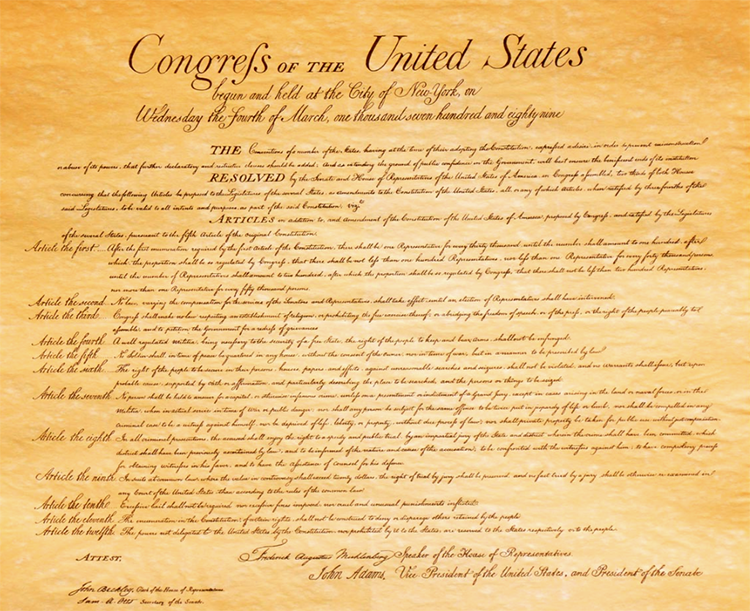
On March 4, 1789, the first bicameral Congress of the United States met in New York, New York, in accordance with the new Constitution.
Two years later on the same date, Vermont was admitted as the fourteenth state of the union.
In a twist in World War II allegiances, Finland declared war on Nazi Germany on March 4, 1945, beginning the Lapland War.