Categories
Today

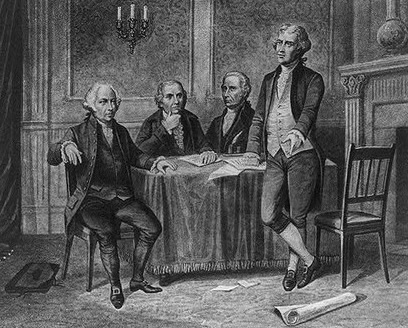
The Original Confederation, Formalized

On November 15, 1777, the Continental Congress approved, and sent to the states for ratification, the “Articles of Confederation — after 16 months of deliberation. The first article gave the official name of the confederacy:

The Stile of this Confederacy shall be
The United States of America.

Categories
by Paul Jacob video

Watch: The Post-Election Horror?

The podcast has a video version: It is ready for you.

Categories
audio podcast

Listen: Friday the 13th!

Was it really so bad? And by “it” I mean “Election Day 2020”?

Categories
Today

PJO!

On November 14, 1918, Czechoslovakia became a republic.

Born on the same date 29 years later — American writer P. J. O’Rourke.

Categories
First Amendment rights ideological culture

The Latest Fake Mystery

We Americans want to have our say, speak our piece — we do not wish to be gagged. No mystery to that. No puzzle. No strange, arcane, unexpected turn of our temper.

But that’s how it must seem to Nathan Bomey, author of “Parler, MeWe, Gab gain momentum as conservative social media alternatives in post-Trump age,” gracing the pages of USA Today.

“America’s crisis of political segregation — we increasingly don’t live alongside, associate with or even marry people who think differently from us — is increasingly leading conservatives to congregate together on social media outlets designed specifically for people who think like them.”

This is a passage of surpassing dumbness.

To pick one fundamental ideological divide at random: capitalist twitterers have never had any problem with posting tweets “alongside” socialist twitterers. The problem is the growing censorship of tweets that officials and employees at tech giants like Twitter, Facebook, and Google happened to dislike or disagree with for any reason.

This censorship was revved up during the recent election.

Bomey does mention claims of censorship by the persons being censored, but treats these as the ravings of “the extremist crowd.” He adds: “Experts on political polarization say [the rise of alternative social media] is a natural outgrowth of our divided culture. . . .”

Again: a major reason the alternatives to Twitter etc. are gaining such traction is the censorship. People are leaving the Big-Tech-sponsored discourse because they are being censored. 

You don’t kick people out of the room and then scratch your head in wonderment, asking, “Gee willikers, why are you guys going away?”

This is Common Sense. I’m Paul Jacob.


N.B. I have Minds and Gab accounts, but do not use them. Should I start again? I just set up a MeWe account. What alternative social media apps do you use?

PDF for printing

See all recent commentary
(simplified and organized)
See recent popular posts
Categories
Thought

Montesquieu

But constant experience shows us that every man invested with power is apt to abuse it, and to carry his authority as far as it will go.

Charles de Montesquieu, The Spirit of the Laws (1748 ).
Categories
Today

Citizens Advancing Science

On this day in 1833, Denison Olmsted was alerted by his neighbors to something truly amazing, a night sky filled with shooting stars.

Not just a one or two or a dozen or a hundred: 72,000 or more per hour. Though recognizing where among the constellations meteors came from was ancient knowledge, it had not been recorded by modern-era scientists, at least in this case. What Olmsted noticed was that the meteors were coming from one point in the sky, the constellation Leo. This regular meteor event is now called the Leonid meteor stream.

In the morning, Olmsted wrote a brief report on the meteor storm for the New Haven Daily Herald newspaper, which elicited correspondence from around the country, thus beginning a social storm, in a sense: crowd-sourced science.


November 13 is World Kindness Day, which has been celebrated in various countries since 1998. It is not an official celebratory day of the U.S.A., or of the United Nations. But individuals are free to be kind this day . . . or any day, for that matter.

Categories
Common Sense

The Price of Freelancing Is Eternal Vigilance

Californian voters have largely reversed an assault on “gig” workers in that state by passing Proposition 22.

Prop 22 is a response to Assembly Bill 5, enacted in California in 2019. The idea was to reclassify many freelancers so that companies could no longer treat them as independent contractors. Instead, to keep giving them work, companies would have to convert erstwhile freelancers to regular employees.

Doing so would mean paying additional costs. Instead, many companies simply stopped working with California-based freelancers. Freelancers of all ideological stripes protested the new law.

Rideshare firms Uber and Lyft were a major target of the legislation. Cabbies who work with them are contractors, not employees. Because of AB5, Uber and Lyft have been on the verge of leaving California — meaning a “victory” only for unions and others who hate market competition. 

Now these firms, and many freelancers, can apparently keep operating in the state.

Mission accomplished?

Not so fast. A national version of AB5 sits in Congress, lying in wait. It has been endorsed by House Speaker Nancy Pelosi, 215 Democratic co-sponsors, and Joe Biden, who may or may not be the next president of these not-so-United States. (Recounts are being conducted and allegations of election fraud are being investigated.)

If we end up with a President Biden, he may well push for a national version of AB5. Especially if the Democrats get at least 50 U.S. Senators after runoffs in Georgia are decided.

Stay vigilant. Protect our right to work.

This is Common Sense. I’m Paul Jacob.


PDF for printing

See all recent commentary
(simplified and organized)
See recent popular posts

Categories
Thought

Josiah Warren

To require conformity in the appreciation of sentiments or the interpretation of language, or uniformity of thought, feeling, or action, is a fundamental error in human legislation — a madness which would be only equaled by requiring all men to possess the same countenance, the same voice or the same stature.

Josiah Warren, Equitable Commerce (1852).
Categories
Today

Monarchy or Republic

On November 12, 1905, Norwegians established, by referendum, a monarchy — not a republic. Exactly 14 years later, to the day, Austria became a republic.