On January 16, 1786, Virginia enacted the Statute for Religious Freedom authored by Thomas Jefferson.
Categories
Religious Freedom
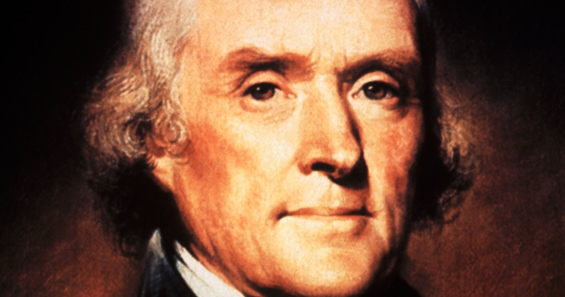
On January 16, 1786, Virginia enacted the Statute for Religious Freedom authored by Thomas Jefferson.
We have long relied upon journalists in major media to cover actual news. And investigate leads to juicy stories of major import to clear up confusion.
But the mainstream media has become mainly propagandistic: “journalists” today rarely “report,” they propound and pontificate. And help spread disinformation for major political factions.
Is it really that bad?
Well, one way to test how bad is to track juicy news leads that get left unexplored.
In June I commented on Harvard’s Dr. Charles Lieber, arrested and charged with not reporting his activities with the Chinese at the Wuhan labs — which have been associated with SARS-CoV-2. In October, Lieber sued Harvard for not backing him up in his legal troubles with the U.S. Government.
There could be a huge story here. Or maybe a mere bureaucratic snafu.
But it is not “in” the news; I cannot find any decent reporting on it.
From the beginning, the idea that the virus could have been grown in a lab “to help discover new vaccines” (or even as a cultivated bioweapon) has been a real possibility.
A year after its public acknowledgment, there is still disagreement.
While we expect reporters to dig deep, instead we see a plethora of premature declarations — as at egregious “fact-checking” sites — that the matter is settled. “Leading researchers have debunked this notion,” as Snopes confidently stated in February. But since then, the origins of the pandemic have remained murky. And allegations of bioweaponry keep re-appearing.
The World Health Organization is on the ground in Wuhan now, investigating.
Belatedly.
Long past time for American reporters to get on the beat.
This is Common Sense. I’m Paul Jacob.
See all recent commentary
(simplified and organized)
See recent popular posts
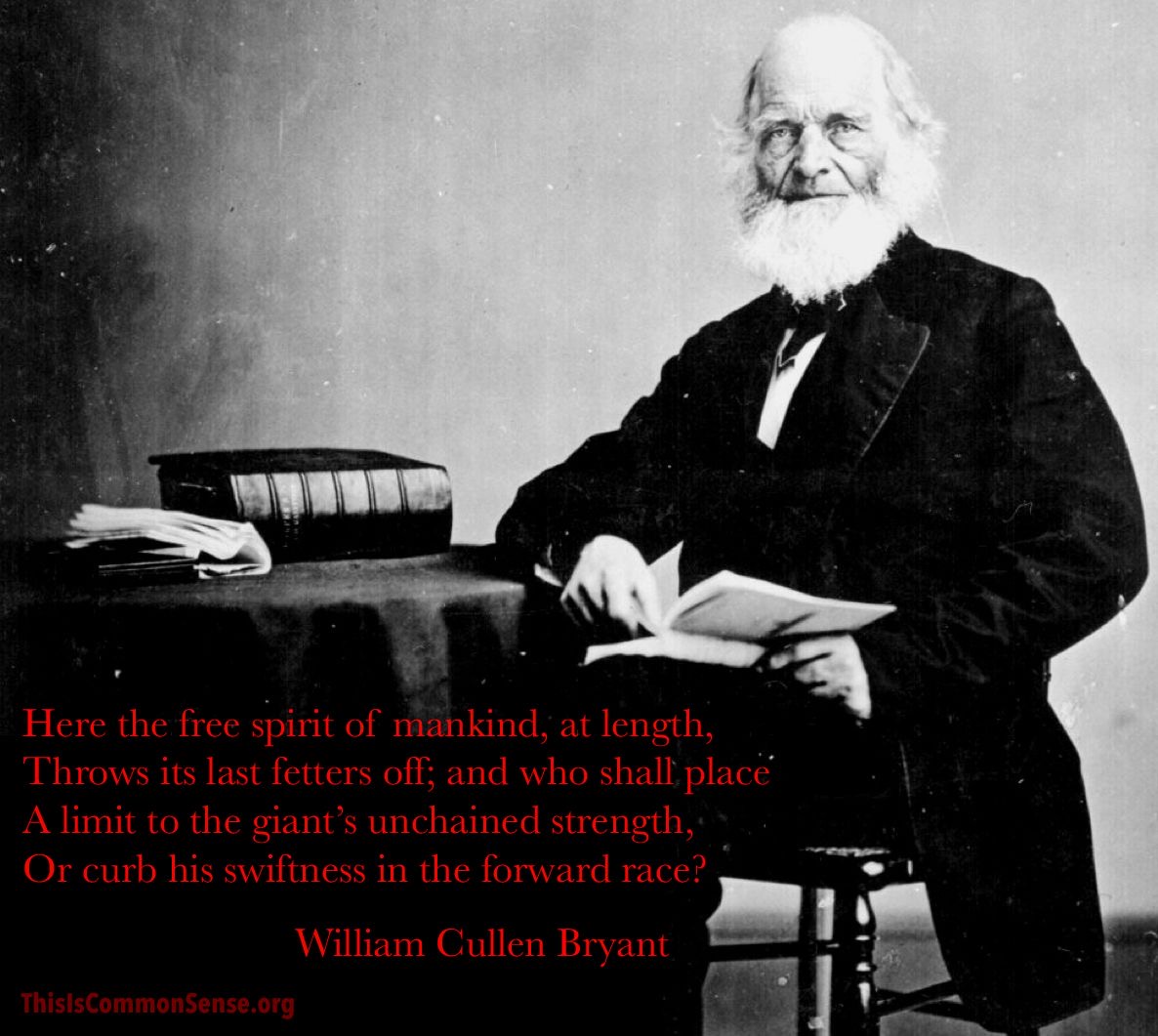
Here the free spirit of mankind, at length,
William Cullen Bryant, The Ages, XXXIII.
Throws its last fetters off; and who shall place
A limit to the giant’s unchained strength,
Or curb his swiftness in the forward race?
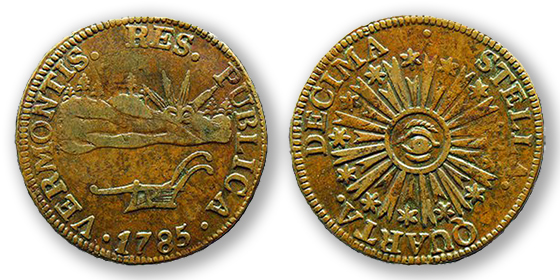
On January 15, 1777, New Connecticut declared independence from the crown of Great Britain and the colony of New York.
Delegates first named the independent state New Connecticut and, in June 1777, finally settled on the name Vermaont, an imperfect translation of the French for Green Mountain.
This new “Vermont Republic” minted copper coins (see above), first struck in 1785. The people of Vermont took part in the American Revolution although the Continental Congress did not recognize the jurisdiction, because of vehement objections from New York, which had conflicting property claims.
In 1791, Vermont was admitted to the United States as the 14th state, upon which its minting of coins ceased.
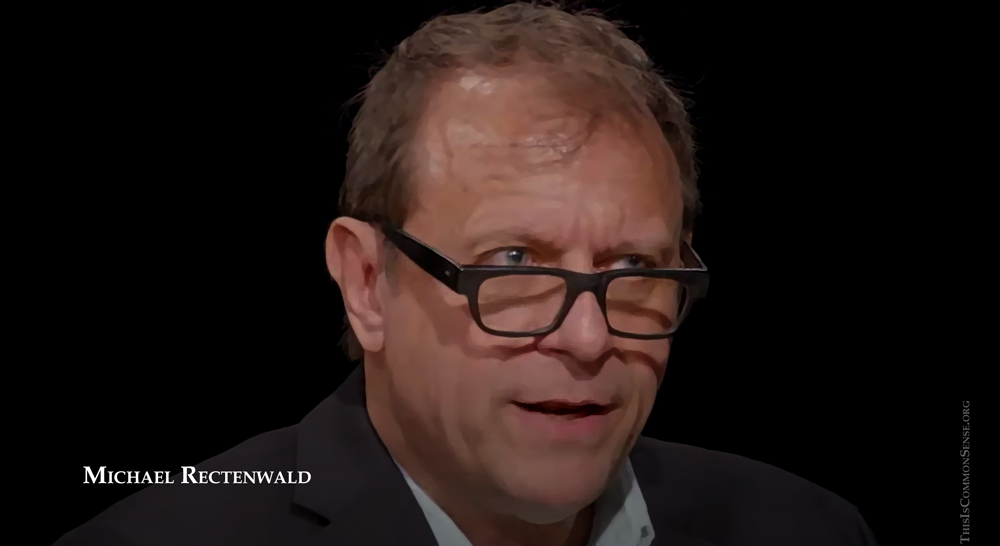
“Do not close your Facebook or Twitter accounts,” wrote Michael Rectenwald a few days ago.
But I already closed my Twitter!
“Do not give up the geography you have and the connections you’ve made within those spaces. Instead, subvert from within.”
Still, I never liked Twitter. It seems a poisonous atmosphere of too much snark, virtue signaling, mobbing, and worse.
“As of now, there are no alternatives. Parler will be shut down by Amazon within hours. It will also be shut out of Apple and Android vis-a-vis Apple Store and Google Play.”
I hopped on Parler, when it got attacked. With the outages, etc., it is impossible to use.
“Gab is a digital silo or ghetto that contains and isolates deviationism.”
And former leftist professor Rectenwald — author of the books Springtime for Snowflakes, The Google Archipelago, and Beyond Woke, as well as a novel, Thought Criminal — means “deviationism” in an entirely good way.
“MeWe has already succumbed to the oligarchical censors,” he informs.
“Instead, keep the beach heads that we have and spread out. Don’t give up the connections. We must retain the network of thought deviationism . . . . Read this article and you’ll understand why it’s not as simple as you think,” linking to a Daniel Greenfield essay on Frontpage, “Parler and the Problem of Escaping Internet Censorship” (January 8, 2021).
The problem is oligopoly, argues Greenfield, since five big corporations “control the mobile ecosystem and can shut down an app like Parler anytime they please. . . . an increasingly small interconnected network of companies . . . can act in concert to suppress anyone or anything they don’t like.”
And what role does the federal government play? It applies pressure by threats at the top end (Nancy Pelosi, et al.) and who-knows-what at the Deep End (the CIA and other intel agencies, which have working arrangements with all major tech companies, including Apple).
All the more reason for you to (ahem) SUBSCRIBE for email service on ThisIsCommonSense.org, if you haven’t already. Email is harder to control.
And we have a lot of work to do, to fight back.
This is Common Sense. I’m Paul Jacob.
See all recent commentary
(simplified and organized)
See recent popular posts
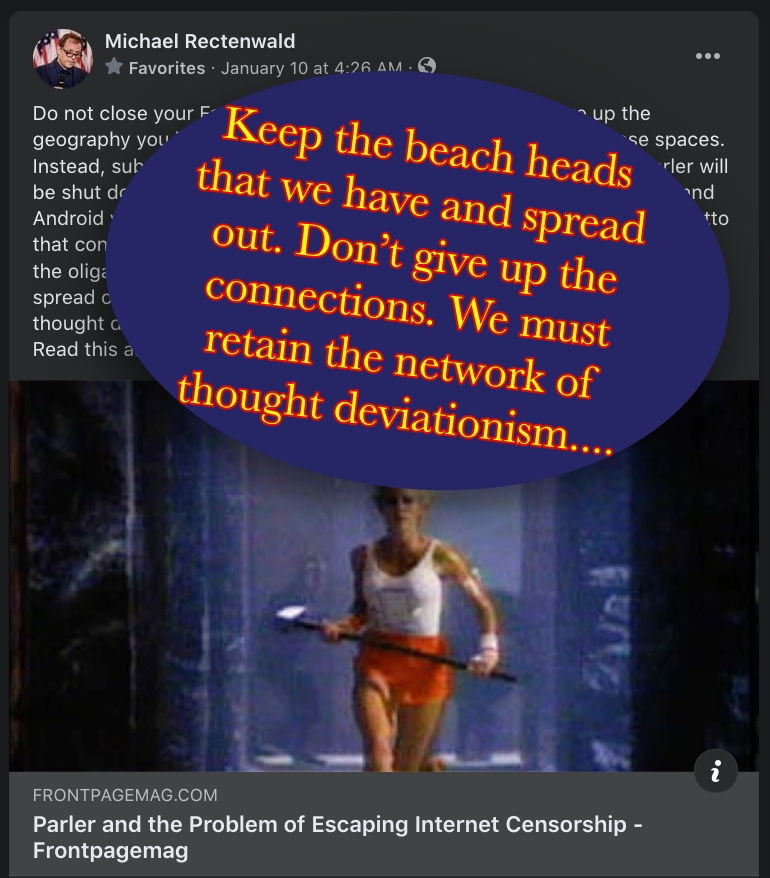
[K]eep the beach heads that we have and spread out. Don’t give up the connections. We must retain the network of thought deviationism. . . .
Michael Rectenwald, author of Beyond Woke and the novel Thought Criminal, on Facebook, January 10, 4:26 AM. See also “Our Info War.”
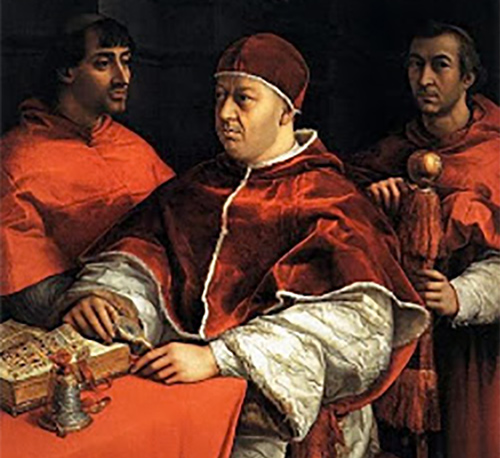
On January 14, 1514, Pope Leo X issued a papal bull against slavery.
On the same date in 1639, the first written constitution to create a government, the “Fundamental Orders,” was adopted in Connecticut.
The U.S. President, along with his most influential followers, has been banned from Twitter and from other social media while also facing yet another impeachment effort.
So who cares whether some silly realtor group imposes an anti-“hate speech” code on members?
Us.
We had better care.
Why?
Bureaucrats and politicians don’t act alone.
They are empowered by individuals who consent to, cheer for, do whatever they can to promote and enable repression. And by all the private organizations and institutions who do the same kind of enabling of repression.
The “hate speech” ban just imposed by the National Association of Realtors on its members to govern their conduct 24/7 (a “blacklisting,” says Reason’s Eugene Volokh) could impose fines up to $15,000 for violations. (I assume NAR would be unable to collect from members who don’t stick around to pay.)
The goal is to make at least the most submissive members struggle never to say anything that could offend some anti-speech client.
If you are a realtor with NAR: quit. Don’t cooperate. Don’t fund and don’t sanction these aspiring tyrants. You can find client leads another way. Join a competing organization that doesn’t ban speech. Or work with other realtors to form one.
Governments do not tyrannize in a social and cultural vacuum.
Do we want a world in which everyone who values freedom is silent — even “voluntarily” — for fear of “hatefully” offending the infinitely tender sensibilities of those who hate freedom of speech and any fundamental disagreement?
This is Common Sense. I’m Paul Jacob.
See all recent commentary
(simplified and organized)
See recent popular posts
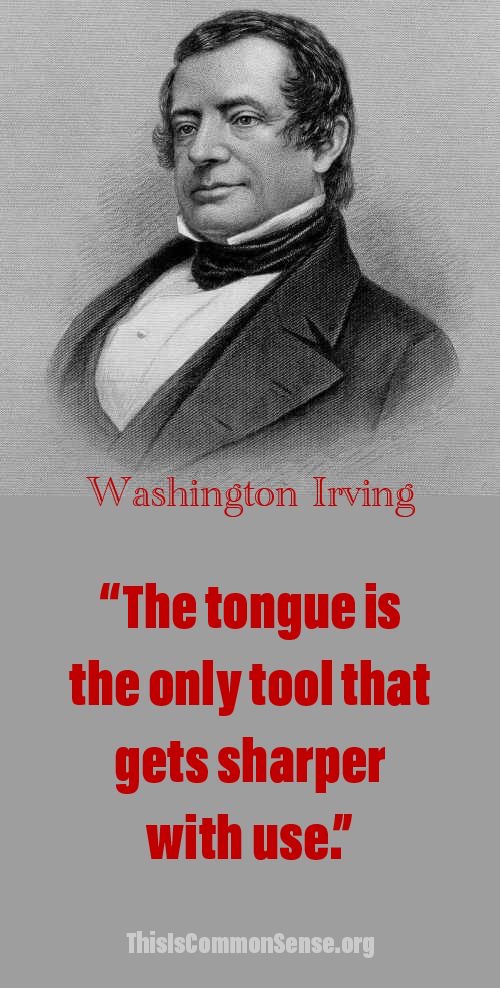
The tongue is the only tool that gets sharper with use.
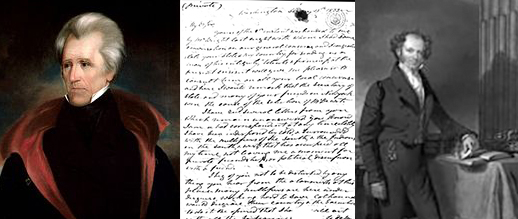
On January 13, 1833, United States President Andrew Jackson (pictured, top left) wrote to Vice President Martin Van Buren (pictured, top right) expressing his opposition to South Carolina’s defiance of federal authority in the Nullification Crisis. Jackson insisted that “the crisis must be now met with firmness” and “the modern doctrine of nullification & succession put down forever.”
South Carolina had blamed protectionist high tariffs for the severity of the economic slump of the time, and Andrew Jackson’s compromise Tariff of 1832 was still too much special-interest “protectionism” for South Carolina, which threatened to nullify the law as unconstitutional. Jackson, a nationalist at heart, had no sympathy for dissidents in the southern states. (The tariffs were designed by northern politicians to encourage the growth of industry. The belief among most economists of that time was that such high “protective” tariffs favored certain businesses at the expense of the general consumer, particularly farmers and agricultural producers.) After the crisis subsided, tariffs were further reduced from the 1832 level, much lower than of 1828’s “Tariff of Abominations,” which had been signed into law by President John Quincy Adams — and written mainly by Martin Van Buren as a way to precipitate the election of Jackson.
Since the somewhat ambiguous end to the Nullification Crisis, the doctrine of state prerogatives — “states’ rights” — has been asserted by opponents of the Fugitive Slave Act of 1850, proponents of California’s Specific Contract Act of 1863 (which nullified the Legal Tender Act of 1862), opponents of Federal acts prohibiting the sale and possession of marijuana in the first decade of the 21st century, and opponents of implementation of laws and regulations pertaining to firearms from the late 1900s up to 2013. State opposition to ObamaCare has also recently conjured up the issue.
On January 13, 1898, Émile Zola’s J’accuse exposed the Dreyfus affair.