Categories
Today

Corn Law

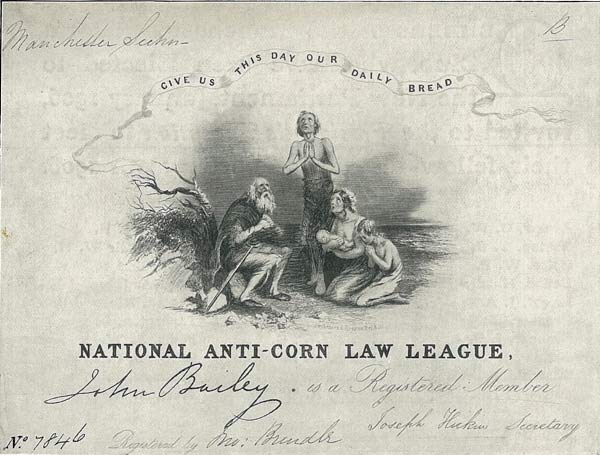
On January 31, 1849, the Corn Laws were abolished in the United Kingdom, one of the most impressive and far-reaching anti-protectionist moves of all time. “Corn” stood for all grains, including wheat, oats, barley, etc.; the free-trade agitation by John Bright and Richard Cobden was one of the main impetuses for the reform.

On Jan. 31, 1865, the United States Congress proposed the Thirteenth Amendment to the U.S. Constitution, submitting it to the states for ratification. The Amendment’s main section reads: “Neither slavery nor involuntary servitude, except as a punishment for crime whereof the party shall have been duly convicted, shall exist within the United States, or any place subject to their jurisdiction.”

On Jan. 31, 1990, the first McDonald’s fast food restaurant opened in the Soviet Union. Having once traveled to Moscow, I’m exceedingly thankful for this.
Categories
Thought

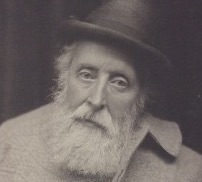
Auberon Herbert

Is the majority morally supreme, or are there moral rights and moral laws, independent of both majority and minority, to which, if the world is to be restful and happy, majority and minority must alike bow?

Categories
audio podcast

Listen: Even Libertarians (but NOT Chinazis)

Paul Jacob appraises the John Brennan and China threats.

Categories
Thought

James Mill

Every man should be considered as having a right to the character which he deserves; that is, to be spoken of according to his actions.

Categories
Today

Non-Violence … and Violent Reaction

On Jan. 30, 1948, Indian leader Mohandas K. Gandhi, known for his non-violent, non-cooperation struggle for freedom and national independence, was assassinated by a Hindu extremist.

On Jan. 30, 1956, Martin Luther King, Jr.’s home was bombed in retaliation for his work on the Montgomery Bus Boycott.

On Jan. 30, 1972, British soldiers killed fourteen unarmed civil rights marchers in Northern Ireland in what came to be known as “Bloody Sunday.” Soldiers shot 26 unarmed protesters and bystanders – 13 males, seven of whom were teenagers, died immediately, while another man died of his injuries nearly five months later. In the immediate aftermath, an investigation by the British Government largely cleared the soldiers and British authorities of blame. A second investigation begun in 1998, released a report in 2010 declaring that all of those shot were unarmed, and that the killings were both “unjustified and unjustifiable.”


Not quite fitting today’s “non-violence elicits violence” theme, on January 30, 1835, Richard Lawrence attempted to shoot former military leader and then-President Andrew Jackson, but failed. He was subdued by a crowd, including several congressmen. That marked the first attempt on the life of a sitting U.S. president.

Categories
ideological culture national politics & policies

Grace the Notes

Harriett Tubman was an American hero, the great Underground Railroad liberator of slaves, worthy of many honors. 

But should she grace the $20 Federal Reserve Note?

This issue was raised during the Obama administration, when movement was made towards swapping the current Gracer of the Note, President Andrew Jackson, for Tubman. But President Trump stalled the swap.

Now, with Biden in office, it’s back!

How should we “feel” about it?

As I explained in 2016, Tubman is my kind of hero. Jackson, on the other hand, was great with his opposition to the Second National Bank, but his horrific removal of the Cherokee left a great stain on his reputation. Much different for Tubman — a criminal in her day, a secular saint in ours. Jackson owned slaves; Tubman freed slaves.

Yet, take a step back:

Is it an honor to be on a Federal Reserve Note?

The American dollar has been in jeopardy for a very long time — at least since President Richard Milhous Nixon closed the Treasury’s gold window, but probably since the forming of the Federal Reserve . . . our plutocratic “Third National Bank.”

Why place someone as excellent as Tubman onto a doomed currency?

The argument to keep Andy Jackson there is stronger than putting Ms. Tubman on it: he opposed central banking, and to festoon his likeness on the second most-used note of our central bank’s denominational line-up is a way of dishonoring him. 

The reason today’s Democrats want to remove their party’s first president from the Twenty is the very reason to keep him on.

But if they must replace, a better candidate might be . . . Dick Nixon.

This is Common Sense. I’m Paul Jacob.


PDF for printing

See all recent commentary
(simplified and organized)
See recent popular posts

Categories
Today

Gallatin

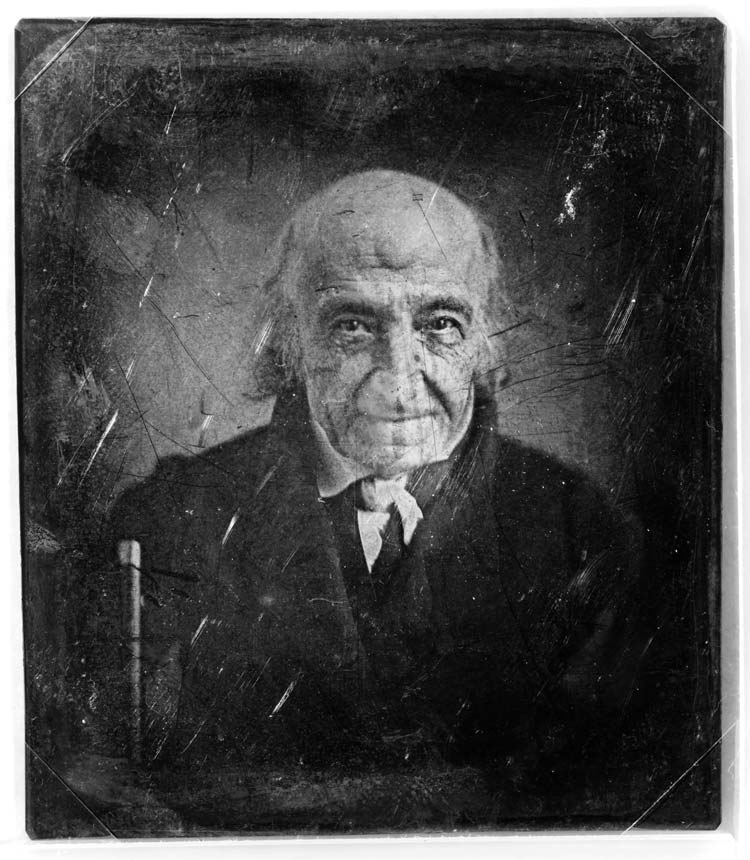
On January 29, 1761, Albert Gallatin was born. Gallatin served as the fourth United States Secretary of the Treasury — a post in which he served longer than any other in American history — advanced the anthropological and linguistic study of native Americans, and became the subject of a biography by Henry Adams. Called the “father of American ethnology,” he has been honored with a 1967 U.S. stamp as well as many place names, including the Gallatin National Forest in Montana.

Categories
Thought

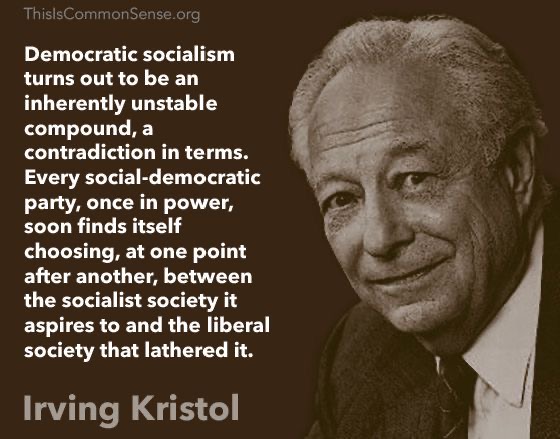
Irving Kristol

Democratic socialism turns out to be an inherently unstable compound, a contradiction in terms. Every social-democratic party, once in power, soon finds itself choosing, at one point after another, between the socialist society it aspires to and the liberal society that lathered it.

Irving Kristol, as quoted in “Capitalism, Socialism, and Democracy: A Symposium,” edited by William Barrett, Commentary (1978).
Categories
general freedom too much government

Diners’ Rebellion

Italy was hit hard by COVID-19, and harder by the lockdowns. 

The lockdown idea — with which we are more than familiar in America — rests upon the notion that the best way to fight a new contagion is to rob it of hosts, and the best way to do that is to enforce anti-social edicts, forbidding normal human interaction thereby (the rationale goes) limiting spread of the disease. 

But Italians are not, say, Scandinavians. While folks up north (and in much of America) tend to maintain a more extensive baseline social distance, by custom enforcing a fairly wide personal space, in Italy folks tend to be much more hands-on, requiring close human contact for everyday happiness. So even had lockdowns worked, they would have been traumatic. But lockdown results have been dubious at best.

So Italians are rebelling.

Specifically, restaurateurs.

And their patrons.

“Thousands of restaurants have opened in Italy in defiance of the country’s strict Chinese coronavirus lockdown regulations,” we read at Breitbart. “The mass civil disobedience campaign —  launched under the hashtag #IoApro (#IOpen) — has seen as many as 50,000 restaurants opening despite evening curfew restrictions.”

My favorite video has diners in Bologna shouting police out of an illegally open restaurant with chants of “Libertà!”

News outfits in America do not appear to be giving much attention to the anti-lockdown movement in Italy — or elsewhere in Europe. It is almost as if the story does not fit The Narrative, which (do I have this right?) has Europeans more accepting of government paternalism, leaving Americans as the more uncooperative, unruly individualists to be controlled by a browbeating press.

But lockdown protests here are nothing like that in Europe.

Makes me a bit sad for America, actually.

This is Common Sense. I’m Paul Jacob.


PDF for printing

See all recent commentary
(simplified and organized)
See recent popular posts

Categories
Today

Deregulated

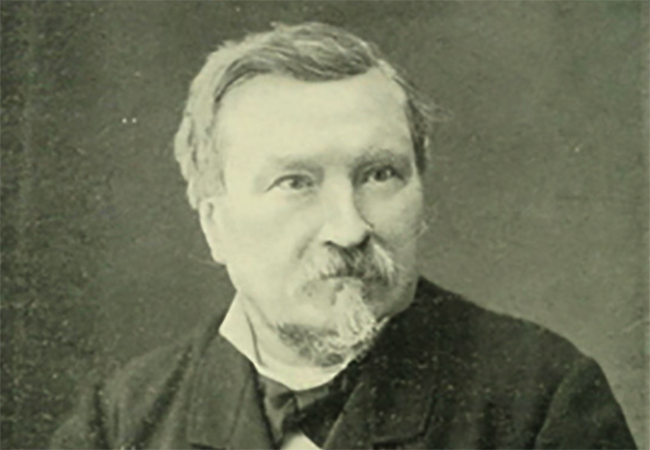
On January 28, 1912, Belgian economist Gustave de Molinari died. Molinari was one of the last major economists of the French Liberal School, heir to Frederic Bastiat, and a prominent advocate of free trade. His last book, The Society of To-morrow (the only one of his many books to be translated into English in his day) envisioned a future of extremely limited government, and argued against the growing tide of socialism and war that was becoming all too apparent as the future of Europe.

Indeed, the old liberal order of Europe ended with the beginning of the Great War, exactly two and one half years after Molinari’s demise.


On Jan. 28, 1981, President Ronald Reagan lifted the federal government’s remaining domestic petroleum price and allocation controls in the United States, helping to end the 1970s energy crisis and begin the 1980s’ oil glut.

The deregulatory move had been begun by Democrats in Congress, particularly Sen. Ted Kennedy, but had been placed on a gradual schedule, and the whole effort clouded with talk of “windfall profits” and a tax on those allegedly unfair returns on investment.