The weekend podcast is up in vlog form at YouTube:
This Week in Common Sense, March 19, 2021.
The weekend podcast is up in vlog form at YouTube:
This Week in Common Sense, March 19, 2021.
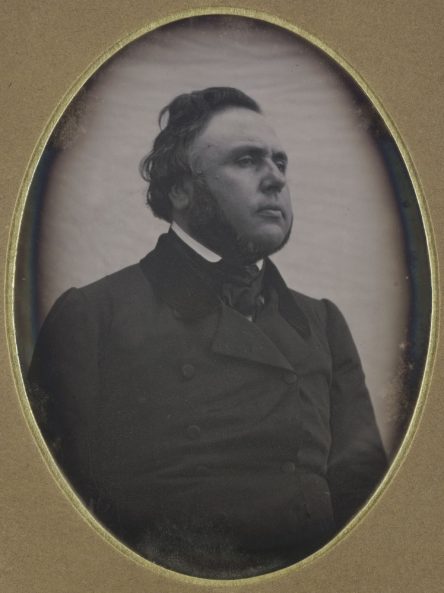
Socialism — that is the State substituting itself for individual liberty and growing to be the most terrible of tyrants.
Alexandre Auguste Ledru-Rollin (September 12, 1848), published as the epigraph to Yves Guyot, The Tyranny of Socialism (1894).
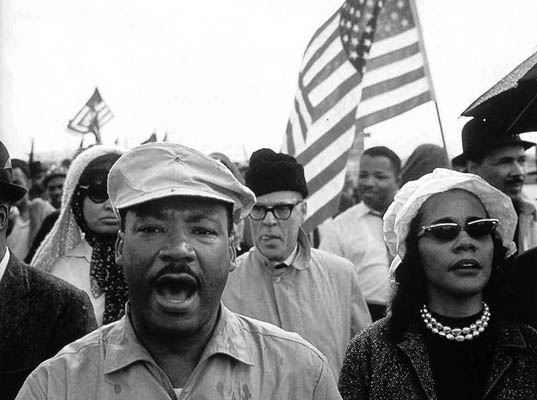
On March 21, 1965, Dr. Martin Luther King, Jr. led 3,200 people on the start of the third and finally successful civil rights march from Selma to Montgomery, Alabama.
Nearly two decades earlier, the Twenty-second Amendment (Amendment XXII) of the United States Constitution, passed Congress. The date was March 21, 1947. The amendment, ratified on February 27, 1951, set a term limit for election and overall time of service to the office of President of the United States. This was an obvious reaction to Franklin Delano Roosevelt’s more than three terms in office.
The first section of the amendment reads as follows:
No person shall be elected to the office of the President more than twice, and no person who has held the office of President, or acted as President, for more than two years of a term to which some other person was elected President shall be elected to the office of the President more than once. But this Article shall not apply to any person holding the office of President, when this Article was proposed by the Congress, and shall not prevent any person who may be holding the office of President, or acting as President, during the term within which this Article becomes operative from holding the office of President or acting as President during the remainder of such term.

Perhaps it is impossible for a person who does no good to do no harm.
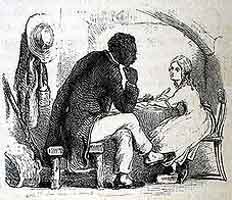
On March 20, 1852, Harriet Beecher Stowe’s anti-slavery novel Uncle Tom’s Cabin was published.
Wikipedia — the free online, once freely editable encyclopedia — started out upholding a principle about “neutrality.”
According to Wikipedia, this means that Wikipedia content “must be written from a neutral point of view (NPOV) . . . representing fairly, proportionately, and, as far as possible, without editorial bias, all the significant views that have been published by reliable sources on a topic.”
NPOV isn’t the same as objectivity, which is about getting at the truth by honest observation and logic, not primarily by balancing viewpoints about what’s true. But if good objective work by “reliable sources” has been done about a subject, Wikipedia’s neutrality standard requires that both the sludge and the good work be included.
Somebody new to the subject has a fighting chance to be steered in the right direction.
NPOV still guides many Wikipedia articles where it is not really necessary, articles about elms and carburetors. The standard is now often ignored, however, in articles about controversial subjects. Like politics. Or socialism.
As I write, Wikipedia’s article on socialism mentions the kill list of “suspected high-ranking Communists” drawn up by Indonesia’s Suharto but not the many millions slaughtered under the commie-socialist regimes of the Soviet Union, China, Cuba, et al. Critiques of socialism are barely touched on. No NPOV here.
Such agitprop is guarded by non-neutral left-wing Wikipedia editors. Britannica is one alternative. Conservapedia was launched in 2006 as “a conservative, family-friendly Wiki encyclopedia,” and appears to be going strong. Wikipedia co-founder Larry Sanger, harshly critical of Wikipedia’s centralized propagandistic turn, is developing an alternative called Encylosphere.
It’s even mentioned in Wikipedia.
This is Common Sense. I’m Paul Jacob.
See all recent commentary
(simplified and organized)
See recent popular posts
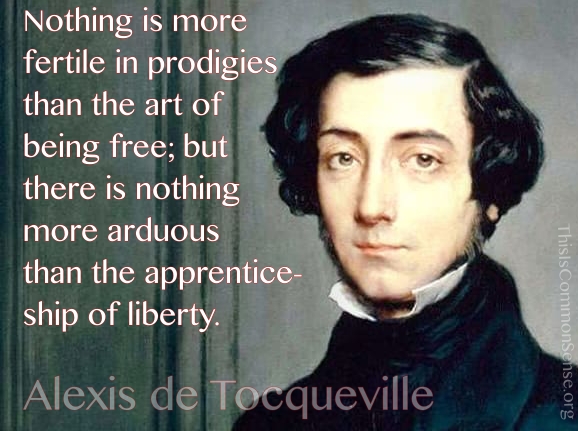
It cannot be repeated too often that nothing is more fertile in prodigies than the art of being free; but there is nothing more arduous than the apprenticeship of liberty. It is not so with despotism: despotism often promises to make amends for a thousand previous ills; it supports the right, it protects the oppressed, and it maintains public order. The nation is lulled by the temporary prosperity that it produces, until it is roused to a sense of its misery. Liberty, on the contrary, is generally established with difficulty in the midst of storms; it is perfected by civil discord; and its benefits cannot be appreciated until it is already old.
Alexis de Tocqueville, Democracy in America, Volume 1.
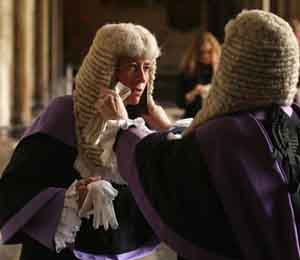
On March 19, 1649, England’s House of Commons passed an act abolishing the House of Lords, declaring it “useless and dangerous to the people of England.”
This was during Oliver Cromwell’s rule as Lord Protector, after the execution of Charles I. The House of Lords did not again meet until the Convention Parliament of 1660, under the Restoration of the monarchy.

Just seven years ago today — March 18, 2014 — Taiwanese students began a 23-day occupation of the country’s legislature, in what became known as the Sunflower Student Movement. They were protesting the rushed and opaque passage of a Cross-Strait Service Trade Agreement with China.
Trade deals usually aren’t so explosive, but China is a neighbor 58 times larger than Taiwan’s 24-million population and one that regularly threatens military invasion. Furthermore, the agreement was negotiated in secret and initially passed by the Legislative Yuan in 30 seconds.
Obviously without debate.
Opponents of the deal argued it would allow China to effectively “purchase” Taiwan, and to economically leverage and then strangle Taiwan’s vibrant democracy, which like Hong Kong’s aspirations constitutes a terrible affront to the anti-democratic Chinese Communist Party (CCP) ruling over more than a billion silenced, disenfranchised Chinese.
The students’ concerns for transparency and safeguards connected with the Taiwanese public, which put enormous pressure on the government.
Ultimately, the spring Sunflower Movement in Taiwan helped influence the autumn Umbrella Movement protests in Hong Kong as well as energizing the 2016 win for Taiwan’s Democratic Progressive Party and far less Beijing-friendly President Tsai Ing-wen (who won a second term last year).
In these last seven years, the world has come a long way in recognizing the threat posed by totalitarian China. For that I give those students in Taipei a lot of credit. Their standing up kept Taiwan free — and helped us all begin to stand up to the Chinazis (as Hong Kongers call the CCP).
The other aftermath? Le Monde’s report on students finally leaving the Yuan, noted it was “not without having thoroughly cleaned the building.”
This is Common Sense. I’m Paul Jacob.
See all recent commentary
(simplified and organized)
See recent popular posts