Wise men profit more from fools than fools from wise men; for the wise men shun the mistakes of fools, but fools do not imitate the successes of the wise.
Cato the Elder, as quoted in Plutarch’s Life of Cato.
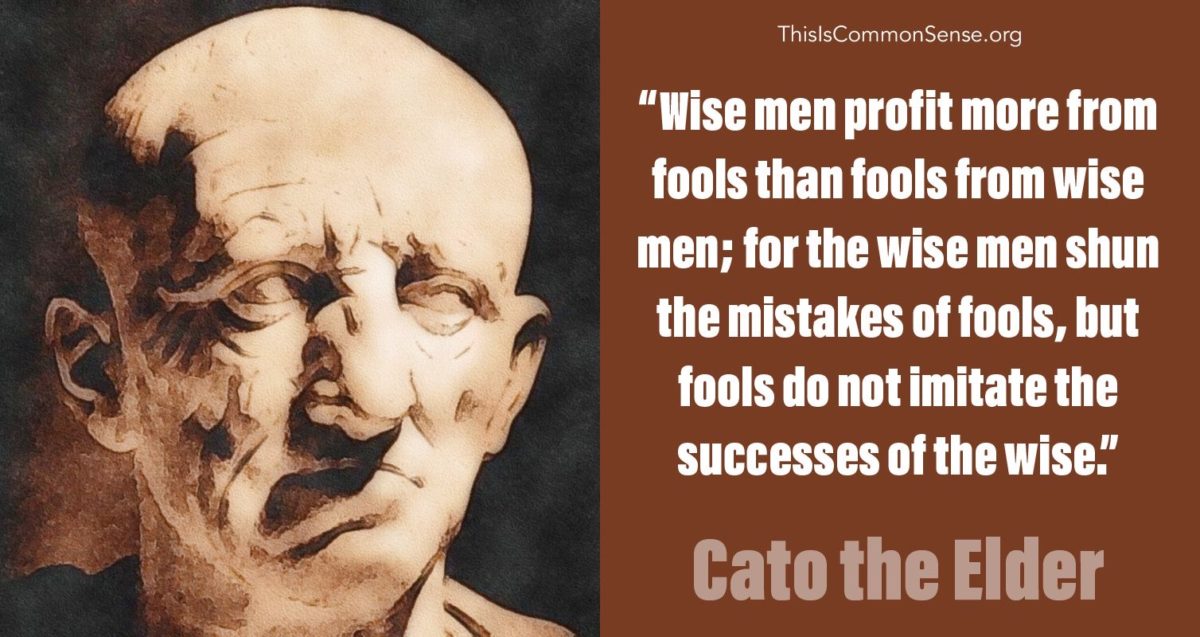
Wise men profit more from fools than fools from wise men; for the wise men shun the mistakes of fools, but fools do not imitate the successes of the wise.
Cato the Elder, as quoted in Plutarch’s Life of Cato.

On April Fools’ Day, 1957, the BBC offered for viewers of the current affairs program “Panorama” the infamous spaghetti harvest report hoax.
By sheer coincidence, one definition of “noodle” is “fool.”

“Given China’s coverup of the outbreak in Wuhan, the WHO’s early praise for the country’s response and the fact that it took a full year to get a joint Chinese-international team on the ground for a brief visit,” explained The Washington Post, “the critical but challenging search for clues faced skepticism from the start.”
“Skepticism” is a kind reaction to the just-released World Health Organization report on the origin of COVID-19’s transmission to humans.
U.S. Secretary of State Antony Blinken informed CNN that “the government in Beijing apparently helped to write it.” Though “foreign scientists on the trip took pains to praise their Chinese counterparts,” The Post noted, “They also acknowledged the limits of working with data collected before they arrived that may or may not be complete.”
Reuters reported yesterday that “Data was withheld from World Health Organization investigators who travelled to China to research the origins of the coronavirus epidemic,” according to a statement from none other than WHO Director-General Tedros Adhanom Ghebreyesus.
Yet, even acknowledging that the WHO report is based on highly questionable and woefully incomplete data, our major media continue to amplify the message that it is “extremely unlikely” the virus passed to humans through a Wuhan lab.
So suggested a BBC story when international scientists went to China last month: “after visiting the Wuhan Institute of Virology, they have closed the lid on a controversial theory.”
Why controversial? It would place further blame on China.
The possibility of a lab accident was raised a year ago, including here, but the media has seemed incurious. Now, with the newly released report, the unlikeliness of a lab breach is again a theme.
But there has been no real investigation.
The Post points out that the scientists who visited “got a tour of the facility, heard about the lab’s rigorous safety protocols and were told the lab was not working with viruses close to SARS-CoV-2.”
Meanwhile, two new tidbits have emerged: (a) “One member of the team said in a post-trip television interview that researchers at the [Wuhan Institute for Virology] lab were sick in the fall of 2019,” and (b) the final WHO report disclosed that a different lab, the Wuhan Center for Disease Control, moved on Dec. 2, 2019.
“I still think the most likely etiology of this pathogen in Wuhan was from a laboratory,” Dr. Robert Redfield, a virologist and former CDC director, said over the weekend, “you know, escaped.”
It’s almost as if COVID-19’s origin is the one thing we’re not supposed to uncover.
This is Common Sense. I’m Paul Jacob.
See all recent commentary
(simplified and organized)
See recent popular posts
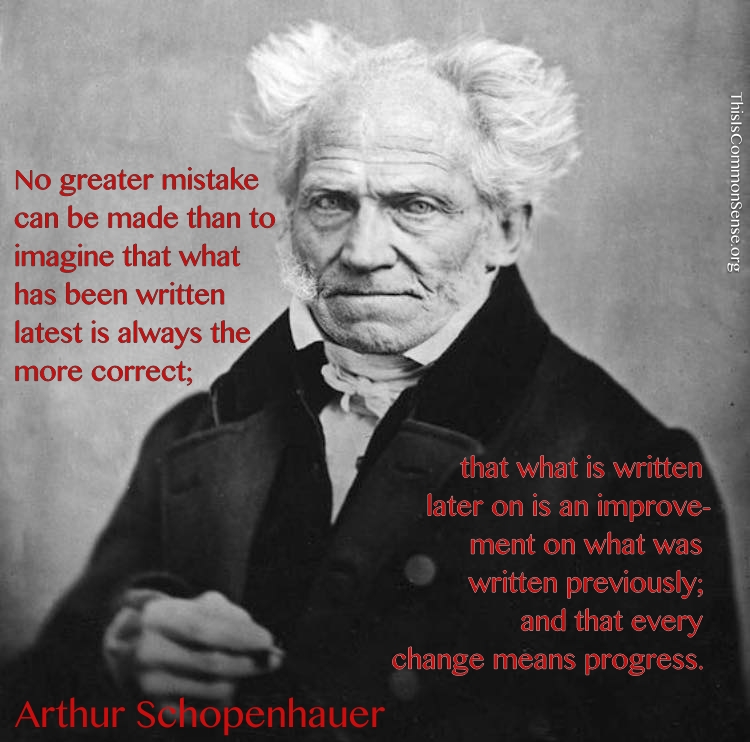
No greater mistake can be made than to imagine that what has been written latest is always the more correct; that what is written later on is an improvement on what was written previously; and that every change means progress.
Arthur Schopenhauer, “On Authorship” in The Essays of Arthur Schopenhauer (T. Bailey Saunders, translator).

On March 31, 1717, a sermon on “The Nature of the Kingdom of Christ,” by Benjamin Hoadly, the Bishop of Bangor, provoked the Bangorian Controversy.
The sermon’s text was John 18:36, “My kingdom is not of this world,” and from that Hoadly deduced — supposedly at the request of King George I himself, who was present in the assembly — that there was no Biblical justification for any church government. Hoadly identified the church with the kingdom of Heaven, noting that Christ had not delegated His authority to any representative.
King George’s preference for the Whig Party, and for latitudinarianism in ecclesiastical policy, is widely thought to have been a strategic maneuver to degrade church power in political government.
On March 30, 1864, German sociologist and economist Franz Oppenheimer was born. This sociologist is most famous for his 1908 book The State, in which he elaborated some consequences of two means for acquiring wealth, the “economic means,” by which he meant private production or by trade, and the “political means,” by which he meant forcible extraction from one group or person by another person or group. Oppenheimer taught in Palestine in the mid-1930s, and fled the Nazis to the United States, via Japan in 1938. In 1941 he became a founder of The American Journal of Economics and Sociology, and died two years later.
Last Thursday, President Biden signaled “that he would be willing to consider supporting the elimination of the filibuster,” CBS News reported following his first news conference, “if Senate Republicans use it to block Democratic legislative priorities from receiving a full vote on the Senate floor.”
“If”? Stopping the majority party from taking its legislation to a floor vote without a 60-vote supermajority to end debate is what the filibuster does.
The president, a Democrat, is saying the filibuster is
You will of course not be shocked to learn that Biden has been a longtime, adamant supporter of the filibuster. In 2005, he gave an impassioned defense, arguing, “At its core, the filibuster is not about stopping a nominee or a bill — it’s about compromise and moderation.”
Biden called the GOP attack then a “fundamental power grab” and said his oration “may be one of the most important speeches for historical purposes that I will have given in the 32 years since I have been in the Senate.”
Yet, the filibuster is not in the Constitution.
It is simply a Senate rule. And the majority party in the Senate can thereby fiddle with it.
I’m not so much wed to the filibuster as I am wed to the idea that the rules with which Washington insiders wield power serve us and not just themselves.
The filibuster should be made official in law or Constitution precisely so politicians cannot change it on whim or passion.
Or it should be ended. But not before one party (or both) actually campaigns to end it, so that the American people can weigh in. Because these must be our rules if it is to be our government.
This is Common Sense. I’m Paul Jacob.
See all recent commentary
(simplified and organized)
See recent popular posts
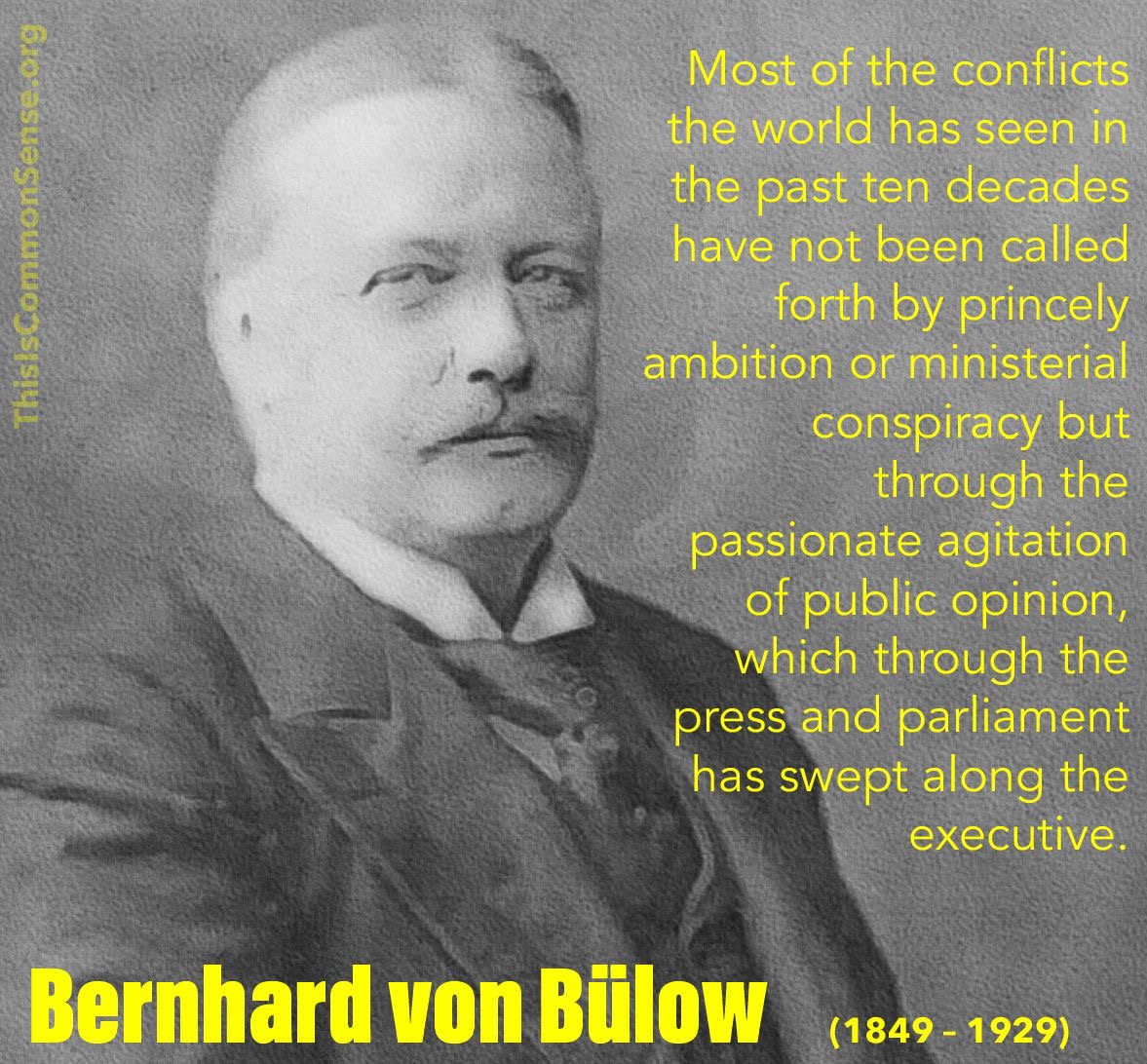
Most of the conflicts the world has seen in the past ten decades have not been called forth by princely ambition or ministerial conspiracy but through the passionate agitation of public opinion, which through the press and parliament has swept along the executive.
Bernhard von Bülow, as quoted in “Karl Kraus, the Press, and War” (International Policy Digest, March 27, 2014), by Franz-Stefan Gady. Von Bülow (1849 – 1929), created Fürst von Bülow in 1905, was a German statesman who served as Secretary of State for Foreign Affairs for three years and then as Chancellor of the German Empire from 1900 to 1909.
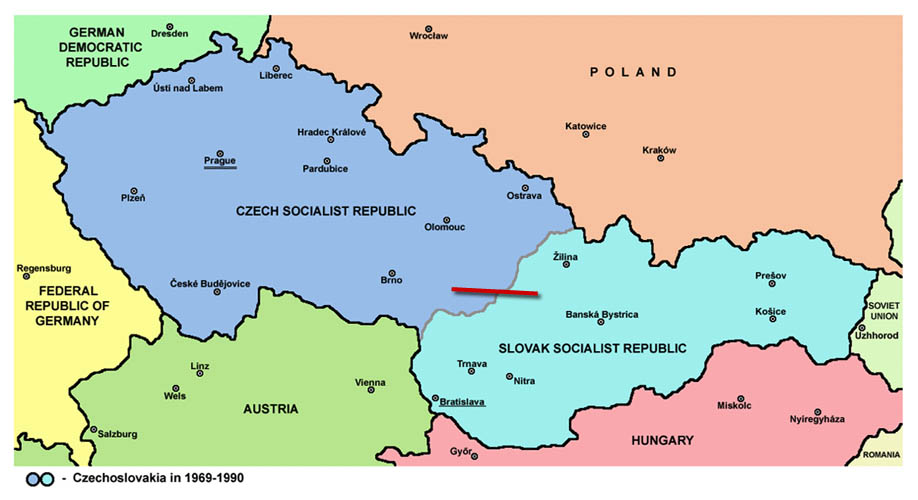
On March 29, 1990, the Czechoslovak parliament proved unable to reach an agreement on what to call the country after the “Velvet Revolution” — in which the Communist Party was booted from sole power. This sparked the “Hyphen War,” a tongue-in-cheek moniker for the dispute between Czechs and Slovaks about official recognition of the two nations’ equal status. (The Slovak representatives wanted to insert a hyphen into the name, to make the Slovak part stand out.) Eventually, the dispute was resolved with the “Velvet Divorce,” in which the two countries split up, on New Year’s Day, 1993.
“Oakland to give low-income residents $500 a month,” reads the headline, “no strings attached.”
Well, actually there may be just a little itty bitty filament attached to what CBS News calls “the latest experiment with a ‘guaranteed income,’ the idea that giving low-income individuals a regular, monthly stipend helps ease the stresses of poverty and results in better health and upward economic mobility.”
Though certainly not universal, “Oakland’s project is significant because it is one of the largest efforts in the U.S. so far, targeting up to 600 families,” notes CBS. It is different in another unique and important way . . . “it is the first program to limit participation strictly to Black, Indigenous and people of color communities.”
You read that right.
But have no fear of excluding poor whites. The network immediately provided, “The reason: White households in Oakland on average make about three times as much annually than black households, according to the Oakland Equity Index.”
Even if accurate, how does this “on average” group statistic justify denying help to someone in poverty who is white?
“It’s also,” CBS News informs, “a nod to the legacy of the Black Panther Party, the political movement that was founded in Oakland in the 1960s.”
You see, the Black Panthers advocated for a basic guaranteed income or universal basic income. And so, since black people in a group with black in the name pushed the idea, it only logically follows that whites should be denied this assistance. Or, uh, hmm, er.
Oakland’s program is different in yet one more way: It is privately funded.
So, what’s the big deal?
Sure, people can privately send money to whomever they want, with whatever racial criteria they design. But, private folks may not create government-run programs that are racist even if they fund every penny of the cost.
This isn’t a pilot program for “guaranteed income” but for a racist America.
This is Common Sense. I’m Paul Jacob.
See all recent commentary
(simplified and organized)
See recent popular posts