Categories
general freedom media and media people

The Other Other

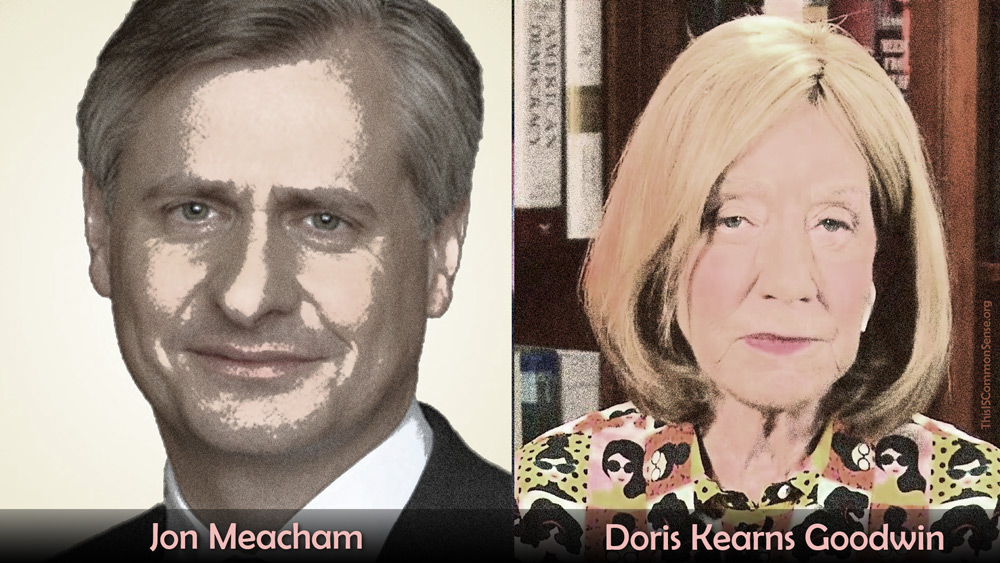
“How would you characterize this moment?” CNN’s Fareed Zakaria asked Pulitzer Prize-winning author and historian (and occasional Biden advisor) Jon Meacham.

“I think you have a dedicated minority of the population — it was the secessionist slave-holding interests in the 1850s,” responded Meacham. “Today, it is this vast swath of people who have found a home in the Republican Party, who are no longer part of a coherent and constructive and good-intentioned conversation about the future of the country.”

Meacham then posited that “a democracy fundamentally depends on our capacity to see each other not as adversaries — or heathen — but as neighbors.”

Wait . . . did the tenured television expert say our whole system relies on not considering those you disagree with politically as “the other,” just mere seconds after comparing a “vast swath” of Republicans to slaveholders and essentially accusing them of being incoherent, destructive, and evil?

While Meacham bemoaned “these” otherwise undefined Republicans, CNN flashed pictures of the January 6th rioters on the screen. Hmmm. Obviously with the best of intentions.

Next, Zakaria sought the input of another Pulitzer Prize-winning author and historian, Doris Kearns Goodwin . . . also a well-known plagiarist. 

“The answer” to seeing folks as this “other,” according to Goodwin? “I believe it’s national service,” she argued. “You get people from the city to the country, country to the city, you begin to create a new generation that has shared values.”

She’s delusional, but serious.*

Notice that her Pulitzer Prize-winning psychopathy would force millions of young (read: less powerful) citizens into government make-work, to be directed and “re-educated” by Washington-based experts . . . like Goodwin (and Meacham).

The other thing? Ironically, the program aired on Independence Day.

This is Common Sense. I’m Paul Jacob.


* Last week, in a New York Times op-ed, Rutgers University President Jonathan Holloway urged “compulsory national service for all young people — with no exceptions.” He contends forcing young people out of their chosen life paths will “build bridges between people” and “shore up our fragile communities.” 

PDF for printing

See all recent commentary
(simplified and organized)
See recent popular posts

Categories
Thought

Aleksandr Solzhenitsyn

A state of war only serves as an excuse for domestic tyranny.

Aleksandr Solzhenitsyn, The Gulag Archipelago 1973

.

Categories
Today

Armenia

The Liberty Bell left Philadelphia by special train on its way to the Panama–Pacific International Exposition, on July 5, 1915 — the last trip outside Philadelphia that the custodians of the bell intend to permit.

In 1937 on this date, Spam, the luncheon meat, was introduced into the market by the Hormel Foods Corporation.

The Twenty-sixth Amendment to the United States Constitution, lowering the voting age from 21 to 18 years, was formally certified by President Richard Nixon on July 5, 1971.

On July 5, 1995, Armenia (flag, above) adopted its constitution, four years after the country’s independence from the Soviet Union.

Categories
by Paul Jacob video

Watch: Who to Trust

Not the Deep State; not the major media; not the State of Idaho; not . . . Tucker Carlson?

Trust Paul Jacob!

This Week in Common Sense, June 28 – July 2, 2021.
Categories
Thought

Gore Vidal

The United States was founded by the brightest people in the country — and we haven’t seen them since.

Gore Vidal, Matters of Fact and Fiction (1978)

Categories
Today

The Fourth

July Fourth events include:

1054 – A supernova was spotted by Chinese, Arab, and possibly Amerindian observers near the star Zeta Tauri, remaining, for several months, bright enough to be seen during the day. Its remnants form the Crab Nebula.

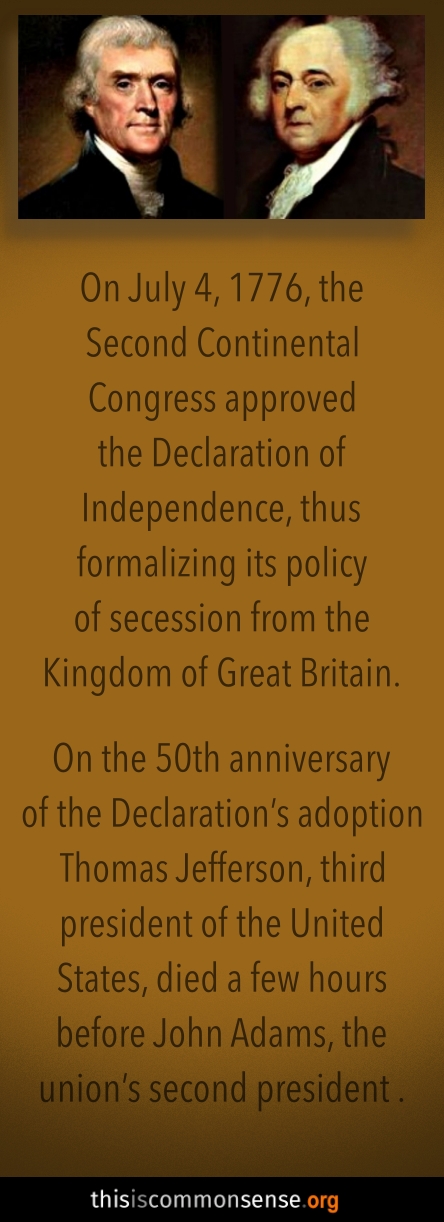
1776 — The Second Continental Congress approved the Declaration of Independence, thus formalizing its policy of secession from the rule of the Kingdom of Great Britain.

1803 — The Louisiana Purchase was announced to the American people.

1804 – Nathaniel Hawthorne, American author of The Scarlet Letter, House of Seven Gables, The Blithesdale Romance, and other classics, was born. Hawthorne became part of the Young America literary movement spawned by Loco-Foco political activism in New England.

1826 – Thomas Jefferson, third president of the United States, died a few hours before John Adams, second president of the United States, on the fiftieth anniversary of the adoption of the United States’ Declaration of Independence.

1826 – Stephen Foster, composer of “Old Black Joe,” “Beautiful Dreamer,” and many other classic American songs, was born.

1827 – Slavery was abolished in New York State.

1831 – Samuel Francis Smith wrote “My Country, ’Tis of Thee” for Boston’s July 4th festivities, set to the tune of Great Britain’s national anthem, “God Save the King/Queen.”

2009 – The Statue of Liberty’s crown re-opened to the public after eight years of closure that resulted from security concerns following the September 11, 2001, attacks.

Categories
audio podcast

Listen: Who You Gonna Trust?

Why, Paul Jacob, of course!

Categories
Today

A Constitution

July 3 marks the 1947 birthday of Dave Barry (pictured), American columnist and author.

Five years later on the same date, Puerto Rico’s Constitution was approved by the Congress of the United States.

Categories
general freedom media and media people

Trust the Spies?

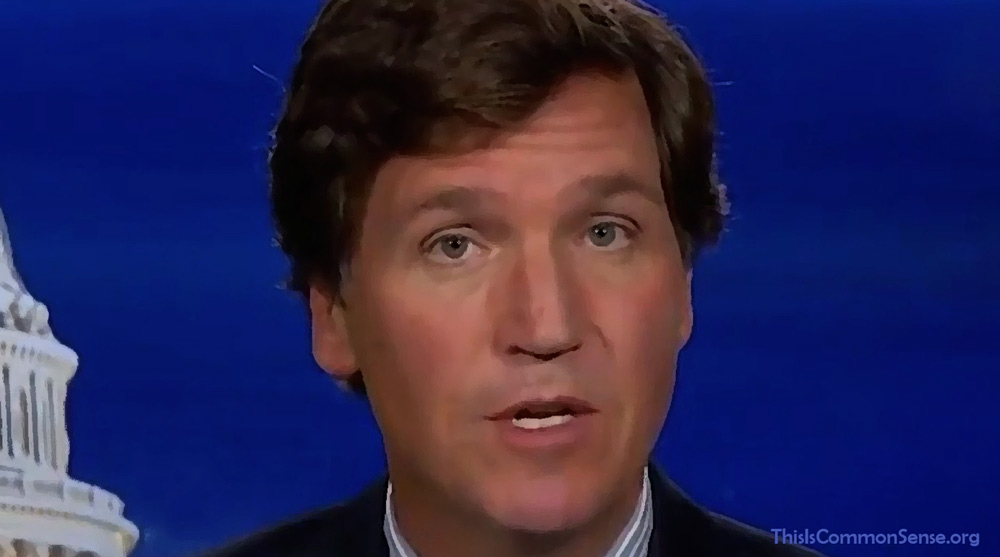
“The Biden administration is spying on us,” Fox News host Tucker Carlson told his Monday night audience. 

“On Sunday, we heard from a whistleblower within the U.S. government, someone with direct knowledge, who warned us the NSA was reading our electronic communications, our emails and texts,” he explained, “and was planning to leak them selectively in an effort to hurt us.”

Quite an explosive allegation.

“[T]he evidence for this claim is lacking,” a Vox story argued, adding that “on Tuesday the NSA took the unusual step of releasing a carefully worded statement denying it.” 

Carlson quickly responded that there was no actual denial in the NSA’s verbiage. Huh? Referring directly to Carlson’s charge, the National Security Agency’s statement read, in part: “This allegation is untrue.”

Awfully clear to me. In fact, so straight-forwardly worded that I wonder if the writer is new to Washington, D.C.

Of course, the problem isn’t really one of language.

The problem? Trust. 

Back in 2013, James Clapper, then-President Barack Obama’s Director of National Intelligence, was asked under oath if the NSA “collected any data at all on million of Americans.” Clapper lied to Congress. He has never been held accountable for making that knowingly false statement.

Carlson showed viewers 2006 footage of then-Senator Joe Biden voicing concerns about NSA spying. “And we’re going to trust the president and the vice-president of the United States that they’re doing the right thing?” inquired Biden. “Don’t count me in on that.”

On Tuesday, Carlson contended “the NSA does routinely spy on Americans. It won’t call it spying — that’s exactly what it is. Millions of Americans. And sometimes it does it for political reasons. And everyone knows this. Everyone.”

But many still deny it.

This is Common Sense. I’m Paul Jacob.


Note: Today’s Thought about lying in the old Soviet Union is relevant to the “everybody knows”/“everybody denies” mentality. Share it far and wide. This wasn’t a feature of America three decades ago, was it?

PDF for printing

See all recent commentary
(simplified and organized)
See recent popular posts

Categories
Thought

Elena Gorokhova

The rules are simple: they lie to us, we know they’re lying, they know we know they’re lying but they keep lying anyway, and we keep pretending to believe them.

Elena Gorokhova, A Mountain of Crumbs (2010), page 181. Several variants of this passage are being circulated widely on the Internet, usually misattributed to Alexandr Solzhenitsyn.