Make yourself known as a philosopher, that is a free man.
Categories
Apollonius of Tyana
Make yourself known as a philosopher, that is a free man.

April 25 is celebrated as Freedom Day in Portugal.

A principal in New York was fired for (how shall we say?) a cavalier attitude towards actual teaching and learning. The point, as he saw it, was merely to pass students through — a scam to get tax money into his budget. He was fired, but given a golden parachute.
Cursèd be his name! (“Khursid” [xʊɾˈʃid] being the excuse for a pun.)
Paul Jacob covers this and other stories from the past week:
If we are going to defend freedom, we have to have to defend ‘two and two equals four.’
David Icke on the Rich in Success podcast.

Paul Jacob discusses the big issues of the week, including the principal whose name is and should be cursed, as well as what has been on the Common Sense politics plate this past week:
You don’t comb the mirror, you comb your own hair and the mirror changes.
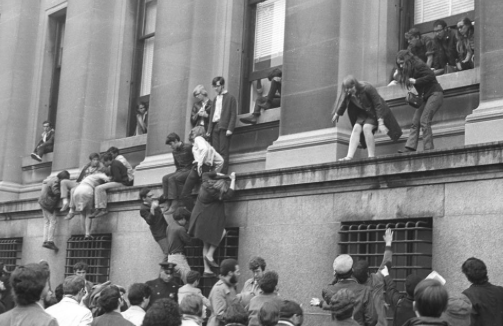
On April 23, 1968, students at New York City’s Columbia University held a demonstration to protest military research and the condemnation of part of the neighboring Morningside Heights section of Harlem to make way for a new student gymnasium. The protest escalated into a week-long occupation of five campus buildings before police moved in. Some 712 students were arrested, and over 100 injured during the forcible eviction. After the university-ordered police response, a student strike shut down the campus for the rest of the semester.
Billions live in Russia, Ukraine, China, Xinjiang, Tibet, Hong Kong, Cuba, New York, Chicago, Seattle, California, Canada, and other statist hellholes. The rest of us live elsewhere. Perhaps we congratulate ourselves on our wise choices of birth location and/or subsequent residencies.
But people are copycats.
As producers, we are often inspired by great achievements and seek to emulate them. The destroyers among us, somewhat similarly, are eager to adopt the latest in fashionable assault on what the producers are doing.
So we don’t necessarily escape if, say, California prohibits physicians from discussing things medical whenever their judgment conflicts with state-approved doctrine. Because next thing you know, lawmakers in Tennessee or Virginia will be saying, “Gee, that’s right, gag the doctors. Why didn’t I think of that?”
Legislative masterminds in California now want to harass doctors who recommend a non-government-approved treatment for COVID-19. If AB 2098 is passed, it would authorize California medical boards to discipline doctors for “dissemination of misinformation” related to COVID-19.
The bill implies that no doctor can legitimately disagree with another about a particular case. (Yeah? See the history of medicine.)
When I say that this legislation assaults truth and truth-seeking — which requires freedom of speech as a necessary corollary of freedom of thought in medicine or in any field — I speak for Californian doctors and California patients.
I speak also for us all.
This is Common Sense. I’m Paul Jacob.
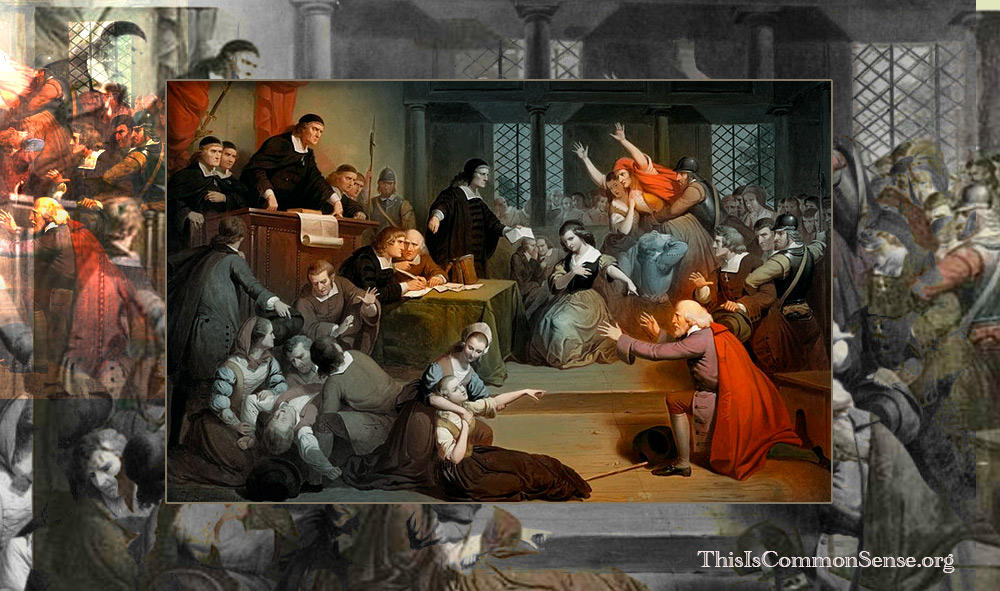
The Witch Trial of George Jacobs by Thompkins. H. Matteson
See all recent commentary
(simplified and organized)
See recent popular posts
[I]f adaptation is everywhere and always going on, then adaptive modifications must be set up by every change of social conditions.
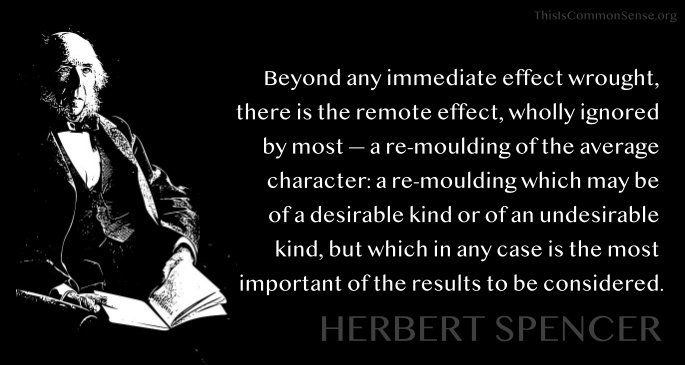
To which there comes the undeniable corollary that every law which serves to alter men’s modes of action — compelling, or restraining, or aiding, in new ways — so affects them as to cause, in course of time, fresh adjustments of their natures. Beyond any immediate effect wrought, there is the remote effect, wholly ignored by most — a re-moulding of the average character: a re-moulding which may be of a desirable kind or of an undesirable kind, but which in any case is the most important of the results to be considered.
Herbert Spencer, “The Sins of Legislators,” in The Man versus the State (1884).
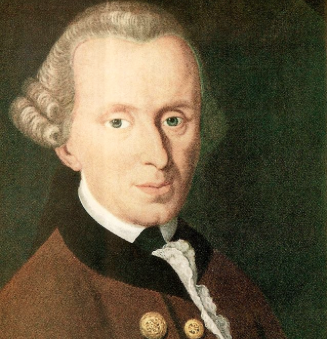
On April 22, 1724, philosopher Immanuel Kant was born.
Aside from being the pre-eminent modern philosopher and originator of transcendental idealism, Kant was also a major figure of Enlightenment thought, a classical liberal, and the originator of the notion of the Categorial Imperative. He was an early and important astronomical theorist in his early career, but produced his greatest works towards the end of his life, including The Critique of Pure Reason and The Groundwork for the Metaphysics of Morals. He was also author of the 1795 essay “Perpetual Peace: A Philosophical Sketch.”
Arthur Schopenhauer is widely known as an admiring and astute critic of Kant’s thought, while philosophical opponents include Friedrich Nietzsche and Ayn Rand. Kant’s approach to ethics continues to excite interest today, with some of the revival a result of the work of John Rawls.
Kant died on February 12, 1804, in Königsberg, Prussia (now Kaliningrad, Russia), where he had lived the bulk of his life.