Categories
Thought

Herbert Spencer

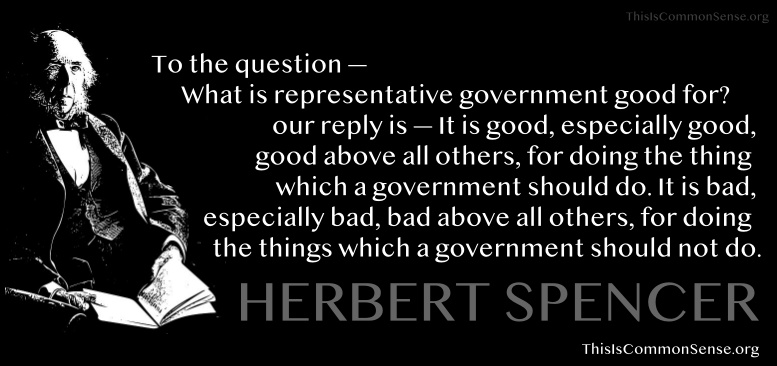
To the question—What is rep­re­sen­ta­tive government good for? our reply is—It is good, especially good, good above all others, for doing the thing which a government should do. It is bad, especially bad, bad above all others, for doing the things which a government should not do.

Herbert Spencer, “Representative Government—What Is It Good For?” in Essays: Scientific, Political & Speculative, Volume III (1891).
Categories
Today

Hawaii

The Hawaiian flag was lowered from ʻIolani Palace in an elaborate annexation ceremony and replaced with the flag of the United States to signify the transfer of sovereignty from the Republic of Hawaii to the United States.

Categories
crime and punishment national politics & policies U.S. Constitution

The Act That Can’t Cut It

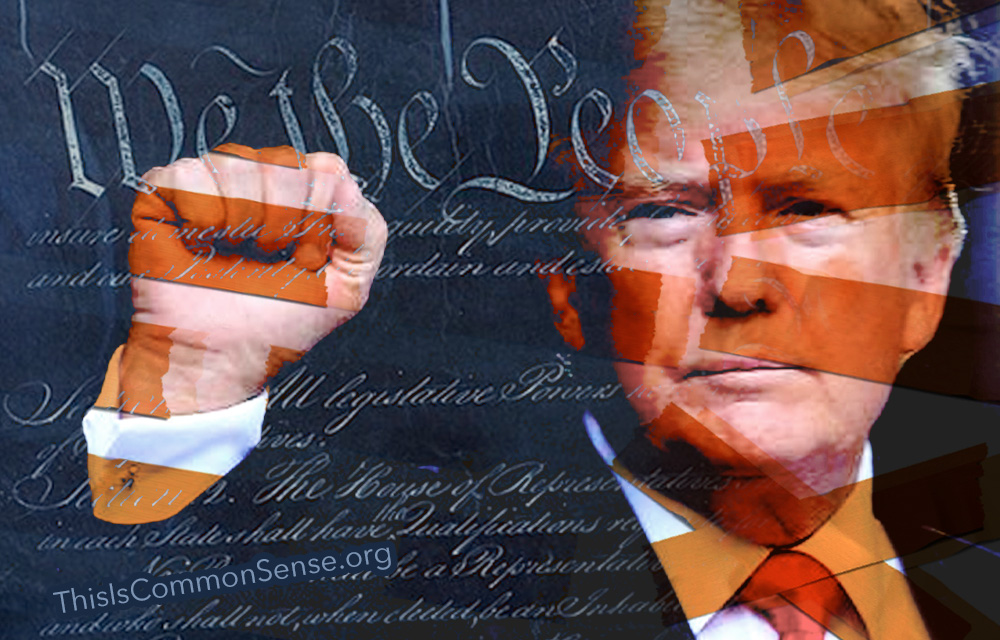
During Donald John Trump’s time at 1600 Pennsylvania Avenue, he expressed his displeasure with some documents by tearing them up.

Which is illegal, as CNN takes pains to make clear. His underlings would then scoop up the shreds of paper and tape them together. 

Keyword: farcical.

This comedy might be funny to watch in a sequel to, say, In the Loop, the 2009 political satire. But it’s not so funny in the current iteration, with the FBI’s raid on Trump’s Mar-a-Lago mansion.

The search for documents “illegally removed from the White House” has seems an obviously political ploy. Since Trump was legally allowed to de-classify documents, his taking of allegedly still-classified docs seem, well, a rather trivial matter.

Keyword: petty.

Right-leaning media and the left-ensconced media talk about all this very differently, of course, and I confess to finding the former a little more convincing than the latter. Focusing on documentation seems like an excuse to find some petty thing to disqualify Trump from running again in 2024.

While Trump not running again might be the best thing for the GOP, and America, that’s not really relevant: Republicans are stuck with the one champion, with few decent alternatives, and Democrats are in worse shape. Which is why they fret about Trump.

Using the Presidential Records Act of 1978 as a disqualifier for a Grover Clevelandesque re-run of a defeated president is on everybody’s lips. But there’s a problem: how could it possibly pass constitutional muster? The Constitution specifies the qualifications for the job. Congress cannot add or subtract to those qualifications by law.

That was the argument used to disqualify term limits in U.S. Term Limits v. Thornton: qualifications for candidates were specified in the Constitution. Neither states nor Congress could change it.

If Democrats seek to breach this principle . . . then let’s look at term limits again.

Keywords: do it.

This is Common Sense. I’m Paul Jacob.


PDF for printing

See all recent commentary
(simplified and organized)
See recent popular posts
Categories
Thought

Marcus Aurelius

Soon you will have forgotten the world, and soon the world will have forgotten you.

Marcus Aurelius Antoninus (121-180 A.D.), Meditations, Book VII.
Categories
Today

Vietnam

On August 11, 1972, the last of American ground combat troops exited South Vietnam.

Categories
crime and punishment general freedom Second Amendment rights

Cannabis and Carry

The Biden Administration wants to make sure that marijuana users do not own guns. 

Florida Commissioner of Agriculture Nikki Fried, a Democrat, is not with the administration on this matter. Her department oversees concealed carry permits as well as some cannabis regulation, and she “argues that prohibiting all cannabis consumers from owning guns violates the Second Amendment” as well as violating “a congressional spending rider, known as the Rohrabacher-Farr Amendment, that bars the Justice Department from interfering with the implementation of state medical marijuana laws,” explains Jacob Sullum for Reason magazine. Fried has sued the federal government to allow Florida to grant concealed carry permits to marijuana users — something the federal government disallows.

The Justice Department has now asked the courts to dismiss the case.

This is especially rich, since President Biden himself has been on the liberal side of marijuana regulation — though certainly not with guns, where he’s on the tyrants’ side.

Among many inconsistencies, current law does not prohibit people addicted to legal psychoactive drugs from owning guns, as Sullum notes, nor make a big deal about alcohol, the abuse of which has a well-understood linkage with violence, while marijuana does not.

One could go through all the inanities, here, but we should not assume government makes sense on these issues. The federal government should generally not be in the business of regulating either gun ownership or drug usage.

States that recognize “constitutional carry” show how Florida could advance beyond the current mess of too much government interference in this realm. 

It wouldn’t be an issue were Florida to get out of the concealed carry permit racket.

This is Common Sense. I’m Paul Jacob.


PDF for printing

See all recent commentary
(simplified and organized)
See recent popular posts

Categories
Thought

Herbert Spencer

Political fetichism will continue so long as men remain without scientific discipline — so long as they recognize only proximate causes, and never think of the remoter and more general causes by which their special agencies are set in motion.

Herbert Spencer, “Political Fetichism” in The Reader (June 10, 1865) and in Essays: Scientific, Political & Speculative, Volume III (1891).
Categories
Today

Independence

On August 10, 1809, Ecuadorians attempted independence from Spain with the Declaration of Independence of Quito, but failed with the execution of all the conspirators a few days less than a year later.

Independence was finally achieved in 1822.

Categories
education and schooling ideological culture

Power Theory

What if CRT were precisely about what its advocates say it is?

“Far-right white people are in a moral panic over Critical Race Theory,” Pennsylvania educators are being taught, “because they fear losing political power.”

Beth Brelje, at The Epoch Times, explains that this is the lesson of a “a webinar presented by Justice Leaders Collaborative, a Michigan-based social justice training organization.” Ms. Brelje quotes Shayla Reese Griffin, the webinar leader, who states that these “far-right white people” are “really just using Critical Race Theory as a kind of an umbrella term for any kind of cultural things that the far-right isn’t interested in.”

This is, of course, disingenuous. Critical Race Theory is not merely an umbrella term. It is a theory of power that tracks oppression (which is a specific variety of power) along rigid class lines, the classes being defined by race.

And it is a movement of the “far left.” 

Which is why CRT’s defenders and obfuscationists identify their opponents as “far right.”

Heaven forbid were moderates and centrists also to object!

It’s a bluffing tactic, this extremist-identification, aiming to make moderates, centrists, and just normal, non-political people ashamed to criticize CRT.

It’s manipulative.

CRT’s way off, since power, broadly defined, is everywhere and omnipresent and omnidirectional — everybody has some power, nobody has all power. Critical race theorists aim to ply victimhood status as leverage against innocents who do not want to harm anyone; too often they pretend that everybody on one side of a racial divide is a victim and everybody on the other side is an oppressor. It’s a repackaging of a too-familiar “guilt trip,” as we used to say in the Sixties.

As for parents in most school districts, they’ve discovered they have little power to lose. But by confronting the people they vote onto school boards, they gain more.

Democracy proves itself as one method of holding the powerful to account.

This is Common Sense. I’m Paul Jacob.


PDF for printing

See all recent commentary
(simplified and organized)
See recent popular posts
Categories
Thought

F. Marion Crawford

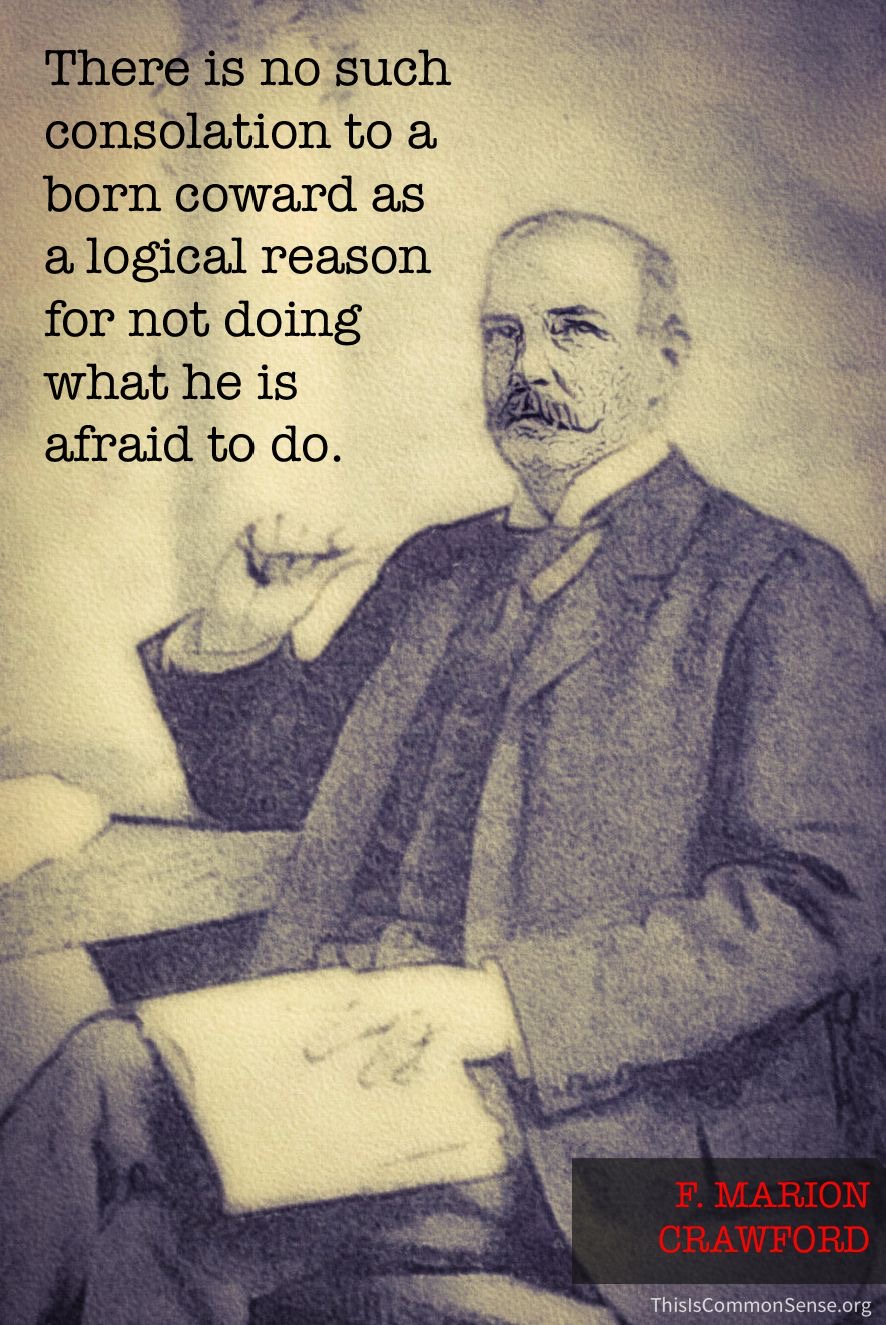
There is no such consolation to a born coward as a logical reason for not doing what he is afraid to do

Francis Marion Crawford, Marietta: Maid of Venice (1901).