Categories
Thought

Michel Chevalier

War, the last argument of kings and people, war, in which they put forth their strength with pride, is not, however, the greatest exhibition of human power. A field of battle may excite terror or a feverish enthusiasm, pity or horror; but human strength applied to create is more imposing, than human strength employed in slaughter and destruction.

Michel Chevalier, Society, manners and politics in the United States; being a series of letters on North America (Boston: Weeks, Jordan and Company, 1839), p. 133-134.
Categories
Today

A Prohibition Overturned

On August 4, 2010, in Perry v. Schwarzenegger, Judge Vaughn Walker overturned California’s Proposition 8, the ballot initiative prohibiting same-sex marriage that had passed two years earlier by the state’s voters.

Categories
free trade & free markets national politics & policies too much government

Slow Murder Is Still Murder

Electricity providers must not beg the government to destroy them more slowly. 

“I’m not saying now’s the time to double down” on fossil fuels, pleads Lanny Nickel, chief operating officer of Southwest Power Pool, which helps provide electricity to 14 states. “I’m just saying now’s the time to slow down on the removal of [those] assets from our footprint.”

The assets Nickel means are oil, gas, coal.

Like others in the business of keeping the lights on, Nickel knows that if and when the percentage of fossil fuels in the utility industry “footprint” is coercively reduced to point oh one percent or whatever, wind and sunshine will not be taking up the slack. 

We’ll suffer, instead, from lots more brownouts and blackouts.

Nickel understands this. 

But begging regulators and politicians to go slower won’t discourage them. They’ll just gloat about how they’re making the utility executives sweat.

We should in fact be doubling down on fossil fuels, because these are the only always-reliable sources of electricity. 

Should solar and other sources of electricity become cheaper and more reliable, people won’t have to be compelled to increasingly turn to them. The transition would happen naturally, in the normal course of progress. 

And the notion that government will be able to fine-tune global weather if only we are forcibly deprived of our means of coping with the ups and downs of the weather is a willful delusion.

Electricity providers must not beg the government to destroy them more slowly, sure. But more importantly, the government should not be destroying them — and us — in the name of the religion of Climate Change at all.

This is Common Sense. I’m Paul Jacob.


PDF for printing

Illustration created with PicFinder.ai

See all recent commentary
(simplified and organized)
See recent popular posts
Categories
Thought

Daniel Defoe

It is better to have a lion at the head of an army of sheep than a sheep at the head of an army of lions.

Daniel Defoe, The Life and Adventures of Christian Davies (1741).
Categories
Today

Set Sail on the Ocean Blue

Seeking a westward route to the Indies, Christopher Columbus on this day in 1492 set sail on his first transatlantic voyage, departing from Palos, Spain, with three small ships — the Niña, Pinta, and Santa María.


On August 3, 2008, Aleksandr Solzhenitsyn died at age 90.

Solzhenitsyn’s novels, such as One Day in the Life of Ivan Denisovich and Cancer Ward, explored life under totalitarian Communism, and remain classics of modern literature. His huge survey of Soviet concentration camps, The Gulag Archipelago, was an important contribution to the demise of Communism as a popular ideology, showing just how horrifying the repression in the Soviet Union had become.

Categories
ideological culture international affairs

Accounting for Taste

“In an open-ended question allowing Americans to name which country they see as the greatest threat to the U.S., 50% name China, almost three times the share who name Russia (17%),” Pew Research reported last week.

Of course, some argue, as does Columbia University professor Jeffrey Sachs, that this “overwrought fear of China and Russia is sold to a Western public through manipulation of the facts.”

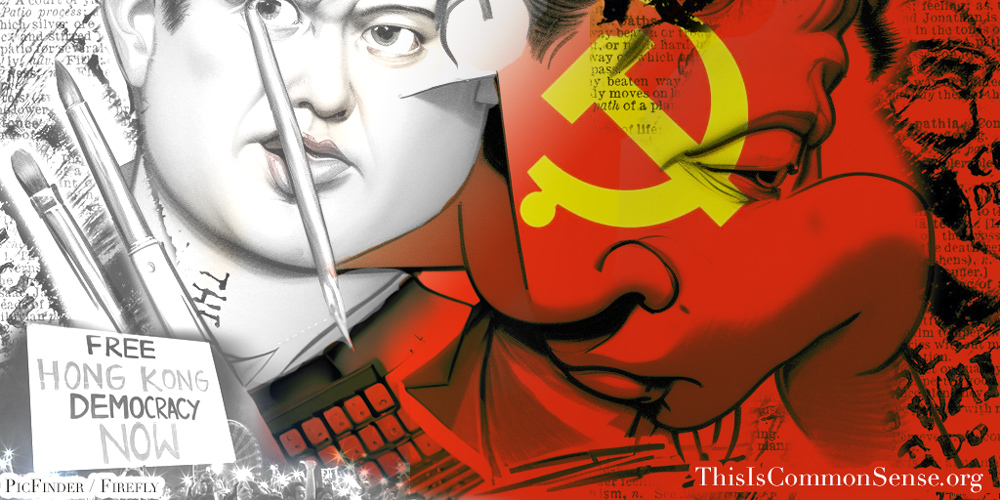
Has our government and media somehow hoodwinked us into not liking Xi Jinping and the Chinese Communist Party? I sorta think we finally convinced them to start paying attention to the Chinazi threat — but whatever.

In perusing the polling at Pew’s website, I came across a recent survey of Asian Americans entitled, “Most Asian Americans View Their Ancestral Homelands Favorably, Except Chinese Americans.”

Strange that China would be the only unpopular outlier . . . unless you know modern Chinese history.

Still, these Asian Americans who responded to the poll might also have fallen victim to “Western propaganda.” What do people outside of the U.S. think?

“The nonpartisan Pew Research Center found that a median of 67% of those surveyed [in 24 countries] have an unfavorable opinion of China, while only 28% have a favorable view of the country. At least 50% of respondents in 17 countries gave China negative marks,” U.S. News & World Report detailed about the international poll, “with shares eclipsing 80% in Australia, Japan, Sweden and the United States. Majorities in only three countries — Kenya, Mexico and Nigeria — gave the country positive ratings.”

Apparently, genocidal totalitarianism isn’t very popular on this planet

This is Common Sense. I’m Paul Jacob.


PDF for printing

Illustration created with PicFinder.ai

See all recent commentary
(simplified and organized)
See recent popular posts
Categories
Thought

Frédéric Bastiat

By virtue of exchange, one man’s prosperity is beneficial to all others.

Frédéric Bastiat, Economic Harmonies (1850).
Categories
Today

Declaration signed!

The Declaration of Independence was signed by members of the Continental Congress of the United States, on August 2, 1776.

Categories
First Amendment rights ideological culture too much government

The Way We Censor Now

In China, the government now sells software to social media companies so they have the best real-time idea of what the government currently does not want people to say. 

The companies then perform such obliging actions as removing posts and banning users.

The software serves as a self-defense system — of the social media companies. You see, if the companies fail to sufficiently prevent government-outlawed speech on their websites, they will be punished. Maybe ruinously. By the Chinese government.

So who is doing the censoring here? 

Obviously, the government.

In the U.S., the intimidatory relationship between government and social media firms is not quite so advanced or nearly so clear. But as we keep learning from documents extracted by litigation and subpoenas, for years now our federal government has been telling firms to censor things, and the firms have complied.

The latest example is that Facebook, which has always said that its content-moderation policies are “independent,” obeyed White House demands to censor posts about the likelihood that the COVID-19 virus originated in a Chinese lab, not in nature.

In a July 2021 email, Nick Clegg, a Facebook executive, asked whether anyone could “remind me why we were removing — rather than demoting/labeling — claims that Covid is man-made.”

To which a VP in charge of content policy replied: “We were under pressure from the [Biden] administration and others to do more. We shouldn’t have done it.”

No matter how White House press secretaries or others try to dress it up, “private” censorship conducted in obedience to governmental requests is governmental censorship.

And is eerily close to the Chinese practice.

This is Common Sense. I’m Paul Jacob.


PDF for printing

Illustration created with PicFinder.ai and DALL-E2

See all recent commentary
(simplified and organized)
See recent popular posts
Categories
Thought

Franz Brentano

What is at first small is often extremely large in the end. And so it happens that whoever deviates only a little from truth in the beginning is led farther and farther afield in the sequel, and to errors which are a thousand times as large.

Franz Brentano, On the Several Senses of Being in Aristotle (1862).