On May 12, 1943, Axis forces in North Africa surrendered.
Categories
Axis in Africa

On May 12, 1943, Axis forces in North Africa surrendered.
The problem of the Left Pole is, who’s not a Nazi who’s not leftist? This is a consequence of the game leftists play, calling everyone not leftist the very worst names they can think of.
The latest casualty is Javier Milei, libertarian president of Argentina. He’s been called a fascist.
Benjamin Williams clears this up in “No, Milei Is Not a Fascist,” over at Mises Wire.
The dictator Benito Mussolini and his close comrade Giovanni Gentile were indisputably fascists. They invented fascism, wrote fascist literature, and called themselves fascists. So it stands to reason that if you want to see if Javier Milei is a fascist, you’d compare him to these fascists. The critics never make these sorts of comparisons because they’re aware it would expose their ridiculous accusations for what they are: ahistorical and ignorant.
Mussolini viewed the state as almost something to be worshipped, with his works riddled with references to its greatness and importance. He summarized his view with the mantra, “Everything within the state, nothing outside the state, nothing against the state.” In stark contrast, Milei’s speeches, debates, and rants are filled with insults and criticisms directed at the state. One of his most famous quotes, “wipe my ass with the state,” encapsulates this disdain. Milei does not hold the state on a pedestal like Mussolini did.
Mussolini believed that capitalism was deeply flawed and needed to be abolished. In “The Political and Social Doctrine of Fascism,” he states that the state was “the force which alone can provide a solution to the dramatic contradictions of capitalism” and that fascism would replace capitalism with “a system of syndicalism.” On the other hand, Milei holds a contrasting view. He frequently praises capitalism as morally and economically superior. In his World Economic Forum speech—dubbed a ‘fascist rant’ by socialists—he declared that people should resist the state, asserting, “The state is not the solution. The state is the problem itself.”
Milei’s policies are certainly not fascist either. Mussolini’s dictatorship supported the socialization of industry, not privatization. His dictatorship mandated union membership, harshly regulated industries, and socialized over eighty firms.
Leftists need to see the world as it is, not as they think it should be — sequestered, as their minds are, at the Left Pole, from which all roads out are “far right.” Ideological geography is more complex than that.

Let us dare to read, think, speak, and write. . . . [L]et every sluice of knowledge be opened and set a-flowing.
John Adams, A Dissertation on the Canon and Feudal Law (1765).

On May 11, 1858, Minnesota was admitted as the 32nd U.S. State.
Nine years later, to the day, the Grand Duchy of Luxembourg’s independence and neutrality were affirmed in the Second Treaty of London.
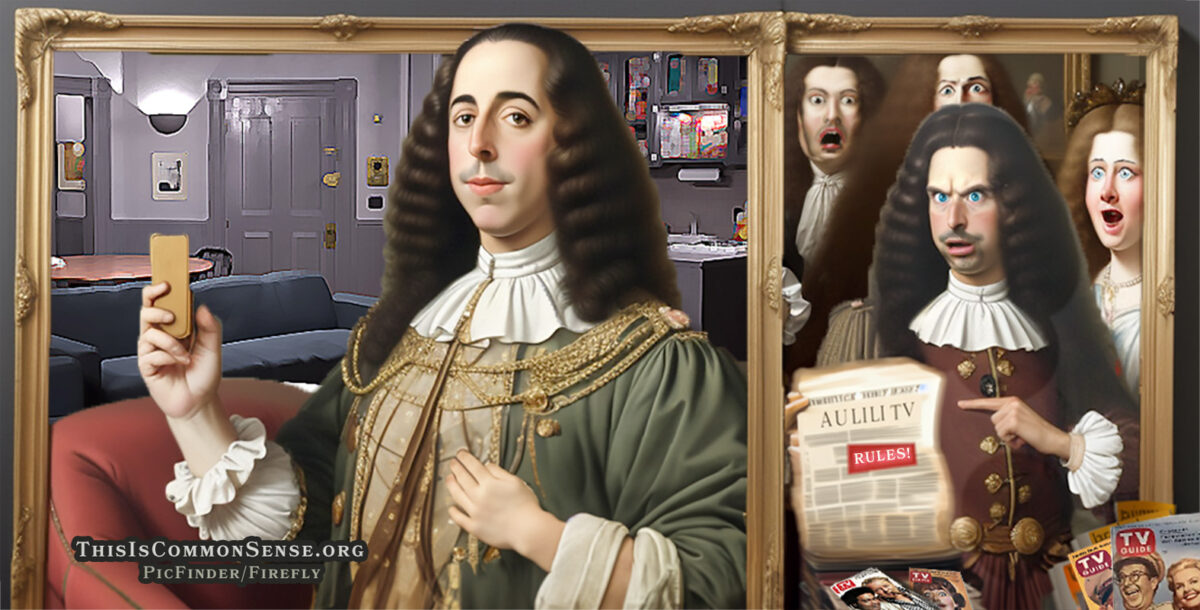
Well, Seinfeld is not pleasing the woke. Not today. Not The Washington Post’s Brian Broome.
“Wake up, Mr. Seinfeld. Mean-spirited humor isn’t cool anymore,” is Mr. Broome’s title. And his opinion is that times change, and meanie Mr. Seinfeld is a has-been for making fun of marginalized people.
You may have judged Jerry Seinfeld as one of the lighter, cleaner comics, his act almost universal. Broome says you’re wrong. “I have never found Jerry Seinfeld funny,” he explains. “Even in the ’90s when his show was all the rage, I didn’t get why people thought it was hilarious. It always seemed to me to be about immigrants being odd or unhygienic or making fun of women’s faces or body parts. The show always seemed mean-spirited to me, and that’s just not my kind of humor.”
O, shall thy pearls be clutched!
Wasn’t the self-described “show about nothing” really a comedy of manners where the main characters, George Costanza, Elaine Benes, Cosmo Kramer, and Jerry himself served as the actual butts of the jokes? These four egoists fretted over their ultra-liberal concerns about good manners but always behaved badly. And we always knew it. And somehow still liked them — because Seinfeld was not mean-spirited!
Broome characteristically ends on a vindictive note: “So, yes, if you make ham-fisted jokes about women or the LGBTQ+ community or people living with disabilities or the French, someone will come for you.” Thus, the mob beheaded the king. And the priest. All with
Would Broome think the point of the “gay French king” joke was to make fun of gays? But recall the actual
This is Common Sense. I’m Paul Jacob.
Illustration created with PicFinder and Firefly
See all recent commentary
(simplified and organized)
See recent popular posts

Art may make a suit of clothes; but nature must produce a man.
David Hume, “The Epicurean,” in Essays, Moral, Political, and Literary (1741-2; 1748).

On May 10, 1872, Victoria Woodhull became the first woman nominated for President of the United States.
In a landmark Supreme Court decision on May 10, 1893, the tomato was ruled a vegetable, not a fruit.

But Bryan Montiea Wilson did not get even a “sorry” from the Bureau of Alcohol, Tobacco, Firearms and Explosives (ATF) or local
Wilson, who works for a railroad equipment manufacturer, had never been arrested when ATF agents nabbed him in December 2023. Accused of gun and drug sales to local police officers said to be working with the ATF, Wilson could only repeatedly assert his innocence.
His looming punishment included up to 115 years in prison and millions in fines. Then, suddenly, he
How did Wilson wind up being falsely accused? The Truth About Guns site reports that prosecutors realized their blunder after his court-appointed lawyer investigated. But an uninformative request to dismiss the case is all ATF offered.
“Further review . . . reveals that the interests of justice would best be served by a dismissal of the pending charges as opposed to further prosecution. . . . The Government respectfully requests that the Court dismiss the pending charges against defendant Bryan Montiea Wilson.”
I guess we can thank the prosecutors for mentioning “justice.” But there should at least be an accounting in such cases; and this accounting, plus further consequences, should
“Something got messed up and they landed on me,” Wilson says. “I don’t know how this happened, but it can’t happen again. It shouldn’t
Wilson has filed a federal civil
This is Common Sense. I’m
Illustration created with PicFinder and Firefly
See all recent commentary
(simplified and organized)
See recent popular posts
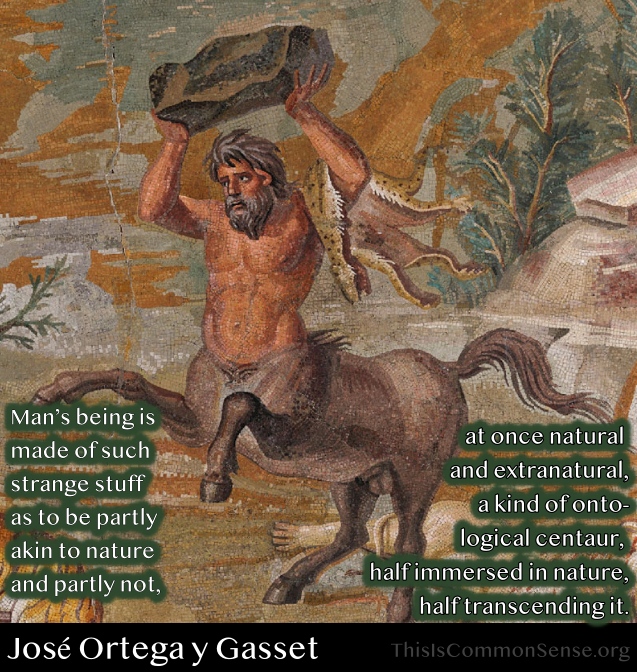
Man’s being is made of such strange stuff as to be partly akin to nature and partly not, at once natural and extranatural, a kind of ontological centaur, half immersed in nature, half transcending it.
José Ortega y Gasset, “Man Has No Nature,” in History as a System (1962).
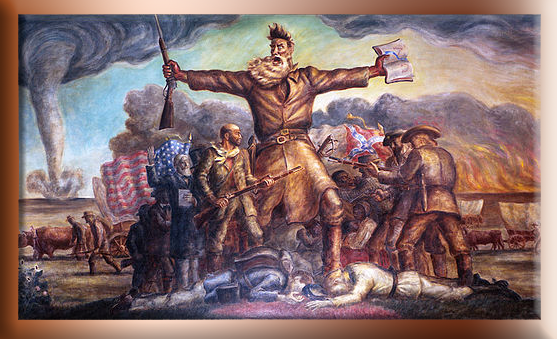
On May 9, 1800, abolitionist and revolutionary (and, depending upon your point of view and certain definitions, insurrectionist and terrorist) John Brown was born.
In 1883 on this date, Spanish philosopher José Ortega y Gasset was born. He is most renowned for his book The Revolt of the Masses.