You’ve got to tell the world how to treat you. If the world tells you how you are going to be treated, you are in trouble.
James Baldwin and Margaret Mead: A Rap on Race (1971).
Categories
James Baldwin
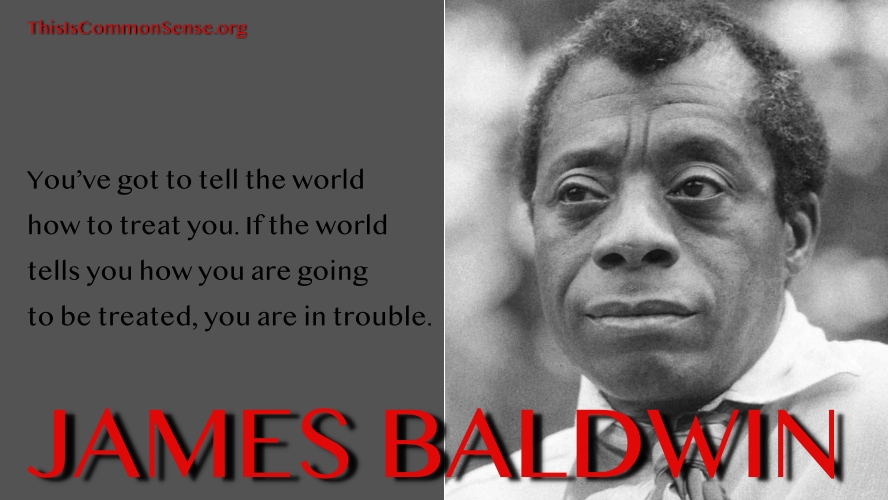
You’ve got to tell the world how to treat you. If the world tells you how you are going to be treated, you are in trouble.
James Baldwin and Margaret Mead: A Rap on Race (1971).

On December 20, 1946, Frank Capra’s holiday classic It’s a Wonderful Life premiered at the Globe Theatre in New York to mixed reviews.

“Of the Emergency Propaganda System.
“In case of a real emergency, we would have bombed you already.
“Or infected you with a new disease from one of our gain-of-function labs.
“Or (and this is a real stretch) found the missing plutonium that’s always whispered about.
“Instead, the mystery drones were a scheduled test run of a newly developed drone technology, which the FAA had this last month scheduled as a testing period for the product. The developer is an above-board military contractor in New Jersey. The test period was indicated in a bulletin. Somebody outside the military must’ve read it.
“Now, if we had the interests of the citizens in mind we would have made a big deal out of the FAA bulletin. Or at least referred to it after people began noticing the drones.
“But let’s get real. We did not do either of those things. Instead, we reacted as if we knew nothing. And, of course, most government functionaries knew nothing. But the Biden administration knew,* and the Federal Aviation Administration knew, and the CIA and the NSA and the military knew. We could have told everyone the whole truth.
“We didn’t because we needed to learn how people would react to a swarm of oversized drones dotting the skyscape. This was a test of how Americans would react in a possible (and admittedly eerie) emergency.
“And, boy, did citizens react entertainingly. Some people — easily confused by parallax effects — saw more drones than existed, misidentifying normal airliners for drones, for grand example.
“Some people opportunistically made fake video footage. Some of those fakers may or may not have been paid by tax dollars.
“And some people noticed non-drone UFOs, and reported them. We won’t talk about those, either, even when they appear over the Pentagon.
“Remember: Only a test.”
And this, here at ThisIsCommonSense.org, is Common Sense. And I’m Paul Jacob.
* Unless nobody bothered to tell the Lame Duck-in-Chief. See Wednesday’s witless assurance.
Illustration created with Flux and Firefly
See all recent commentary
(simplified and organized)
See recent popular posts

They constantly try to escape
Thomas Stearns Eliot, Choruses from The Rock (1934).
From the darkness outside and within
By dreaming of systems so perfect that no one will need to be good.

On December 19, 1776, Tom Paine published one of a series of pamphlets in the Pennsylvania Journal titled The American Crisis. Exactly one year later, George Washington’s Continental Army went into winter quarters at Valley Forge, Pennsylvania.
On December 19, 1828, Vice President of the United States John C. Calhoun penned the South Carolina Exposition and Protest, arguing against the Tariff of 1828, a key moment in what became known as the Nullification Crisis.

If it means using crime patterns to determine which neighborhoods should get more police patrols, that’s reasonable enough.
But what if it means assuming that certain individuals may commit a crime if left to themselves? And then “preventatively” harassing them?
The Institute for Justice has just won an important victory against predictive policing as practiced by the sheriff’s office of Pasco County, Florida.
The office’s idea was to predict which residents were most likely to commit future crimes. Algorithms — or what IJ attorney Rob Johnson calls a “glorified Excel sheet” — were supposed to perform a function comparable to that of “precogs,” the psychics in the movie Minority Report, who envision future crimes.
To counter the precrime, the sheriff’s office made frequent visits to the homes and haunts of pre-guilty individuals to interrogate them and their families, “sometimes multiple times a week.” Families who objected would get slapped with citations for bogus code violations.
All that’s over with now, we hope.
In response to IJ’s litigation, the sheriff’s office has admitted violating the due process rights and Fourth Amendment rights of the people they harassed, and it has dropped the program.
Scott Bullock observes that if the policy of harassing people based solely on guesses about what they or associates “might” do had been allowed to stand, such a program could easily have spread to other locales.
This is much less likely now.
This is Common Sense. I’m Paul Jacob.
Illustration created with Flux and Firefly
See all recent commentary
(simplified and organized)
See recent popular posts

When he laughed, respectable senators burst with laughter,
W. H. Auden, Epitaph on a Tyrant (1939).
And when he cried the little children died in the streets.
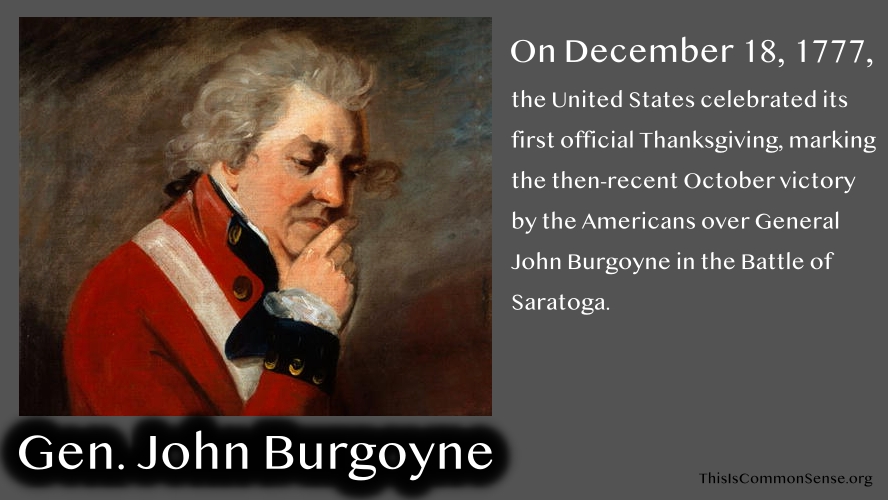
On December 18, 1777, the United States celebrated its first official Thanksgiving, marking the then-recent October victory by the Americans over General John Burgoyne in the Battle of Saratoga.

An apostrophe.
The T-shirt boldly proclaimed “Save Girls* Sports.”
But matters were more complicated for students of Martin Luther King Jr. High School in Riverside, California, who wore the shirts to protest their school’s decision to let a boy claiming to be a girl join the girls’ cross-country team.
The school sent students wearing the shirt to detention, allegedly for violating the dress code. Two of the girls who wore it said that school administrators compared the wearing of it to wearing a T-shirt with a swastika.
Those two students and their families sued the school and school district on constitutional grounds.
Maybe it was the lawsuit, or maybe it was the show of solidarity — but something caused MLK High to cave. And hundreds of other students did show up wearing the “Save Girls Sports” T-shirt, willing to buck the dress code or thought code, whatever it is, to support their classmates.
Somehow the school failed to place these hundreds of students in detention and has apparently dropped the detention policy.
Students at other schools in the area had also started wearing the T-shirts.
With regard to the policy of letting boys play on girls’ sports teams, the Riverside Unified School District says that its hands are tied. “RUSD is bound to follow California law,” which requires letting students “participate in sex-segregated” activities in a way “consistent with his or her gender identity.”
Laws are meant to be changed, however, if not through California’s legislature, then through the state’s citizen initiative process.
This is Common Sense. I’m Paul Jacob.
* We leave the [sic] for the title.
Illustration created with Flux and Firefly
See all recent commentary
(simplified and organized)
See recent popular posts

If anybody ever attacked democracy, I might discover what the word means.
Thomas Stearns Eliot, The Idea of a Christian Society (1939).