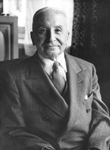
 It is not true that the masses are vehemently asking for socialism and that there is no means to resist them. The masses favour socialism because they trust the socialist propaganda of the intellectuals. The intellectuals, not the populace, are moulding public opinion. It is a lame excuse of the intellectuals that they must yield to the masses. They themselves have generated the socialist ideas and indoctrinated the masses with them. No proletarian or son of a proletarian has contributed to the elaboration of the interventionist and socialist programmes. Their authors were all of bourgeois background. The esoteric writings of dialectical materialism, of Hegel, the father both of Marxism and of German aggressive nationalism, the books of Georges Sorel, of Gentile and of Spengler were not read by the average man; they did not move the masses directly. It was the intellectuals who popularized them.
The intellectual leaders of the peoples have produced and propagated the fallacies which are on the point of destroying liberty and Western civilization. The intellectuals alone are responsible for the mass slaughters which are the characteristic mark of our century. They alone can reverse the trend and pave the way for a resurrection of freedom.
 If Columbus had an advisory committee he would probably still be at the dock.
 Over at
  If not an economist, what am I? An outdated freak whose functional role in the general scheme of things has passed into history? Perhaps I should accept such an assessment, retire gracefully, and, with alcoholic breath, hoe my cabbages. Perhaps I could do so if the modern technicians had indeed produced “better” economic mousetraps. Instead of evidence of progress, however, I see a continuing erosion of the intellectual (and social) capital that was accumulated by “political economy” in its finest hours.
 There is a Passion natural to the Mind of man, especially a free Man, which renders him impatient of Restraint.