Categories
free trade & free markets general freedom national politics & policies

Celebrities, Cannabis, Change

A new website, Marijuana Majority, makes an impression by listing famous people who think America’s laws against marijuana are crazy, unjust, or at least not very wise.

The site is elegant; it presents a long list. And by offering statements from each celebrity, we get a few ideas beyond the “marijuana should be legalized [to some degree]” message. Lawrence O’Donnell makes something close to an actual argument:Sarah Palin on Marijuana

Since Gallup starting asking Americans if marijuana should be legal back in 1969, most have always said no — until now. In a Gallup poll released yesterday, 50 percent said pot use should be legalized. . . . A minority of 46 percent continue to say marijuana should not be legalized. . . . In a democracy we should expect such a dramatic shift in public opinion to be reflected in our public officials.

Evangelist Pat Robertson offers the practical point, often iterated:

I really believe we should treat marijuana the way we treat beverage alcohol. I’ve never used marijuana and I don’t intend to, but it’s just one of those things that I think: this war on drugs just hasn’t succeeded.

A lot of folks, including British entrepreneur Richard Branson, enthuse about the taxing possibilities:

[I]t’s currently estimated that the annual revenue that would be raised in California if it taxed and regulated the sale of marijuana would be $1,400,000,000!

But this is not primarily a propaganda-by-the-word site, it’s a propaganda-by-the-celebrity site. Alas, the bulk of celebrities hail from the entertainment industry . . . not the most convincing bunch on the whole.

Still, the barrage of support and ideas is impressive, showing you don’t have to be a stoner to want to liberalize marijuana laws.

This is Common Sense. I’m Paul Jacob.
Categories
Thought

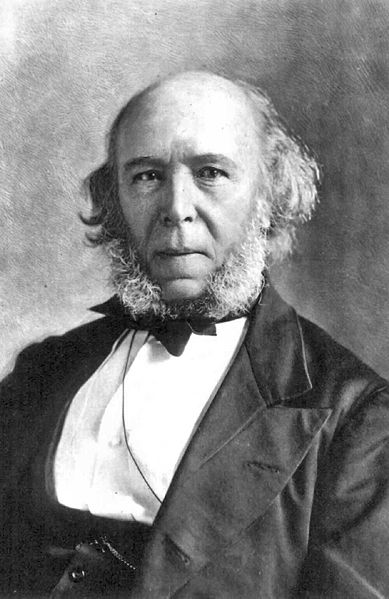
Herbert Spencer

The pursuit of individual happiness within those limits prescribed by social conditions, is the first requisite to the attainment of the greatest general happiness.

Categories
Thought

Herbert Spencer

No one can be perfectly free till all are free; no one can be perfectly moral till all are moral; no one can be perfectly happy till all are happy.

Categories
First Amendment rights national politics & policies political challengers

Silence, Please?

At this time in an election year, condemnations of “negative” political ads crescendo to fortissimo. But hey: Are folks really so attached to watching the standard menu of TV advertisements for GEICO, Viagra, and Chia Pets?

I doubt it. I think they worry about what such nasty attacks say about our political process. Granted, many 30-second political spots stretch the truth like a pretzel, though not any more than the candidates regularly do in person.

Still, political debate today is no nastier than it was when Washington and Adams and Jefferson roamed the earth.

And TV wasn’t even very big back then.

“An onslaught of negative political advertisements in congressional races,” the New York Times relates, “has left many incumbents, including some Republicans long opposed to restrictions on campaign spending, concluding that legislative measures may be in order to curtail the power of the outside groups behind most of the attacks.”

Incumbents are smart . . . and informed about campaigns. I’ll bet they know that in the 54 races lost by incumbents in 2010, Super PACs spent on average over $900,000. In races incumbents won, about $75,000.

“Incumbents have a lot more money than challengers do,” Professor Bradley Smith, former Commissioner of the Federal Election Commission, points out, “and Super PACs help to level that playing field and make challengers competitive.”

Incumbents think that elections are a time for them to speak. It’s all about them. Plus, no one — great, lousy or mediocre — likes to be attacked.

But elections in a free society are a time for everyone to speak.

This is Common Sense. I’m Paul Jacob.

Categories
general freedom too much government

A Civilized Context

I think of people as basically good. Most folks treat me well enough. I can navigate my neighborhood at night; I can go to an ATM unmolested in most cities I visit; often, I get smiles — and it isn’t because of my extraordinary good looks (alone).

But evil is all around us. Some folks harbor deep resentments, and worse. Garett Jones, writing at EconLog, notes that “a lot of people are actually just awful. . . .

In a series of studies of male college students in the 1980’s, Malamuth found that about 35% of these students in the U.S. and Canada said they’d consider committing a rape if they knew they wouldn’t get caught; 20% would seriously consider it. . . . And these studies are just detecting those students who are willing to state their proclivities in a survey; the true number is surely higher.

We are, all of us, constantly surrounded by such people.

Jones draws a startling moral: “I suspect that if people were more aware of the awfulness of their neighbors, support for the welfare state would decline.”

He may be right, but contemplating crime is different than committing it. The move from wish to action often depends on “context.”

Studies have shown this. Clean up your neighborhood, replace broken windows: crime goes down.

Some social engineers argue that the welfare state is more than mere window-dressing, it’s a swap: The dole buys off potential criminals.

I suspect the opposite is true: It funds criminals, supporting their bad habits, and serves as a trap for everyone else, preventing the vast majority from climbing out of the velvet cage.

We should work for better contexts.

This is Common Sense. I’m Paul Jacob.

Categories
Thought

Russell Means


I wanna be free

I want you to be free

A lot easier for me to be free if you are free.

Categories
Thought

Herbert Spencer

He who carries self-regard far enough to keep himself in good health and high spirits, in the first place thereby becomes an immediate source of happiness to those around, and in the second place maintains the ability to increase their happiness by altruistic actions. But one whose bodily vigour and mental health are undermined by self-sacrifice carried too far, in the first place becomes to those around a cause of depression, and in the second place renders himself incapable, or less capable, of actively furthering their welfare. In estimating conduct we must remember that there are those who by their joyousness beget joy in others, and that there are those who by their melancholy cast a gloom on every circle they enter.

Categories
education and schooling free trade & free markets too much government

That Was Fast

Ah, Minnesota. The home of “nice” Big Government. And in keeping with that, last week the state produced a grand example of mindlessly intrusive regulation. That’s the “Big Government” part. The “nice” part is how quickly the government conceded it was wrong.

I read about it first at Reason’s Hit & Run, where Katherine Mangu-Ward proclaimed “Minnesota Bans Free Online College Courses from Coursera. I Give Up.” She briefly related the burgeoning online industry of offering college course lectures free to the public (minus the accreditation), and how one of them was singled out for prohibition from the state’s Office of Higher Education: “Coursera is unwelcome in the state because it never got permission to operate there.”

Ms. Mangu-Ward’s conclusion was simple:

Idiots.

A day later, however, the story had radically changed. Minnesota’s bureaucrats had rethought their position, as related by this particular bureau’s bigwig, Larry Pogemiller: “Obviously, our office encourages lifelong learning and wants Minnesotans to take advantage of educational materials available on the Internet, particularly if they’re free.”

Obviously.

Pogemiller went on to promise that, when the legislature “convenes in January, my intent is to work with the Governor and Legislature to appropriately update the statute to meet modern-day circumstances.”

The regulators of Minnesota’s higher education proved that they could learn a new lesson. How well? We’ll see, as online schooling continues to gain its foothold — and accreditation, too.

Gerard Piel famously wrote of the “acceleration of history.” With the Internet, we see the feedback time from bad policy to removal of said policy cut down to a mere day.

This is Common Sense. I’m Paul Jacob.

Categories
Thought

Albert Jay Nock

The positive testimony of history is that the State invariably had its origin in conquest and confiscation. No primitive State known to history originated in any other manner.

Categories
links

Townhall: Confused, Concerned, and Canaried

This weekend’s Townhall column by Yours Truly is, truly, an expansion of Thursday‘s Common Sense. The story just couldn’t be confined to one brief comment, I guess. Check it out.

Oh, here are links to articles and relevant reading matter: