 On November 4, 1879, American humorist Will Rogers was born. Aside from his cowboy act, and his work as an actor in Hollywood, he gained much fame for being a topical comedian “just reporting what’s in the papers.”
Categories
On November 4, 1879, American humorist Will Rogers was born. Aside from his cowboy act, and his work as an actor in Hollywood, he gained much fame for being a topical comedian “just reporting what’s in the papers.”
 Comfort the afflicted, and afflict the comfortable.
On November 3, 1783, its mission fulfilled, the American Continental Army was disbanded.
On November 3, 1969, U.S. President Richard M. Nixon made a television and radio appearance, asking the “silent majority” to join him in solidarity on the Vietnam War effort.
Maybe Burkina Faso, in northwest Africa between Mali and Niger, isn’t the easiest “Jeopardy” question for most of us in the U.S. But any place that’s seen massive protests because the head of state tried to escape term limits becomes pretty memorable to me.
In fact, the first region that pops into my head as a point of comparison and contrast is my own home state of Arkansas.
 There are big differences in the respective battles over term limits, of course. In Burkina Faso, thousands clogged the streets after the 27-year presidential incumbent, Blaise Compaore, schemed to evade a constitutional term limit on his office. Facing unrelenting pressure, Compaore soon stepped down, not even awaiting the next election.
The furtive attempt to water down state legislative term limits in Arkansas hasn’t gotten as high on the radar there as the machinations in Burkina Faso. But the folks at Arkansas Term Limits (“vote AGAINST Issue #3”) have done much to publicize the scam, taking a wooden Trojan horse from town to town to vivify the point that the politicians bearing the “gift” of suspiciously eager self-reform have hidden a bomb at the bottom of the package: a doubling (or more) of their maximum permitted stay in a single legislative seat.
The media has started to pay attention. The story has gotten out.
Has it been enough? Have enough voters been reached to fend off the assault? When Tuesday’s results come in, we’ll know.
This is Common Sense. I’m Paul Jacob.
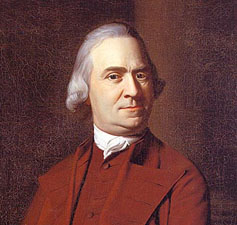 On November 2, 1772, Samuel Adams and Joseph Warren formed the first Committee of Correspondence.
Click on over to Townhall for what the next Congress — the country’s 114th — really needs. Hint: it isn’t cowardice.
Then come back here for more reading.
And hey: buck up. Courage isn’t just required for Congress.
The most dishonest ballot measure in America is one from my former home state of Arkansas. Watch this short video featuring Bob Porto, co-chair of Arkansas Term Limits, explaining why this 22-page-long amendment to the state constitution is a “Trojan Horse.” His group has been touring the state with a rather large symbolic horse to dramatize the danger of Issue 3.
http://youtu.be/KcoN9rA8t44
The mobile horse symbol was donated to Arkansas Term Limits by Liberty Initiative Fund. I warn about Issue 3 in more detail here.
On November 1, 1790, Edmund Burke published his “Reflections on the Revolution in France,” predicting that the French Revolution would end in disaster. Though many have disputed his premises, few dispute his prophecy, which proved spot on.
Ireland, Canada, United Kingdom, United States and other nations celebrate Halloween on October 31. The word Halloween or Hallowe’en dates to about 1745 and is of Christian origin, meaning “hallowed evening” or “holy evening.” It comes from a Scottish term for All Hallows’ Eve (the evening before All Hallows’ Day). In Scots, the word “eve” is “even,” and this is contracted to “e’en” or “een.” Over time, (All) Hallow(s) E(v)en evolved into Halloween.
It is one of those darker-themed celebrations, often conjuring up images of death and horror. As if in keeping with this theme, Stalin’s body was removed from Lenin’s Tomb on October 31, 1961.
Which came first, the dead chicken or the rotten egg?
A bit gruesome. Sure. But it’s Halloween, no? Trick or Treat time.
Anyway, the subject for today’s exploration into contemporary horror is the modern city, so expensive it frightens middle-income earners away.
But wait. It’s not all cities. Only some are horror shows.
Particularly, I’m referring to those in “blue” states, the ones run by “liberal” Democrats.
 It’s been pretty obvious for some time — especially as we witness hordes of everyday folks moving to parts South, particularly to Texas’s sprawling cities. But if you needed some statistics and graphs and the like, Derek Thompson provides them over at The Atlantic. His title addresses his basic question: “Why Middle-Class Americans Can’t Afford to Live in Liberal Cities.” Citing economist Jed Kolko, he notes the most astounding thing about housing in modern cities: “Liberal cities seem to have the worst affordability crises.”
Or, as Kolko puts it, “[e]ven after adjusting for differences of income, liberal markets tend to have higher income inequality and worse affordability.”
Why? Thompson contemplates the chicken-and-eggness of it all. Do liberal progressives congregate in coastal cities with limited land availability, and just happen to find themselves crunching out home growth, thus raising prices and reducing affordability? Or do they cause it?
Considering the nature of their favored policies, they almost certainly (if inadvertently) cause it.
Big government inevitably yields big bad effects. Support big government? Expect more inequality, not less. Then demand more government to “solve” the problem. Which causes yet more bad effects.
This trick-and-treat trap should horrify big government advocates.
It certainly horrifies me.
This is Common Sense. I’m Paul Jacob.