On October 28, 1886, in New York Harbor, the Statue of Liberty was dedicated by President Grover Cleveland, despite the fact that the monument was not a federally funded project.
Categories
Statue of Liberty
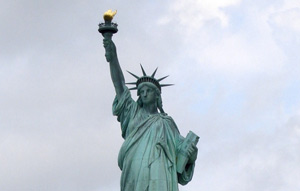
On October 28, 1886, in New York Harbor, the Statue of Liberty was dedicated by President Grover Cleveland, despite the fact that the monument was not a federally funded project.
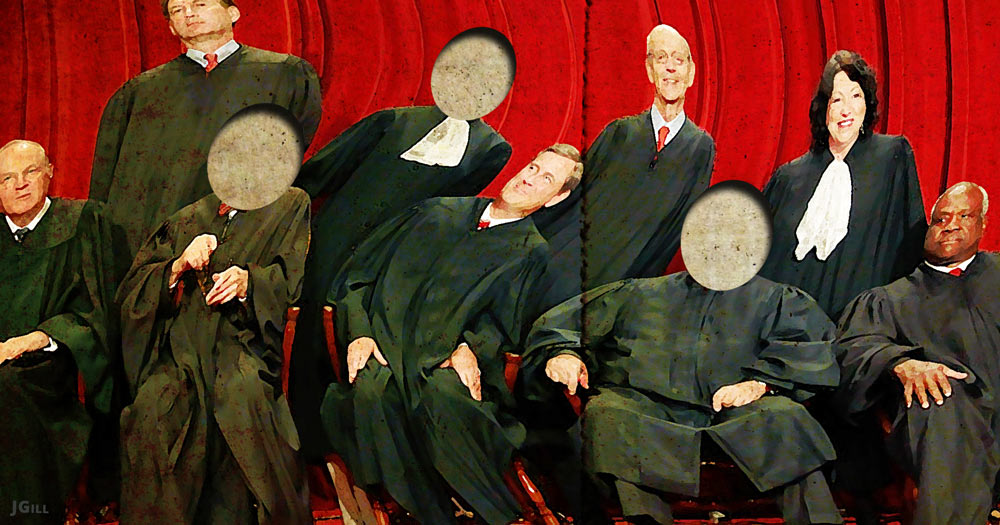
I support neither Hillary Clinton nor Donald Trump for the presidency. Still, I do understand several reasons to vote for Trump, including, most obviously, “he’s not a Clinton.”
The most persuasive strategic reason given for voting for the man, however, and the one that has most purchase with me, is that he would appoint better Supreme Court justices than would Mrs. Clinton.
Note: if the Democrats gain hold of the U.S. Senate, an elected Donald Trump would “negotiate.” And the next set of Supremes might be quite bad.
But is all this irrelevant? It does not look like Trump will be elected, so any vote thrown at him will be just as “wasted” as a vote for Johnson, Stein, or Mickey Mouse.
More importantly, if Hillary wins, no biggie on the Supreme Court front IF (a big “if”?) the Republicans maintain congressional dominance.
Why?
Our Senators are not required to vote for any of a president’s appointees. But, alas, that is not what Democrats are saying now! Forget such self-serving nonsense. The Constitution does not specify the number of justices on the Supreme Court. It is nine now, sure, but the Highest court in the land was first manned by five justices, then seven.
So, after the election, unpack the court.* Back down to seven, at least.
And then let’s talk terms for the currently “serving for life” justices, and term limits.
In any case, the best case for Trump isn’t so much a case for him, as a plan of action no matter who is elected.
This is Common Sense. I’m Paul Jacob.
*This notion is more doable, I think, than Franklin Delano Roosevelt’s infamous court packing scheme, in which he threatened to put more justices in to over-rule those justices who thought his “New Deal” program unconstitutional. Congress, not required to vote in any proposed Supreme Court candidate, could balk at all and then, by law, reduce the number, even removing one justice from office if need be.
Questions Answered:
Does the best reason to vote for Donald Trump really hold water?
Does the Constitution specify the number of justices that should be on the Court?
Is Congress really at the mercy of any bully who occupies the Oval Office?
 The Next Question:
Will voting for someone other than Trump be more of a “wasted vote” than voting for Trump himself, if, as polls indicate, he loses?
Socialism is but the further screwing up of the State machine to limit the individual.
James Huneker, in Egoists: A Book of Supermen (1913), p. 364.
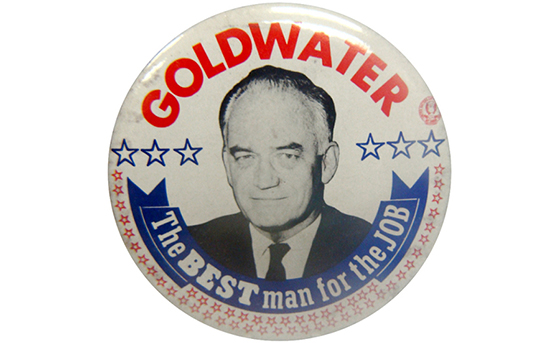
On October 27, 1964, Ronald Reagan delivered a speech on behalf of Republican candidate for president, Barry Goldwater, thereby launching Reagan’s political career. The speech came to be known as “A Time for Choosing.”

Russia is being painted as Enemy No. 1 by Hillary Clinton, despite her predecessor’s mocking of the same notion four years ago, when Republican Mitt Romney said it.
Of course, Mrs. Clinton is just using Russia as a distraction from her conspiracies and crimes and inadequacies as revealed by WikiLeaks.
What’s more worrying is Russia’s military adventuring, surely.
Before we wander into the morass that is foreign policy, maybe we should consider the Russian military itself . . . and its supporting economy.
Last year, TASS confidently informed us that the military budget was going up 0.8 percent in 2016, with $750 million slated for nuclear weaponry. I still hear talk of the latter fact; not much of the former factoid, that shockingly modest increase.
Even last year it was commonly noted that Russia’s military budget was getting “squeezed” . . . by hard times. Lack of revenue.
Now the hammer has fallen on the sickle: “Russian defence budget set to drop by 12%” in yesterday’s IHS Jane’s 360 article by Craig Caffrey.
First, don’t be alarmed: “defence” is how Brits misspell “defense.”
Second, take heart: Russia simply cannot do all it may want even in its darkest hearts.
Third, take caution: a weaker Russia is still dangerous, in some ways more so. We might see increased (and relatively cheap) cyber-warfare, of which Mrs. Clinton is so particularly mindful.
Finally, let’s acknowledge that American politicians have never focused rationally on the Russian threat, often hyping it gratuitously to enhance their own power, or, for that same reason, ignoring the threat entirely, as when smirking at Romney’s wise concerns.
This is Common Sense. I’m Paul Jacob.
Questions Answered:
Is Russia a threat?
Why are Democrats obsessed with Russia?
Why is Russia reducing its military budget?
Ask The Next Question:
What kind of defense should a free people insist upon?
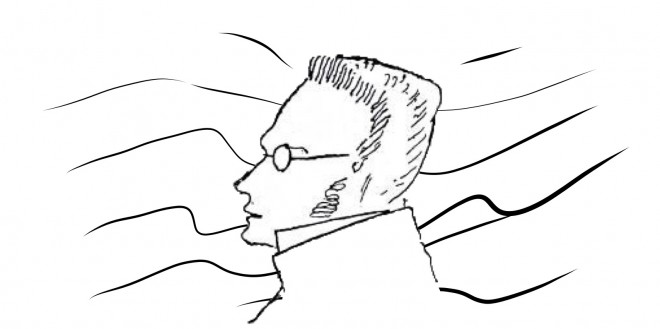
What matters the party to me? I shall find enough anyhow who unite with me without swearing allegiance to my flag.
Max Stirner, Der Einzige und sein Eigenthum translated by Steven T. Byington (1907).
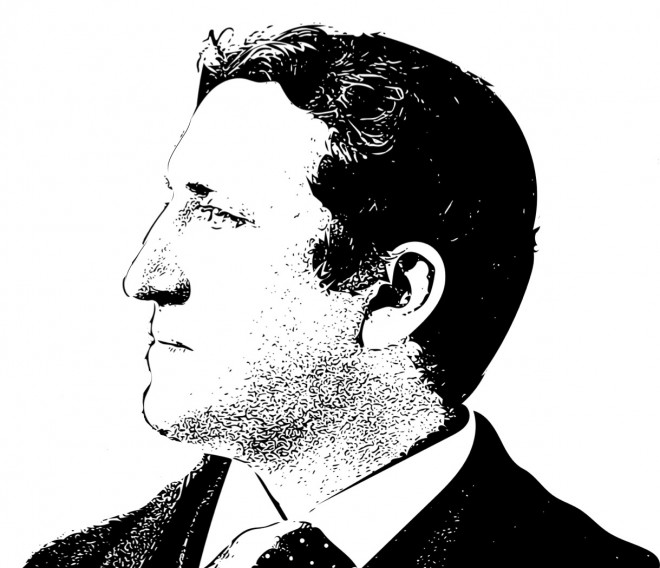
Illustration of Stirner by Friedrich Engels, modified.
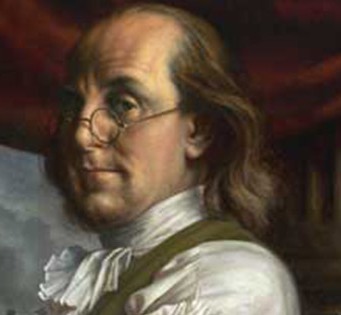
On October 26, 1774, the first Continental Congress adjourned in Philadelphia, Pennsylvania. Exactly one year later, King George III of Great Britain went before Parliament to declare the American colonies in rebellion. And one year later yet, to the day, in 1776, septuagenerian Benjamin Franklin departed from America for France, seeking financial support for the American Revolution.
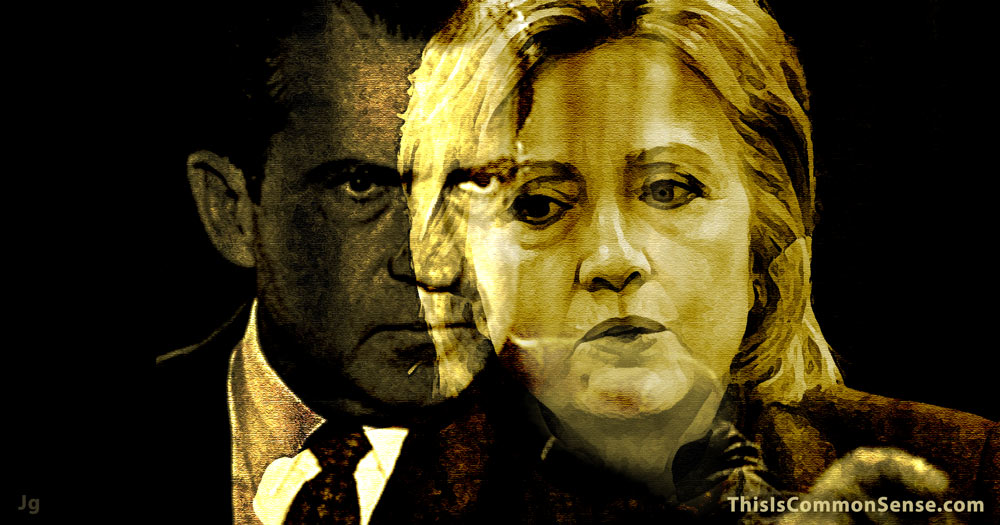
That grin. That cackle. Please: No more!
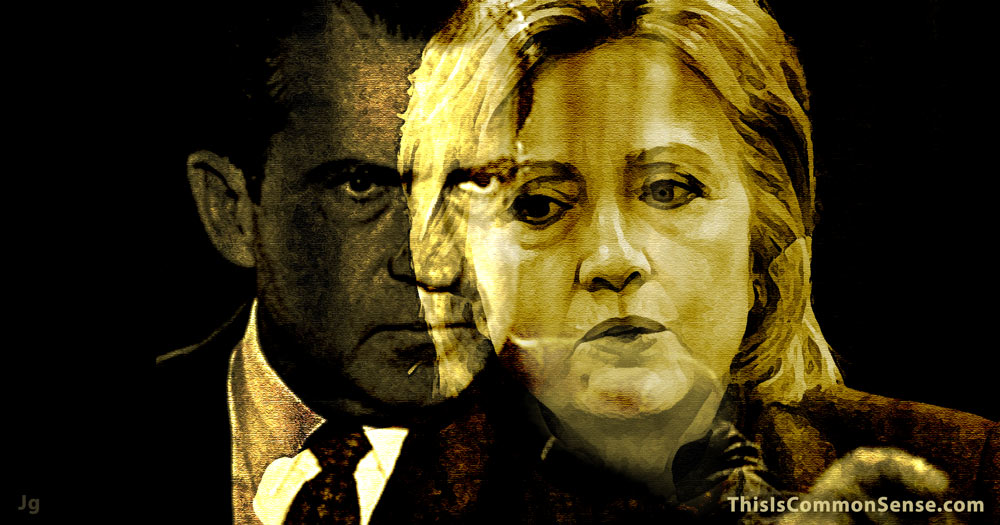
While there is much to be said against Donald Trump, and I’ve said some of it, the sheer unlikability and . . . distastefulness . . . of Hillary Clinton is . . . precedented.
Historically, she reminds me of two past Republican presidential candidates: Richard Milhous Nixon (1913-1994) and James G. Blaine (1830-1893).
Nixon was a power-lusting careerist — just like Mrs. Clinton. Both made runs for office and were brushed aside before ultimate success. Clinton lost the Democratic nod to Obama in 2008; Nixon famously lost the presidential race to John F. Kennedy in 1960, and then went on to lose a governor’s race in California — to the current governor’s father.
But he got in when the Democratic Party was divided over the Vietnam War. If Clinton gets in it will be largely the result of Republican disarray, not her own sparkling personality and charm.
‘Crooked’ Hillary, like ‘Tricky Dick,’ demonstrates extreme social awkwardness as well no small trouble keeping her temper, and being likable. Both are probably best defined as misanthropes. That was Florence King’s judgment of Nixon, and I’d concur regarding Hillary.
But, in terms of corruption, could Hillary be worse than Nixon?
Surely, she’s not as corrupt as James G. Blaine was. Indeed, it was this Maine politician’s outrageous corruption that led to his undoing, and to the election of Democrat Grover Cleveland — despite Cleveland’s sex scandal.
Win or lose, Hillary will have made history, but it won’t be for her gender. Instead, for her striking similarity to past . . . deplorables.
This is Common Sense. I’m Paul Jacob.
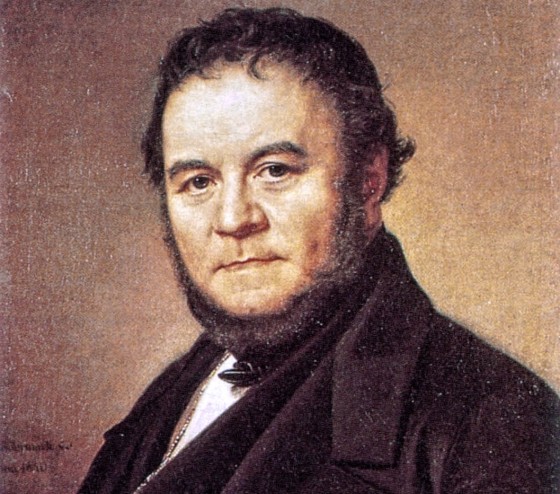
No man with a face capable of a hundred shades of expression can be ugly.
James Huneker, a portrait of “A Sentimental Education: Henry Beyle — Stendhal” [pictured above], in Egoists: A Book of Supermen (1913), p. 2.
On October 25, 1806, the German philosopher Max Stirner was born. Stirner was known for his radical individualism, which under the name of “egoism” became culturally chic in the late 19th and early 20th centuries. In addition to Der Einzige und sein Eigentum, a major work that was famously attacked by Karl Marx, he translated Adam Smith’s Wealth of Nations into German.
Der Einzige und sein Eigentum has been translated into English as The Ego and Its Own and The Ego and His Own.