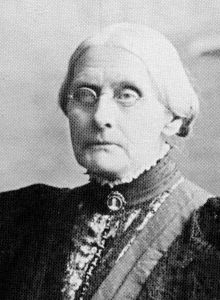
 On November 5, 1872, Susan B. Anthony defied the law to vote, and was later fined $100.
Categories
On November 5, 1872, Susan B. Anthony defied the law to vote, and was later fined $100.
 On November 4, 1879, American humorist Will Rogers was born. Aside from his cowboy act, and his work as an actor in Hollywood, he gained much fame for being a topical comedian “just reporting what’s in the papers.”
On November 3, 1783, its mission fulfilled, the American Continental Army was disbanded.
On November 3, 1969, U.S. President Richard M. Nixon made a television and radio appearance, asking the “silent majority” to join him in solidarity on the Vietnam War effort.
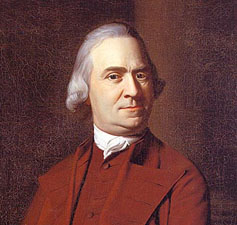 On November 2, 1772, Samuel Adams and Joseph Warren formed the first Committee of Correspondence.
On November 1, 1790, Edmund Burke published his “Reflections on the Revolution in France,” predicting that the French Revolution would end in disaster. Though many have disputed his premises, few dispute his prophecy, which proved spot on.
Ireland, Canada, United Kingdom, United States and other nations celebrate Halloween on October 31. The word Halloween or Hallowe’en dates to about 1745 and is of Christian origin, meaning “hallowed evening” or “holy evening.” It comes from a Scottish term for All Hallows’ Eve (the evening before All Hallows’ Day). In Scots, the word “eve” is “even,” and this is contracted to “e’en” or “een.” Over time, (All) Hallow(s) E(v)en evolved into Halloween.
It is one of those darker-themed celebrations, often conjuring up images of death and horror. As if in keeping with this theme, Stalin’s body was removed from Lenin’s Tomb on October 31, 1961.
 On October 30, 1907, Sol Tax was born. Tax, an important anthropologist at the University of Chicago, organized a four-day conference on military conscription, which was the start of an intellectual movement that led to the end of the draft less than seven years later. Tax’s most famous work was probably his study of a Guatemalen Indian economy, “Penny Capitalism.”
On October 29, 539 BC, Cyrus the Great entered the city of Babylon as conqueror. His general policy of religion toleration would be extended to the Jews, who were not long after allowed to return to their homeland.
On the same date in 1923 AD, the Ottomon Empire’s dissolution marked the start of the Turkish Republic.
 On October 28, 1886, in New York Harbor, the Statue of Liberty was dedicated by President Grover Cleveland, despite the fact that the monument was not a federally funded project.
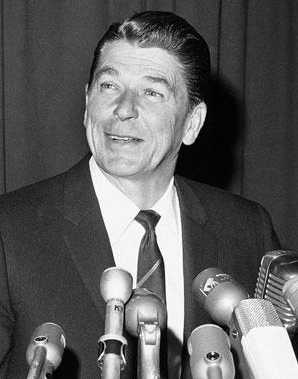 On October 27, 1964, Ronald Reagan delivered a speech on behalf of Republican candidate for president, Barry Goldwater, thereby launching Reagan’s political career. The speech came to be known as “A Time for Choosing.”