Despite being outnumbered 16 to one, forces of the Old Swiss Confederacy proved victorious over the Archduchy of Austria in the Battle of Näfels, April 9, 1388.
On this date in 1991, Georgia declared its independence from the Soviet Union.
Despite being outnumbered 16 to one, forces of the Old Swiss Confederacy proved victorious over the Archduchy of Austria in the Battle of Näfels, April 9, 1388.
On this date in 1991, Georgia declared its independence from the Soviet Union.
On April 8, 1913, the 17th amendment to the Constitution, providing for the popular election of U.S. senators, was ratified.
On April 7, 1933, Prohibition in the United States was repealed for beer of no more than 3.2 percent alcohol by weight, eight months before the ratification of the XXI amendment.
On April 6, 1930, Mohandas K. Gandhi raised a lump of mud and salt, declaring, “With this, I am shaking the foundations of the British Empire.”
Thus began the Salt Satyagraha.
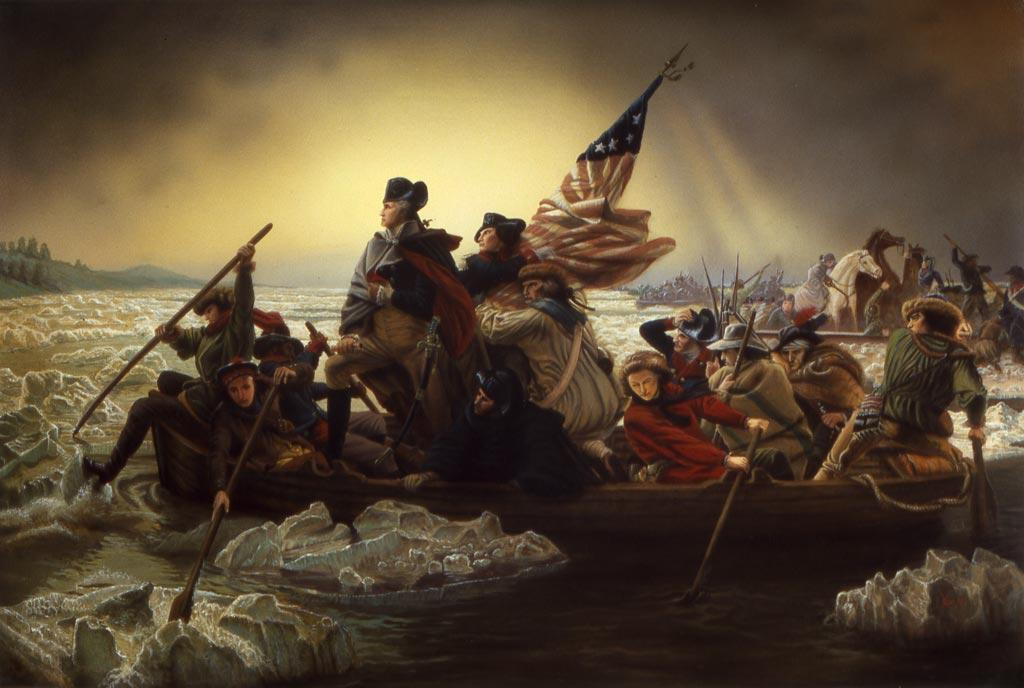
On April 5, 1792, U.S. President George Washington exercised his authority to veto a bill, the first time this power was used in the United States.
On April 4, 1841, William Henry Harrison died of pneumonia, becoming the first President of the United States to die in office and the one with the shortest term served (he died on his 32nd day as president). Renowned Indian killer (having risen to fame for his part in 1811’s Battle of Tippecanoe), a proponent of the expansion of slavery into Northwest Territories, and a Whig, Harrison won the presidency in part by turning the Democrats’ “log cabin and hard cider” aspersions on his character as the basic symbols of the campaign.
Though hardly a “limited government man,” some limited government history buffs proclaim him the Greatest President, on the ostensibly droll and possibly cynical grounds that he spent so little time in office.
On a sadder note, Martin Luther King, Jr., was assassinated on this day in 1968.
On April 3, 1968, Martin Luther King, Jr., delivered his “I’ve Been to the Mountaintop” speech.
American author, art critic, and commentator Camille Paglia was born April 2, 1947.
On April Fools’ Day, 1957, the BBC offered for viewers of the current affairs program “Panorama” the infamous spaghetti tree report hoax. In the spirit of the day, Common Sense offers these “historic” events:
On April 1, 1787, James Madison, father of the Constitution, removed the General Welfare clause from his draft of the U.S. Constitution, telling friends that, “I fear future big-government-loving politicians will undoubtedly abuse the clause’s vague concept to drown the people in federal overreach.”
On April 1, 1918, Woodrow Wilson became the first and only President of the United States to be impeached and removed from office for lying about munitions being aboard the Lusitania in an effort to whip up war fever against Germany and push the nation into World War I.
On April 1, 2002, the U.S. Congress refused to grant President George W. Bush’s request for a declaration of war against Iraq.
On April 1, 2014, President Barack Obama admitted to being a Kenyan, er, Keynesian, but argued that the Constitution did not bar Keynesians from office.
As of April 1, 2017, President Donald Trump — often declared a fool or worse by the “Not My President” crowd — has proven himself foursquare for liberty, extolling the Freedom Caucus in Congress, and praising them from saving the nation from House Speaker Paul Ryan’s ObamaCare Lite plan.
Alas, only the first paragraph, above, is completely true.
On March 31, 1717, a sermon on “The Nature of the Kingdom of Christ,” by Benjamin Hoadly, the Bishop of Bangor, provoked the Bangorian Controversy.
The sermon’s text was John 18:36, “My kingdom is not of this world,” and from that Hoadly deduced — supposedly at the request of King George I himself, who was present in the assembly — that there was no Biblical justification for any church government. Hoadly identified the church with the kingdom of Heaven, noting that Christ had not delegated His authority to any representative.
King George’s preference for the Whig Party, and for latitudinarianism in ecclesiastical policy, is widely thought to have been a strategic maneuver to degrade church power in political government.