On November 28, 1893, women voted for the first time in New Zealand’s parliamentary election.
Categories
NZ Women Vote
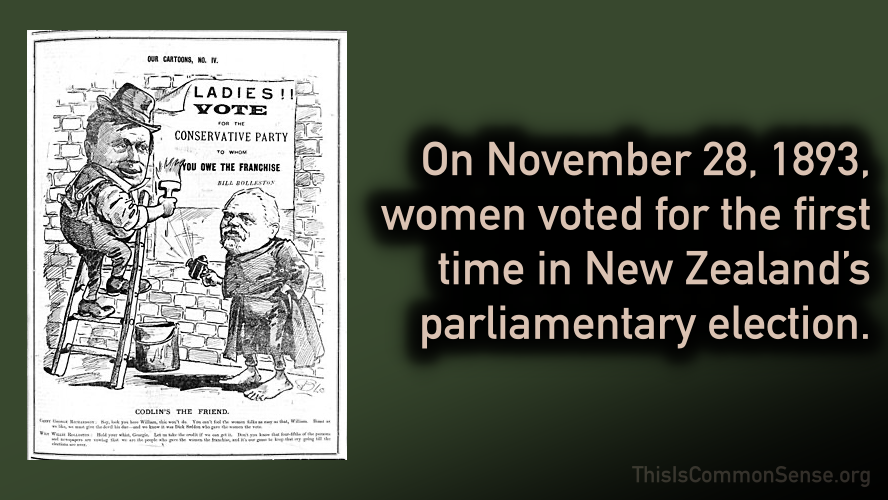
On November 28, 1893, women voted for the first time in New Zealand’s parliamentary election.
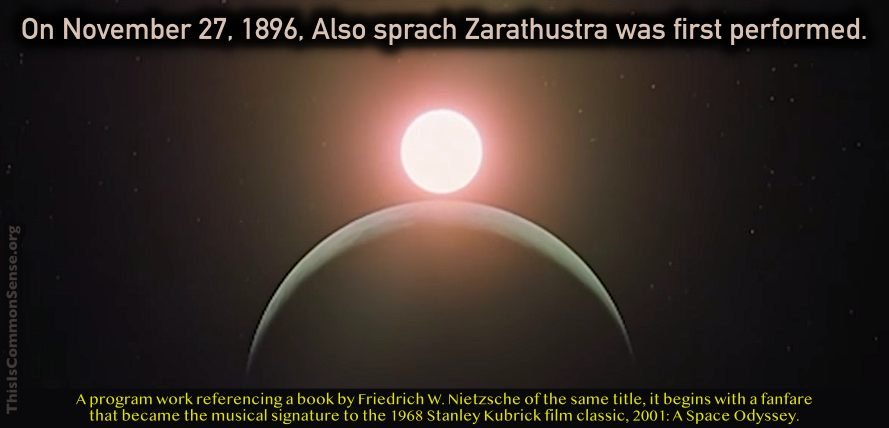
On November 27, 1896, Also sprach Zarathustra — a tone poem by the great composer Richard Strauss — was first performed. It is a program work referencing a book by Friedrich W. Nietzsche of the same title. It begins with a fanfare that became the musical signature to Stanley Kubrick’s 1968 film classic 2001: A Space Odyssey.
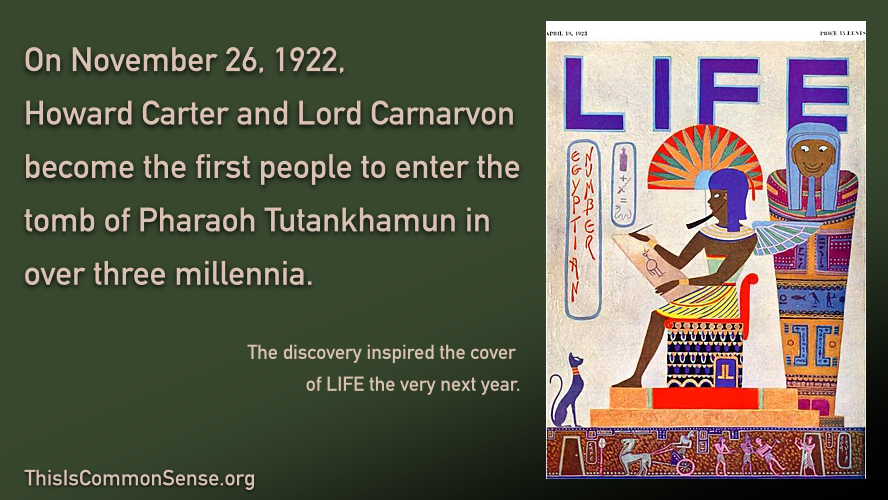
On November 26, 1922, Howard Carter and Lord Carnarvon become the first people to enter the tomb of Pharaoh Tutankhamun in over 3,000 years.
King Tut, as he is now popularly known, started life as “Tutankhaten.” The future pharaoh’s name references the 18th Dynasty conception of a deity as represented in the sun disk, the monotheistic worship of which was the point of the Atenism of Akhenaten (Amenhotep IV), who reigned when he was a boy. During the reign of Tut, the religious revolution instigated by Akhenaten was overthrown, and the Amenist cult and its priesthood restored to preëminence. Thus the name change referencing another conception of a sun god, Amun.
Tutankhamun (c. 1341 BC – c. 1323 BC) died before age 20 and his burial appears to have been hastily made in the Valley of the Kings. He was succeeded by Ay, and then a general, Horemheb, who tried to erase from the records the “Amarna Period” pharaohs and any mention of the Atenist monotheistic revolution associated with pharaohs Akhenaten, Smenkhkare, Tutankhamun, and Ay. The tomb designated KV62 had been left intact, its grave good astounding the world, hence the April 19, 1923, issue of Life, reproduced in the image above.
November 25, 1975, Suriname gained independence from the Netherlands.
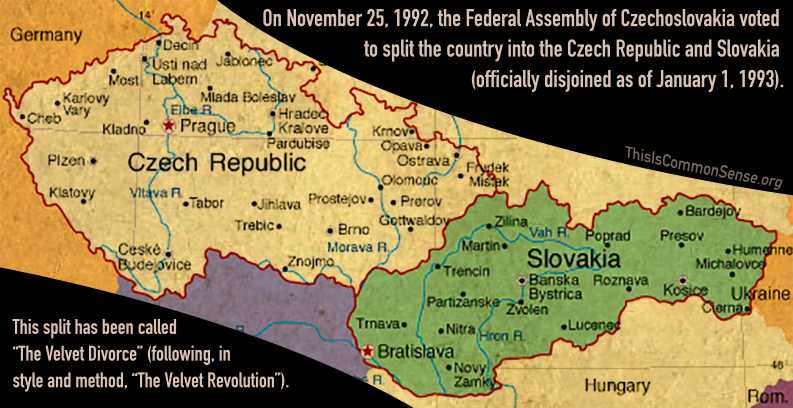
On the same month and date 17 years later, the Federal Assembly of Czechoslovakia voted to split the country into the Czech Republic and Slovakia (officially disjoined as of January 1, 1993). This split has been called “The Velvet Divorce” (following, in style and method, “The Velvet Revolution”). The Czech Republic is now also known as Czechia.
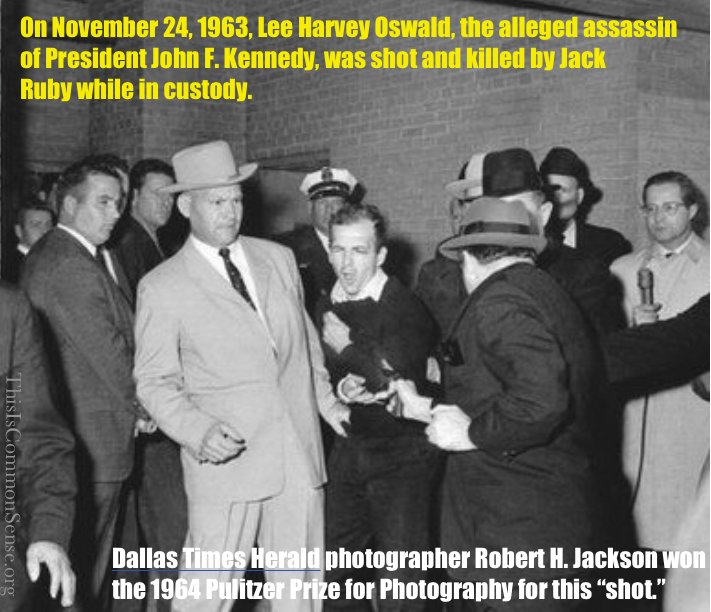
On November 24, 1963, Lee Harvey Oswald, the alleged assassin of President John F. Kennedy, was shot and killed by Jack Ruby while in custody.

On November 23, 1644, British poet John Milton published Areopagitica, a pamphlet decrying censorship.
Revolutions of ages do not oft recover the loss of a rejected truth, for the want of which whole nations fare the worse.
John Milton, Areopagitica; A speech of Mr. John Milton for the Liberty of Unlicenc’d Printing, to the Parlament of England (1644).
The name “Areopagitica” references a speech by Isocrates, the “Areopagitikós” that itself referenced a hill in Athens, Greece, the Areopagus, which had been the site of an important tribunal that the Greek orator had hoped to restore. It may also refer to the defense that St. Paul made before the Areopagus against charges of promulgating alien gods and outré teachings (see Acts 17:18–34).

On November 22, 1307, Pope Clement V issued the papal bull Pastoralis Praeeminentiae which instructed all Christian monarchs in Europe to arrest all Templars and seize their assets.
This was a little over a month after France’s King Philip IV ordered de Molay and scores of other French Templars to be simultaneously arrested. The liquidation of the order of the Templars was a major event of the late Middle Ages.
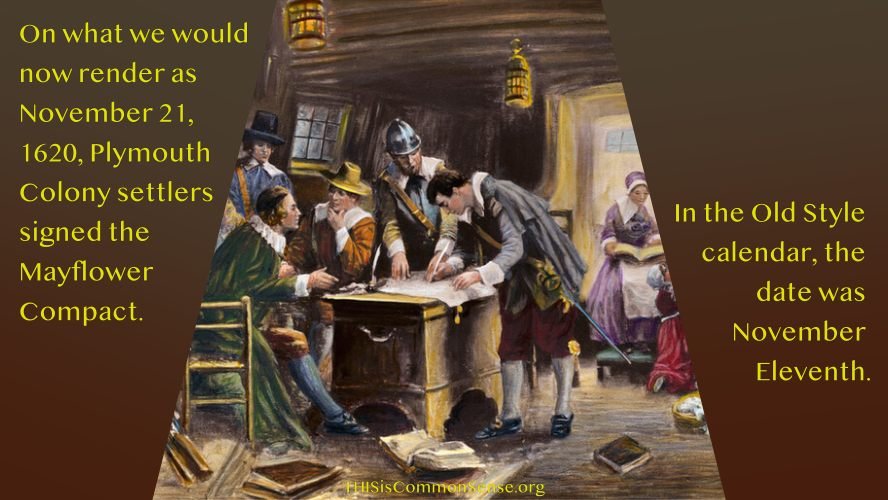
On what we would now render as November 21, 1620, Plymouth Colony settlers signed the Mayflower Compact. In the Old Style calendar, the date was November Eleventh.
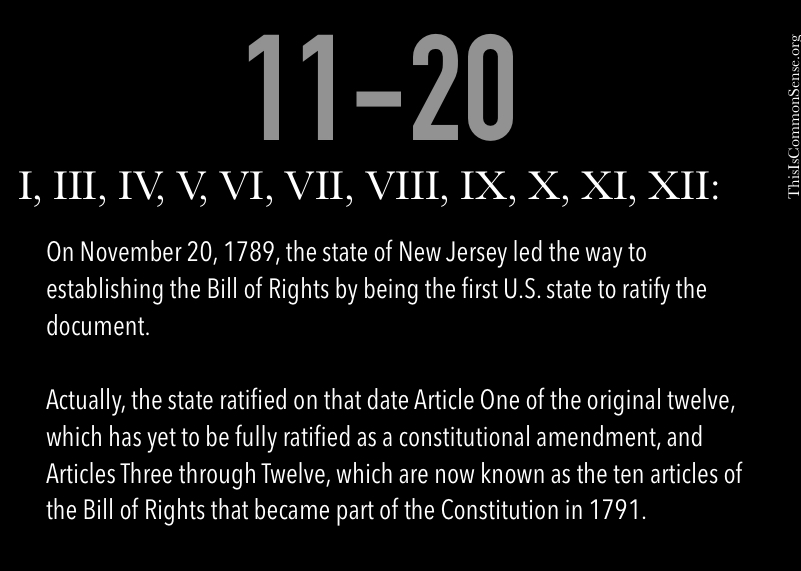
On November 20, 1789, the state of New Jersey led the way to establishing the Bill of Rights by being the first U.S. state to ratify the document.
Actually, the state ratified on that date Article One of the original twelve, which has yet to be fully ratified as a constitutional amendment, and Articles Three through Twelve, which became the ten articles of the Bill of Rights. On May 7, 1992, the state ratified Article Two, which became the Twenty-seventh Amendment to the Constitution.
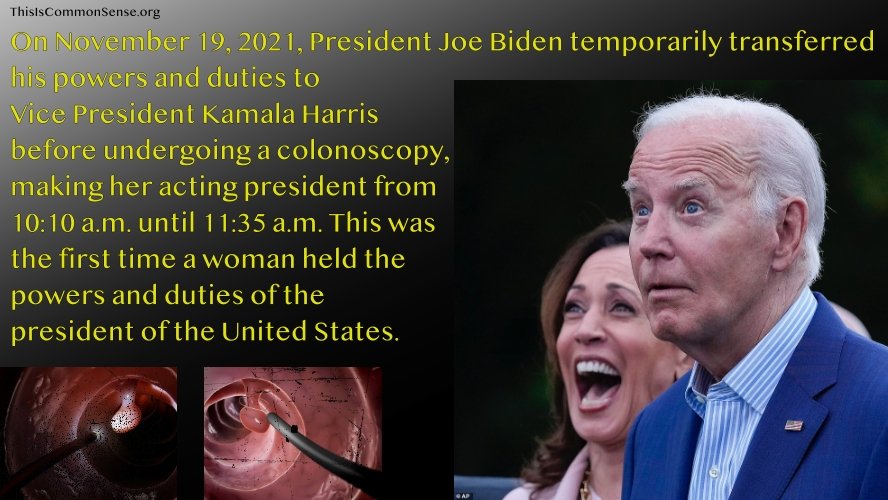
On November 19, 2021, President Joe Biden temporarily transferred his powers and duties to Vice President Kamala Harris before undergoing a colonoscopy, making her acting president from 10:10 a.m. until 11:35 a.m. This was the first time a woman held the powers and duties of the president of the United States.
Biden had a benign but pre-cancerous polyp removed from his colon during that procedure.