Categories
Today

A Declaration Read

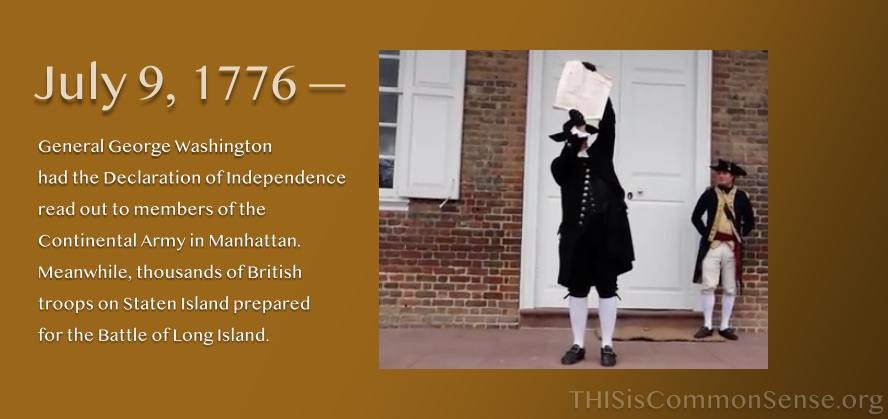
On July 9, 1776, General George Washington had the Declaration of Independence read out to members of the Continental Army in Manhattan. Meanwhile, thousands of British troops on Staten Island prepared for the Battle of Long Island.

Categories
Today

Bells, Bells, Bells

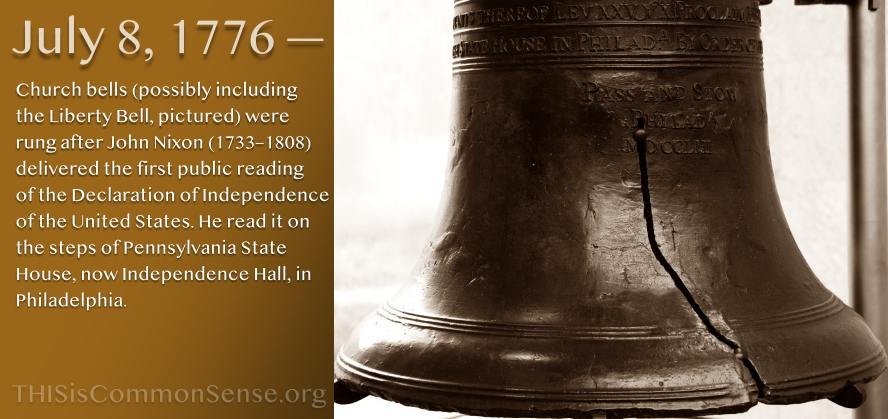
July 8, 1776 — Church bells (possibly including the Liberty Bell, pictured) were rung after John Nixon (1733–1808) delivered the first public reading of the Declaration of Independence of the United States. He read it on the steps of Pennsylvania State House, now Independence Hall, in Philadelphia.

Categories
Today

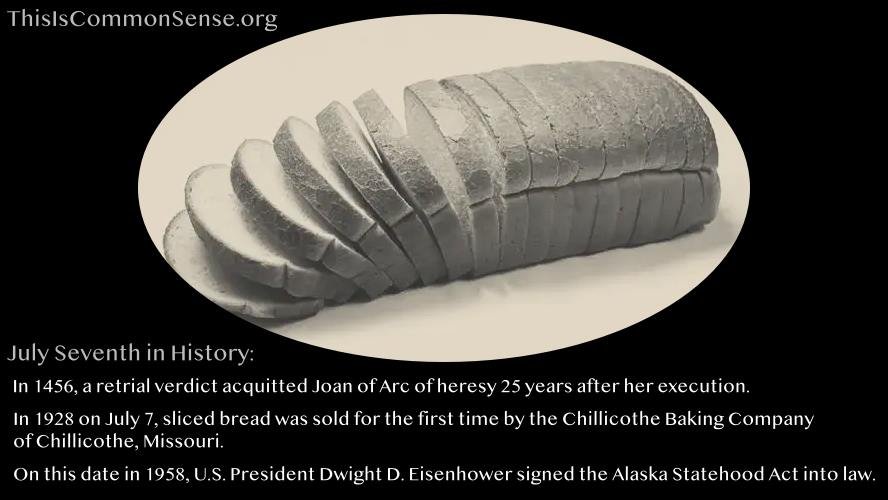
Seventh of July

In 1456, a retrial verdict acquitted Joan of Arc of heresy 25 years after her execution.

In 1928 on July 7, sliced bread was sold for the first time by the Chillicothe Baking Company of Chillicothe, Missouri.

On this date in 1958, U.S. President Dwight D. Eisenhower signed the Alaska Statehood Act into law.

Categories
Today

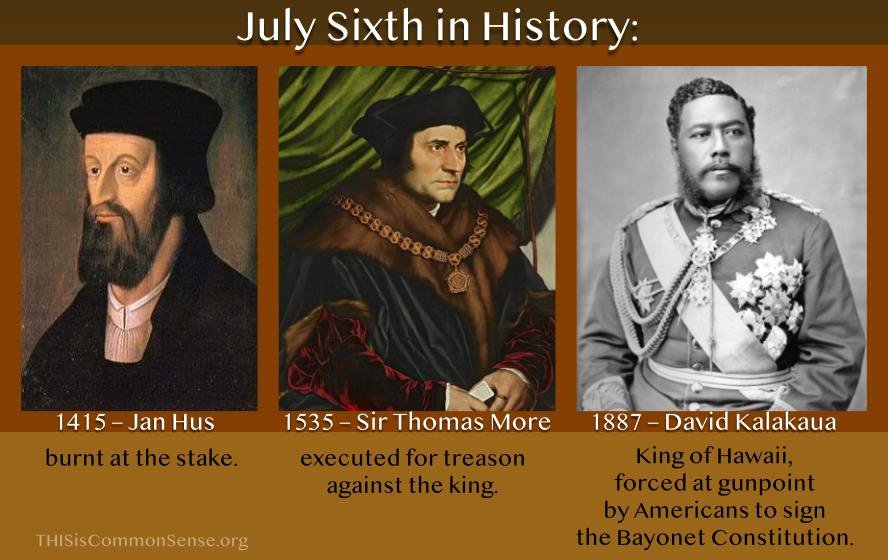
Tyranny

The Sixth of July serves better as a “Today in Tyranny” marker than anything positive, at least when you consider these events:

  • 1415 – Jan Hus was burnt at the stake.
  • 1535 – Sir Thomas More was executed for treason against King Henry VIII of England.
  • 1887 – David Kalakaua, monarch of the Kingdom of Hawaii, was forced at gunpoint by Americans to sign the Bayonet Constitution giving Americans more power in Hawaii while stripping Hawaiian citizens of their rights.
  • 1939 – The Nazi “Third Reich” closed the last remaining Jewish enterprises in Germany.
Categories
Today

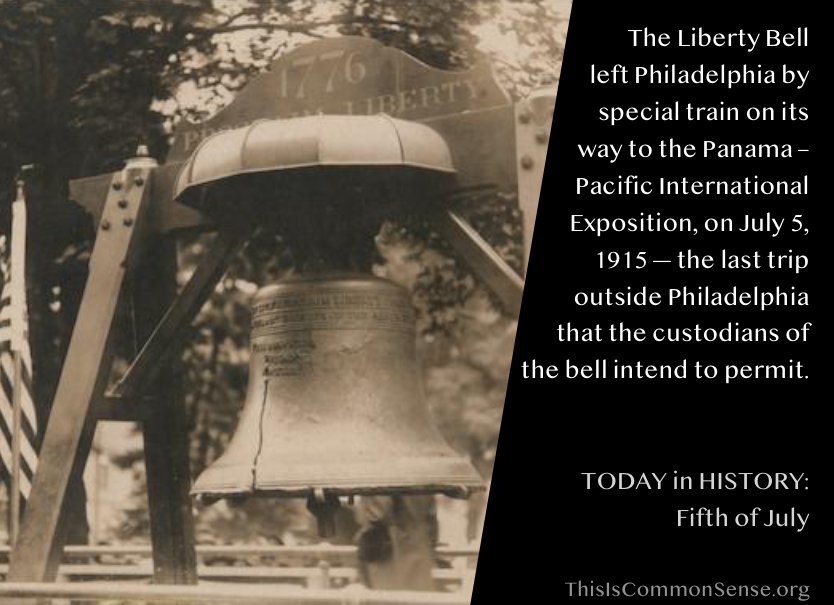
July Fifth

The Liberty Bell left Philadelphia by special train on its way to the Panama–Pacific International Exposition, on July 5, 1915 — the last trip outside Philadelphia that the custodians of the bell intend to permit.

In 1937 on this date, Spam, the luncheon meat, was introduced into the market by the Hormel Foods Corporation.

The Twenty-sixth Amendment to the United States Constitution, lowering the voting age from 21 to 18 years, was formally certified by President Richard Nixon on July 5, 1971.

On July 5, 1995, Armenia adopted its constitution, four years after the country’s independence from the Soviet Union.

Categories
Today

July Fourth Events

1054 – A supernova was spotted by Chinese, Arab, and possibly Amerindian observers. The celestial event occurred near the star Zeta Tauri, remaining, for several months, bright enough to be seen during the day. Its remnants form the Crab Nebula.

1776 — The Second Continental Congress approved the Declaration of Independence that had been submitted by committee members Thomas Jefferson, Benjamin Franklin, and John Adams, thus formalizing its policy of secession from the empire of the Kingdom of Great Britain.

1803 — The Louisiana Purchase was announced to the American people.

1804 – Nathaniel Hawthorne, American author of The Scarlet Letter, House of Seven Gables, The Blithesdale Romance, and other classics, was born. Hawthorne became part of the Young America literary movement spawned by Loco-Foco political activism in New England.

1826 – Thomas Jefferson, third president of the United States, died a few hours before John Adams, second president of the United States, on the fiftieth anniversary of the adoption of the United States’ Declaration of Independence.

1826 – Stephen Foster, composer of “Old Black Joe,” “Beautiful Dreamer,” and many other classic American songs, was born.

1827 – Slavery was abolished in New York State.

1831 – Samuel Francis Smith wrote “My Country, ’Tis of Thee” for Boston’s July 4th festivities, set to the tune of Great Britain’s national anthem, “God Save the King/Queen.”

2009 – The Statue of Liberty’s crown re-opened to the public after eight years of closure that resulted from security concerns following the September 11, 2001, attacks.
Categories
Today

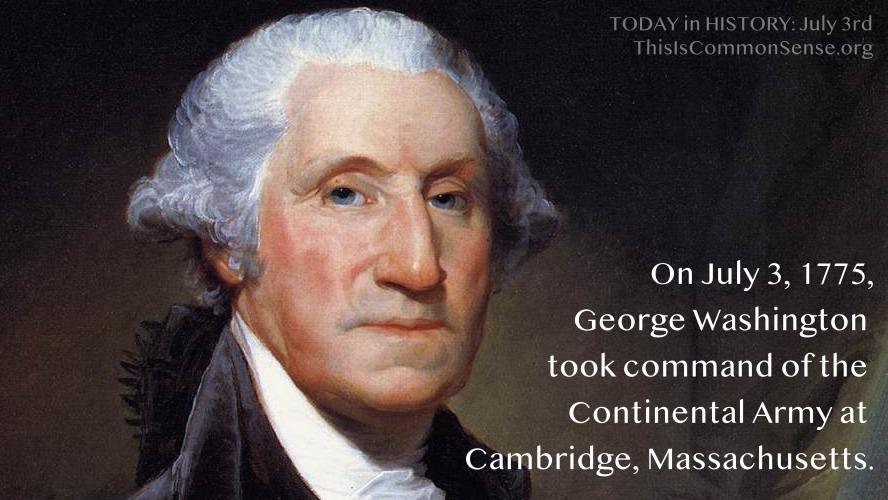
July Third

On July 3, 1775, George Washington took command of the Continental Army at Cambridge, Massachusetts.

In 1952 on July 3, Puerto Rico’s Constitution was approved by the Congress of the United States.

Categories
Today

Secession & Abolition

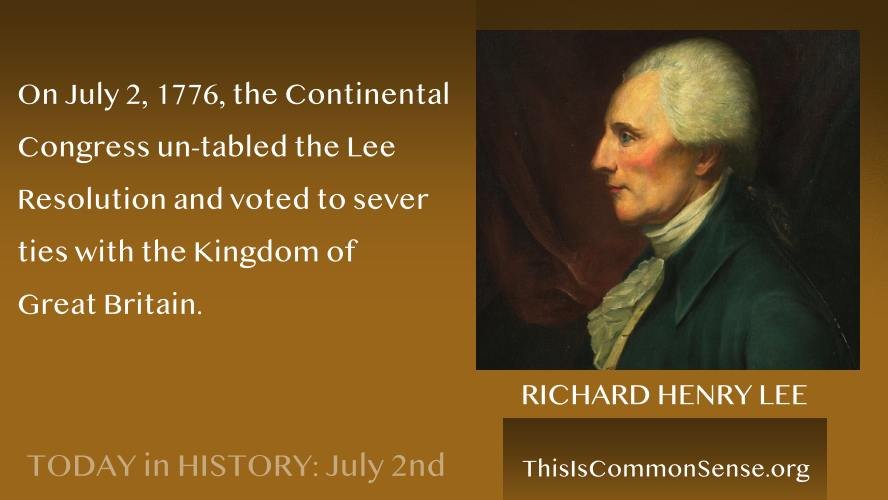
On July 2, 1776, the Continental Congress un-tabled the Lee Resolution and voted to sever ties with the Kingdom of Great Britain.

One year later, to the day, Vermont became the first American territory to abolish slavery.

Categories
Today

Natural Selection

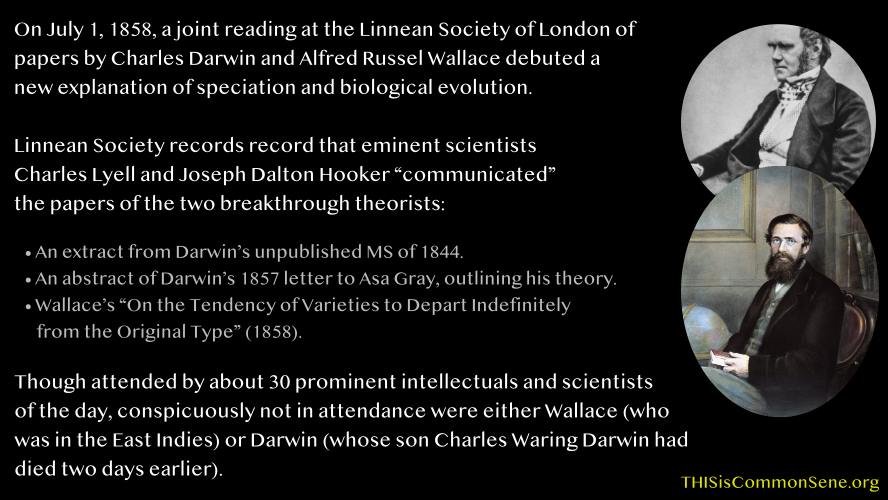
On July 1, 1858, a joint reading at the Linnean Society of London of papers by Charles Darwin and Alfred Russel Wallace debuted a new explanation of speciation and biological evolution.

Linnean Society records record that eminent scientists Charles Lyell and Joseph Dalton Hooker “communicated” the papers of the two breakthrough theorists:

  • An extract from Darwin’s unpublished manuscript (written in 1844, part of his Essay).
  • An abstract of Darwin’s 1857 letter to Asa Gray, outlining his theory.
  • Wallace’s essay, “On the Tendency of Varieties to Depart Indefinitely from the Original Type” (written in 1858).

Though attended by about 30 prominent intellectuals and scientists of the day, conspicuously not in attendance were either Wallace (who was in the East Indies) or Darwin (whose son Charles Waring Darwin had died two days earlier).

The event proved to be one of the more significant scientific presentations in the history of western civilization.

Categories
Today

An Assassin Hanged

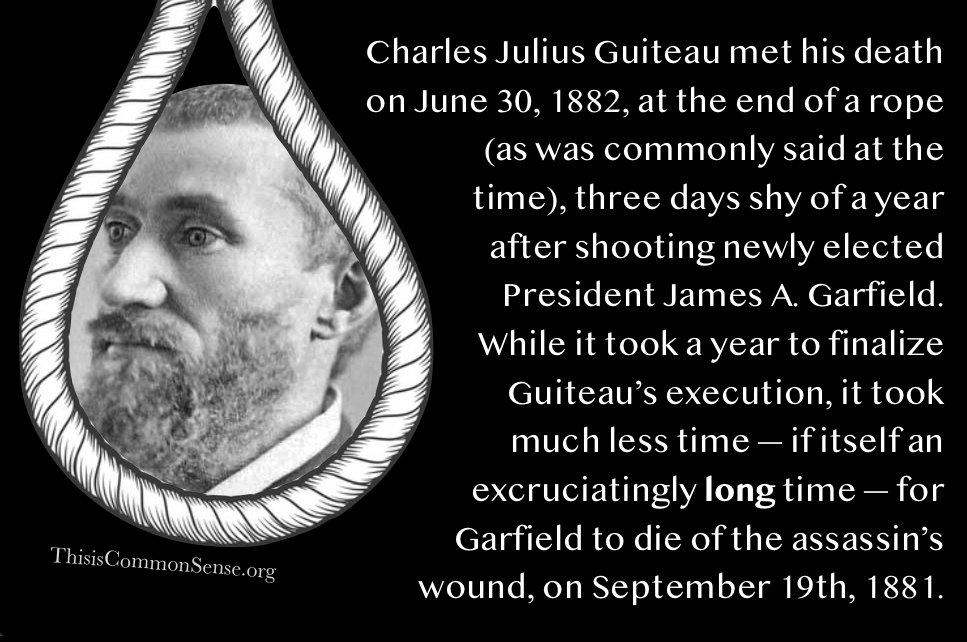
Charles Julius Guiteau met his death on June 30, 1882, at the end of a rope (as was commonly said at the time), three days shy of a year after shooting newly elected President James A. Garfield.

Guiteau was a member of the “Stalwart” faction of the Republican Party, devoted to the continuation of the kind of job-seeking corruption that Garfield, the reformer, opposed on principle. Despite being on the opposite team, so to speak, Guiteau was an ardent supporter of Garfield in the election campaign, and expected a diplomatic position in return. Failing to gain such a position in the new administration, Guiteau decided upon a sort of mad revenge as the apt response to Garfield’s “betrayal.”

While it took a year to finalize Guiteau’s execution, it took much less time — if itself an excruciatingly long time — for Garfield to die of the wound and the subsequent doctoring, on September 19th, 1881.