Categories
Today

Kauaʻi & Fire

On July 19, 1817, Georg Anton Schäffer — unsuccessful in his attempt to conquer the Kingdom of Hawaiʻi for the Russian-American Company — was forced to admit defeat and leave Kauaʻi. The effort had begun in 1815 as a shipwreck recovery mission but escalated after the German physician in the company’s employ had been played by native politicians. Legal action against Schäffer — considered, after the fact, a bungler (his efforts cost his employer over 200,000 roubles) — proved unsuccessful.


In A.D. 64 on the 19th of July, the Great Fire of Rome began. It caused widespread devastation and raged for six days, destroying half the city.

One thousand seven hundred eighty-one years later, the last great fire to affect Manhattan began early in the morning and was subdued that afternoon. This “Great New York City Fire of 1845” killed four firefighters and 26 civilians, destroying 345 buildings.

Categories
Today

Succession?

President Harry S. Truman signed the Presidential Succession Act on July 18, 1947. Article II, Section 1, Clause 6 of the United States Constitution authorizes Congress to enact such a statute, which Congress has done on three occasions: 1792, 1886, and 1947. The 1947 Act was last revised 59 years after passing, in 2006.

Categories
Today

Wrong Way?

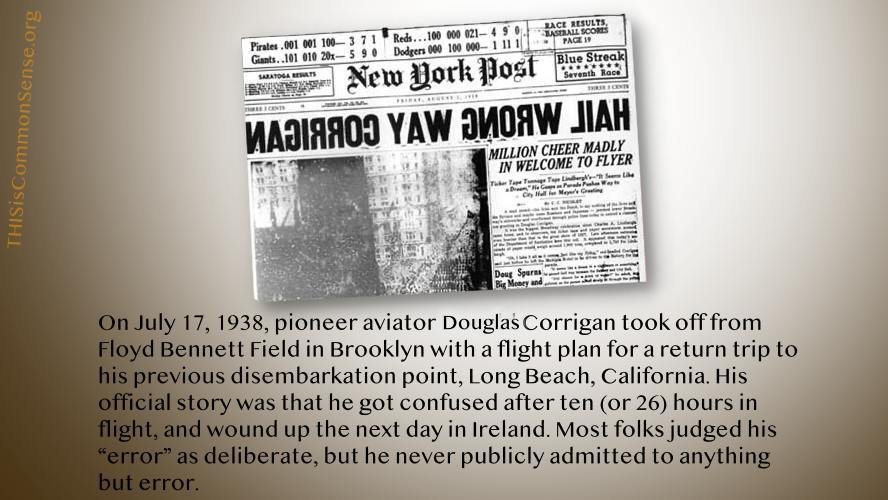
On July 17, 1938, pioneer aviator Douglas Corrigan took off from Floyd Bennett Field in Brooklyn — New York City’s first municipal airport — with a flight plan for a return trip to his previous disembarkation point, Long Beach, California. His official story was that he got confused after ten (or 26) hours in flight, and wound up the next day in Ireland. Most folks judged his “error” as deliberate, but he never publicly admitted to anything but error. He was nicknamed “‘Wrong Way’ Corrigan,” an affectionate moniker, and received a 14-day suspension of his pilot’s license as punishment for his breaking of many, many regulations.

One occasionally hears the epithet “Wrong Way Corrigan” applied to anyone who similarly takes a slight liberty, skirting official rules or practices — or simply goes the wrong direction.


July 17, 1975, had a very different kind of aviation event, one well-planned: Apollo 18 and Soyuz 19 made the first US/USSR linkup in space.

Categories
Today

Ethiopia

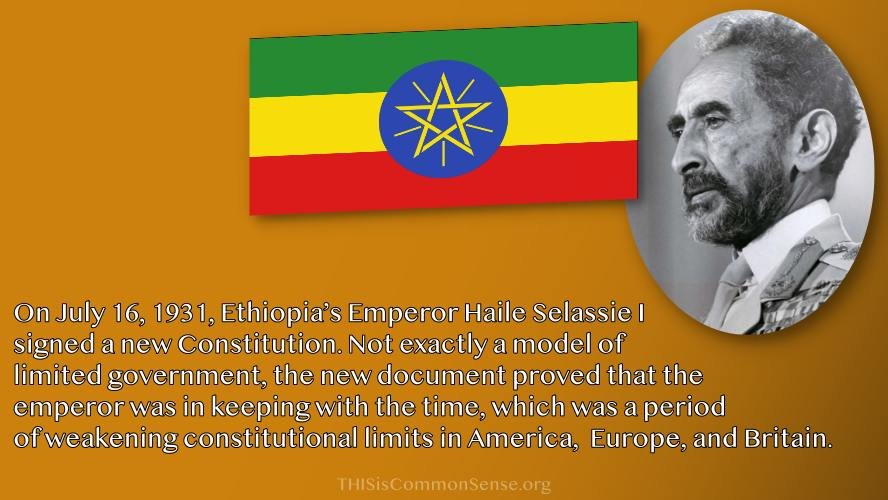
On July 16, 1931, Ethiopia’s Emperor Haile Selassie I signed a new Constitution. Not exactly a model of limited government, the new document proved that the emperor was in keeping with the time, which was a period of weakening constitutional limits in America, Europe, and Britain. A flavor of the document can be gained by its most “rights-oriented” measures:

Art. 22. Within the limits laid down by the law, Ethiopian subjects have the right to pass freely from one place to the other.
Art. 23. No Ethiopian subject may be arrested, sentenced, or imprisoned except in pursuance of the law.
Art. 24. No Ethiopian subject may, against his will, be deprived of his right to be tried by a legally established court.
Art. 25. Except in cases provided for by law, no domiciliary searches may be made.
Art. 26. Except in cases provided by the law, no one shall have the right to violate the secrecy of the correspondence of Ethiopian subjects.
Art. 27. Except in cases of public necessity determined by the law, no one shall have the right to deprive an Ethiopian subject of any movable or landed property which he owns.
Art. 28. All Ethiopian subjects have the right to present to the Government petitions in legal form.
Art. 29. The provisions of the present chapter shall in no way limit the measures which the Emperor, by virtue of his supreme power, may take in the event of war or public misfortunes menacing the interests of the nation.

Categories
Today

“Malaise”

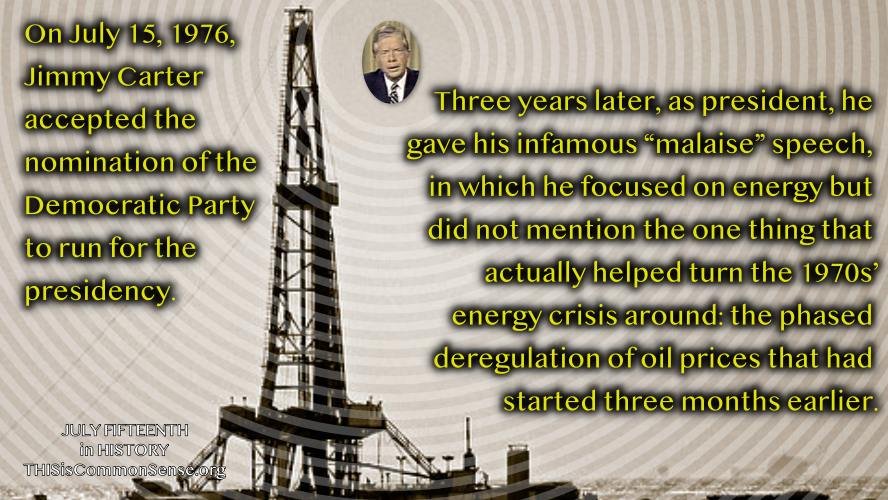
On July 15, 1976, Jimmy Carter accepted the nomination of the Democratic Party to run for the presidency.

Three years later, as president, he gave his infamous “malaise” speech, in which he focused on energy but did not mention the one thing that actually helped turn the 1970s’ energy crisis around: the phased deregulation of oil prices that had started three months earlier, under his own directive. Instead of touting this deregulatory effort, Carter did the politic thing, promising a number of new government programs while extensively grinding a “crisis of confidence” message and vaguely speaking of a spiritual challenge.

The deregulation was startlingly effective, in the long run — though the immediate effect was a rocketing of prices. These high prices presented profit opportunities, and (lo and behold!) domestic production greatly increased, allowing for many, many years of lower prices. Those high prices would have worked better as market signals had not Carter and Congress also established “windfall profits” taxes, to take away those temporary gains to existing business.

Had Carter deregulated prices earlier, he would probably have been re-elected president. Had he emphasized deregulation, he probably would have beat back Ronald Reagan’s free market rhetoric — with actual action.

The price controls had been put in place earlier in the decade by the Republican president at the time, Richard M. Nixon, with the great help of his aides Dick Cheney and Donald Rumsfeld.

Categories
Today

The Bastille Stormed

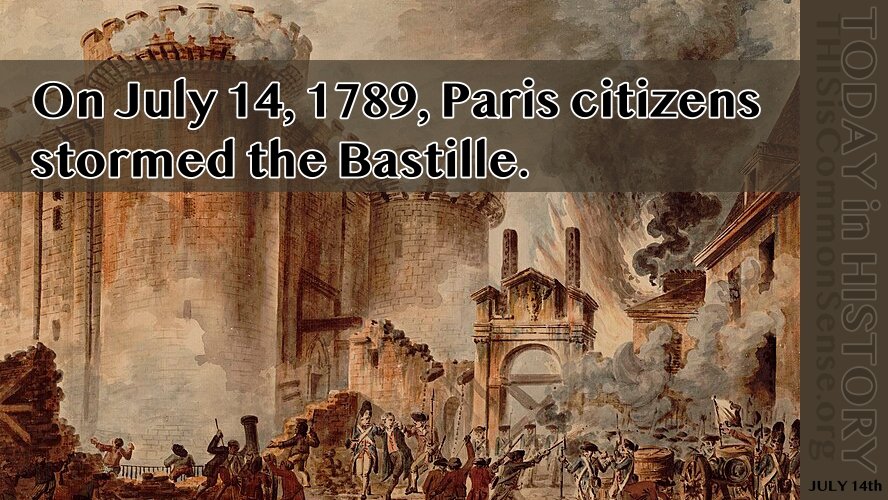
On July 14, 1789, Paris citizens stormed the Bastille.

The word “storm” in its various forms is almost invariably paired with “Bastille” in discussions of the event. It is one of the great clichés of historical chitchat.


On the same date nine years later, in America, the Sedition Act was signed into law, prohibiting the writing, publishing, or speaking false or malicious statements about the United States government.

The passage of this repressive law spurred the formation of the first opposition party in the United States, with Thomas Jefferson as its leader and figurehead.

Categories
Today

The Nixon Tapes

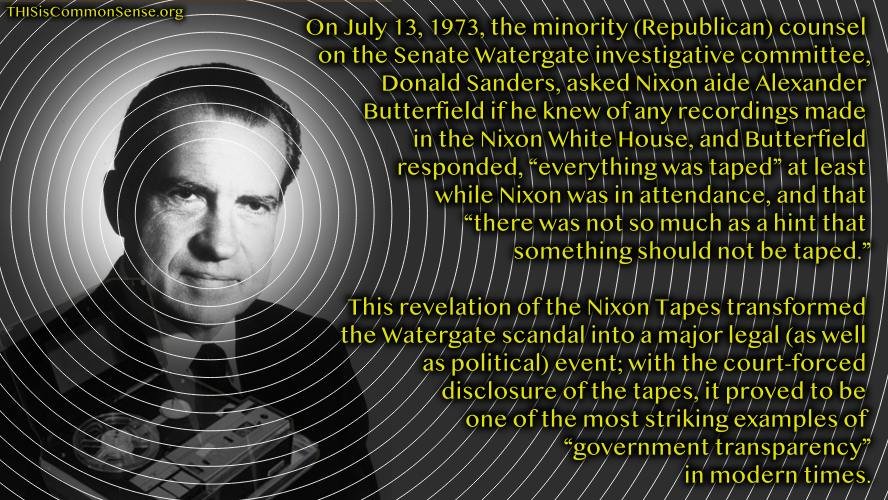
On July 13, 1973, the minority (Republican) counsel on the Senate Watergate investigative committee, Donald Sanders, asked Nixon aide Alexander Butterfield if he knew of any recordings made in the Nixon White House, and Butterfield responded, “everything was taped” at least while Nixon was in attendance, and that “there was not so much as a hint that something should not be taped.”

This revelation of the Nixon Tapes transformed the Watergate scandal into a major legal (as well as political) event; with the court-forced disclosure of the tapes, it proved to be one of the most striking examples of “government transparency” in modern times.

Categories
Today

Two Expulsions

On July 12, 1917, vigilantes kidnapped and deported nearly 1,300 striking miners and others from Bisbee, Arizona. This came to be known as the Bisbee Deportation.

On the same day in 1948, Israeli Prime Minister David Ben-Gurion ordered the expulsion of Palestinians from the towns of Lod and Ramla.

Categories
Today

The Weehawken Duel

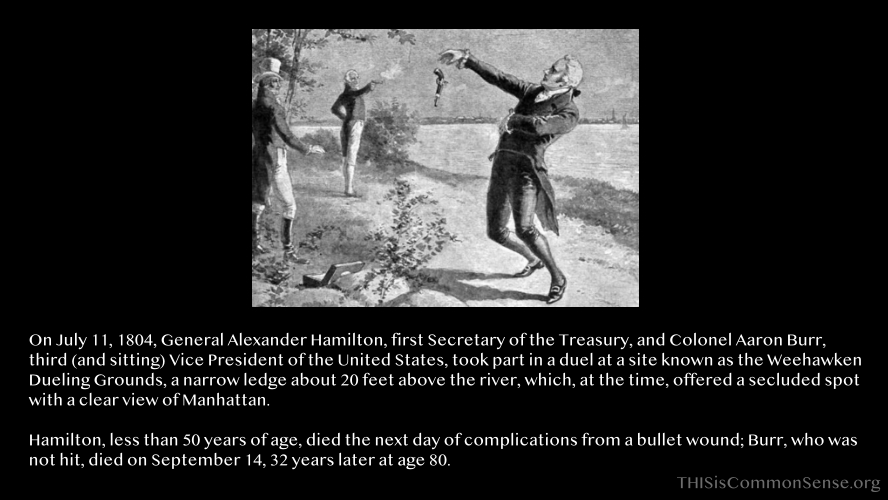
On July 11, 1804, General Alexander Hamilton, first Secretary of the Treasury, and Colonel Aaron Burr, third (and sitting) Vice President of the United States, took part in a duel at a site known as the Weehawken Dueling Grounds, a narrow ledge about 20 feet above the river, which, at the time, offered a secluded spot with a clear view of Manhattan. 

Hamilton, less than 50 years of age, died the next day of complications from a bullet wound; Burr, who was not hit, died on September 14, 32 years later at age 80.

Categories
Today

Anti-Bankster

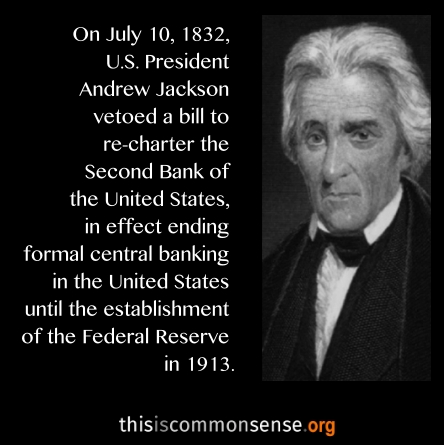
On July 10, 1832, U.S. President Andrew Jackson vetoed a bill to re-charter the Second Bank of the United States, in effect ending formal central banking in the United States until the establishment of the Federal Reserve in 1913.