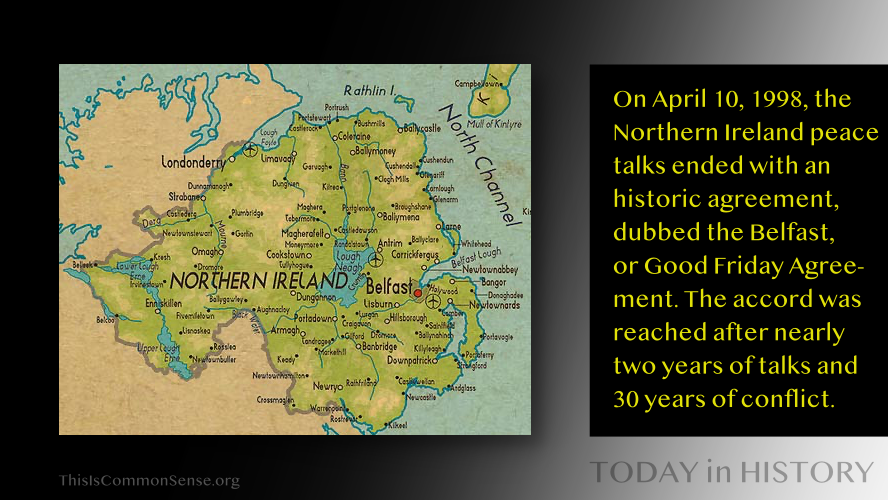
On April 10, 1998, the Northern Ireland peace talks ended with an historic agreement, dubbed the Belfast, or Good Friday Agreement. The accord was reached after nearly two years of talks and 30 years of conflict.
The agreement was approved by voters across the island of Ireland in two referendums held on May 22, 1998. The agreement came into force on December 2, 1999.
Despite being outnumbered 16 to one, forces of the Old Swiss Confederacy proved victorious over the Archduchy of Austria in the Battle of Näfels, April 9, 1388.
On this date in 1991, Georgia declared its independence from the Soviet Union.
On April 8, 1913, the 17th amendment to the Constitution, providing for the popular election of U.S. senators, was ratified.
Prior to this, senators had been appointed by state legislatures. It was John Dickinson of Delaware who suggested that the Senate be selected by state legislatures. “The combination of the state governments with the national government was as politic as it was unavoidable,” he argued. But as early as 1826, resolutions calling for direct popular election of senators appeared in the House of Representatives, but none succeeded. Following the Civil War, disputes among state legislators over Senate elections resulted in deadlocks, leaving some Senate seats vacant for long periods — Delaware remained without representation in the U.S. Senate for two years. In light of such problems, reformers in many states began calling for a change to the system of electing senators. In 1906, publisher William Randolph Hearst, a proponent of direct election, hired novelist David Graham Phillips to write a number of articles on the subject. Phillips’ series, “The Treason of the Senate,” portrayed senators as pawns of industrialists and financiers — with no small amount of hyperbole (to put it politely). The articles further galvanized public support for reform.
Senator Joseph Bristow of Kansas offered, in 1911, a Senate resolution to amend the Constitution. In two years the Constitution was amended.
On April 7, 1933, Prohibition in the United States was repealed for beer of no more than 3.2 percent alcohol by weight — eight months before the ratification of the 21st amendment, which repealed the 18th (or Prohibition) Amendment.
The enabling legislation was the Cullen-Harrison Act, which figured the low alcohol content as the excuse to get around the 18th Amendment’s prohibition of intoxicating beverages. The act passed Congress on March 21, 1933, and was signed into law by Franklin Delano Roosevelt the next day.
On April 5, 1792, George Washington exercised the first presidential veto of a congressional bill, a new plan for dividing seats in the House of Representatives, which would have increased the number of seats for northern states.
Washington vetoed only one other bill during his two terms in office, an act that would have reduced the number of cavalry units in the army.
UFOs exist. Not just hearsay or fuzzy photos of unidentified, apparent aerial phenomena — and not mere testimony from government officials, as in the case of but actual scientific evidence of artificial shiny objects in orbit around Earth.
In the 1950s. Before Sputnik.
So, more accurately, it appears that, at the very least, UFOs existed!
In orbit, before the Soviets sent up the first satellite (as we have read in the history books and what some of us remember from the news when we were young).
“The studies by Dr. Beatriz Villarroel and her colleagues have identified bright ‘transient’ objects that appeared in photographs but were not present in photographs taken soon thereafter,” explainsThe Washington Examiner. “The transient nature of these lights strongly suggests they are not stars.” Indeed, Dr. Villarroel and her colleagues go much further, weeding out any natural explanations. Hundreds, perhaps thousands of examples of these transients not only appear on photographic plates from the 1950s taken from the Palomar Observatory.
Since these studies hit the news a few years ago, we haven’t heard much on it from major news sources despite its obvious news value and historic importance. But Dr. Villarroel has not stopped working on the project, and has maintained a fairly heavy podcast presence.
Now a new paper from Ivo Busko, late of NASA, appears to confirm Villarroel’s results, using plates from a different astronomical observatory.
Meanwhile, Representatives Anna Paulina Luna (R-Fla.) and Tim Burchett (R-Tenn.) have made news regarding their work in Congress investigating UFOs (the Deep State calls them “UAPs” now). When Rep. Luna called for defunding AARO, the All-domain Anomaly Resolution Office, because she says it keeps lying to Congress, Burchett leaped quickly on board.
I’ve been briefed by just about every alphabet agency there is, and I’ll just tell you this: if they would release the things that I’ve seen, you would stay up — you’d be up at night worrying about or thinking about this stuff.
We just need to disclose it all. I’m sick of it. Well, I was briefed — I’ll just tell you this — I was briefed last week on an issue, or excuse me, two weeks ago, and it would have set the earth on fire.
This country would have come unglued, I think, if they would have heard all that I heard. They would demand answers.
And we need to — but you know, it’s never going to get — unfortunately, it just keeps getting covered up and covered up, and the people that know are dying or disappearing, as the case may be.
Paul Jacob has been covering the ongoing UFO disclosure story for some time, demanding transparency:
On April 4, 1841, William Henry Harrison died of pneumonia, becoming the first President of the United States to die in office and the one with the shortest term served (he died on his 32nd day as president). A renowned Indian killer (having risen to fame for his part in 1811’s Battle of Tippecanoe), a proponent of the expansion of slavery into Northwest Territories, and a Whig, Harrison won the presidency in part by turning the Democrats’ “log cabin and hard cider” aspersions on his character as the basic symbols of the campaign.
Though hardly a “limited government man,” some libertarian history buffs proclaim him the Greatest President, on the ostensibly droll and possibly cynical grounds that he spent so little time in office.
The campaign slogan of 1840, “Tippecanoe and Tyler Too,” proved an actual campaign promise, as Vice President John Tyler took over the job of the presidency, establishing a precedent on presidential succession that would later be enshrined into constitutional law, in the form of the Twenty-fifth Amendment.
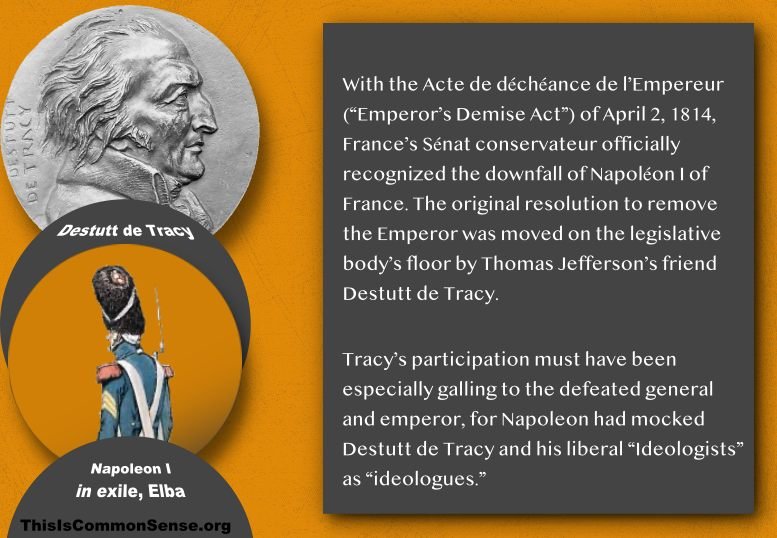
With the Acte de déchéance de l’Empereur (“Emperor’s Demise Act”) of April 2, 1814, France’s Sénat conservateur officially recognized the downfall of Napoléon I of France. The original resolution to remove the Emperor was moved on the legislative body’s floor by Thomas Jefferson’s friend Destutt de Tracy* and was drawn up by Charles Lambrechts. The final paragraph summarized the new reality concisely:
The Senate declares and decrees as follows: 1. Napoleon Buonaparte is cast down from the throne, and the right of succession in his family is abolished. 2. The French people and army are absolved from their oath of fidelity to him. 3. The present decree shall be transmitted to the departments and armies, and proclaimed immediately in all the quarters of the capital.
Nine days later, after attempting to put his son on the throne, Napoléon abdicated unconditionally. The Allies exiled him to Elba, which was to be the whole extent of this reign as “Emperor.”
This arrangement proved unstable, with Napoléon staging a comeback, eventually leading to more war, his defeat at Waterloo, and his exile to an island in the South Atlantic.
* According to Tracy himself — official records do not name the member.