Categories
Thought

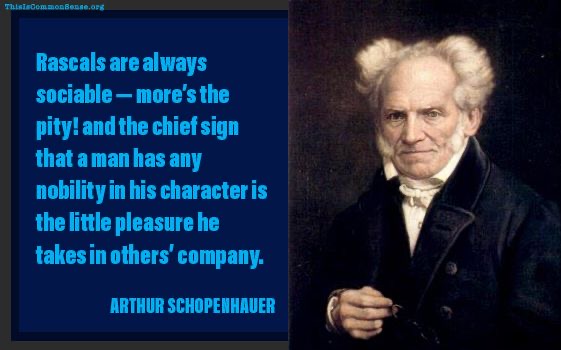
Arthur Schopenhauer

Rascals are always sociable — more’s the pity! and the chief sign that a man has any nobility in his character is the little pleasure he takes in others’ company.

Arthur Schopenhauer, Aphorismen zur Lebensweisheit (On The Wisdom of Life: Aphorisms), Vol. 1, Ch. 5, § 9.
Categories
Thought

Adam Smith

To hurt in any degree the interest of any one order of citizens, for no other purpose but to promote that of some other, is evidently contrary to that justice and equality of treatment which the sovereign owes to all the different orders of his subjects.

Adam Smith, An Inquiry into the Nature and Causes of the Wealth of Nations (1776).

Categories
Thought

Ludwig von Mises

If we wish to gain insight into the essence of nationality, we must proceed not from the nation but from the individual. We must ask ourselves what the national aspect of the individual person is and what determines his belonging to a particular nation.

Ludwig von Mises, Nation, State and Economy (1919; 1983, Leland B. Yeager, trans.), p. 34.
Categories
Thought

Jonathan Haidt

Our politics will become more civil when we find ways to change the procedures for electing politicians and the institutions and environments within which they interact.

Jonathan Haidt, The Righteous Mind: Why Good People Are Divided by Politics and Religion (2012).
Categories
Thought

Ludwig von Mises

It is not the task of history to project the hatred and disagreements of the present back into the past and to draw from battles fought long ago weapons for the disputes of one’s own time. History should teach us to recognize causes and to understand driving forces; and when we understand everything, we will forgive everything.

Ludwig von Mises, Nation, State and Economy (1919; 1983, Leland B. Yeager, trans.), p. 28.
Categories
Thought

Adam Smith

In every country it always is and must be the interest of the great body of the people to buy whatever they want of those who sell it cheapest. The proposition is so very manifest, that it seems ridiculous to take any pains to prove it; nor could it ever have been called in question, had not the interested sophistry of merchants and manufacturers confounded the common sense of mankind.

Adam Smith, An Inquiry into the Nature and Causes of the Wealth of Nations (1776).

Categories
Thought

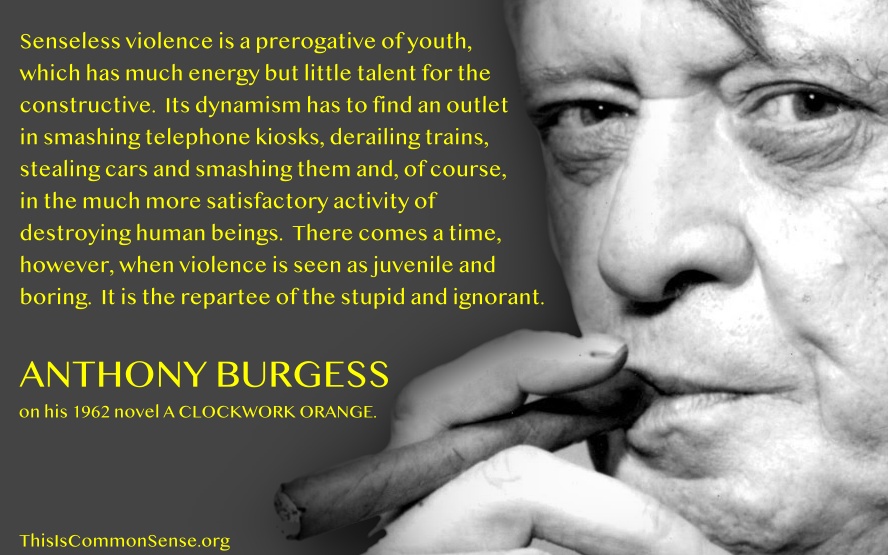
Anthony Burgess

Senseless violence is a prerogative of youth, which has much energy but little talent for the constructive. Its dynamism has to find an outlet in smashing telephone kiosks, derailing trains, stealing cars and smashing them and, of course, in the much more satisfactory activity of destroying human beings. There comes a time, however, when violence is seen as juvenile and boring.  It is the repartee of the stupid and ignorant.

Anthony Burgess, Introduction (“A Clockwork Orange Resucked”) to a later, restored version of his 1962 novel A Clockwork Orange. The American publishers of the novel elided the 21st and last chapter to his novel of futuristic “ultra-violence,” and in this introduction the author explained the publication history.
Categories
Thought

Jack Woodford

Americans pass a law against liquor and go right on drinking; they frown, publicly and openly upon the relationship of mistress and lover, and go right on having such relationships under cover. They draw up huge categories of business ethics, and American business is rotten to the core. It’s America’s fetich: this, ‘Save the Surface and You Save All,’ theory.

The character Nausicaa Bradford in Jack Woodford’s novel Unmoral, 1934.

Categories
Thought

Michel Chevalier

War, the last argument of kings and people, war, in which they put forth their strength with pride, is not, however, the greatest exhibition of human power. A field of battle may excite terror or a feverish enthusiasm, pity or horror; but human strength applied to create is more imposing, than human strength employed in slaughter and destruction.

Michel Chevalier, Society, manners and politics in the United States; being a series of letters on North America (Boston: Weeks, Jordan and Company, 1839), p. 133-134.
Categories
Thought

Daniel Defoe

It is better to have a lion at the head of an army of sheep than a sheep at the head of an army of lions.

Daniel Defoe, The Life and Adventures of Christian Davies (1741).