People who fear death . . . live no longer than those who don’t, and live scared.
Gene Wolfe, The Knight (2004), p. 384.
Categories
Gene Wolfe
People who fear death . . . live no longer than those who don’t, and live scared.
Gene Wolfe, The Knight (2004), p. 384.
What is essential to the idea of a slave? We primarily think of him as one who is owned by another. To be more than nominal, however, the ownership must be shown by control of the slave’s actions — a control which is habitually for the benefit of the controller. That which fundamentally distinguishes the slave is that he labours under coercion to satisfy another’s desires. The relation admits of sundry gradations. Remembering that originally the slave is a prisoner whose life is at the mercy of his captor, it suffices here to note that there is a harsh form of slavery in which, treated as an animal, he has to expend his entire effort for his owner’s advantage. Under a system less harsh, though occupied chiefly in working for his owner, he is allowed a short time in which to work for himself, and some ground on which to grow extra food. A further amelioration gives him power to sell the produce of his plot and keep the proceeds. Then we come to the still more moderated form which commonly arises where, having been a free man working on his own land, conquest turns him into what we distinguish as a serf; and he has to give to his owner each year a fixed amount of labour or produce, or both: retaining the rest himself. Finally, in some cases, as in Russia before serfdom was abolished, he is allowed to leave his owner’s estate and work or trade for himself elsewhere, under the condition that he shall pay an annual sum. What is it which, in these cases, leads us to qualify our conception of the slavery as more or less severe? Evidently the greater or smaller extent to which effort is compulsorily expended for the benefit of another instead of for self-benefit. If all the slave’s labour is for his owner the slavery is heavy, and if but little it is light. Take now a further step. Suppose an owner dies, and his estate with its slaves comes into the hands of trustees; or suppose the estate and everything on it to be bought by a company; is the condition of the slave any the better if the amount of his compulsory labour remains the same? Suppose that for a company we substitute the community; does it make any difference to the slave if the time he has to work for others is as great, and the time left for himself is as small, as before? The essential question is — How much is he compelled to labour for other benefit than his own, and how much can he labour for his own benefit? The degree of his slavery varies according to the ratio between that which he is forced to yield up and that which he is allowed to retain; and it matters not whether his master is a single person or a society. If, without option, he has to labour for the society, and receives from the general stock such portion as the society awards him, he becomes a slave to the society.
Herbert Spencer, “The Coming Slavery,” The Contemporary Review (April 1884), p. 474. See also The Man versus the State (1884).
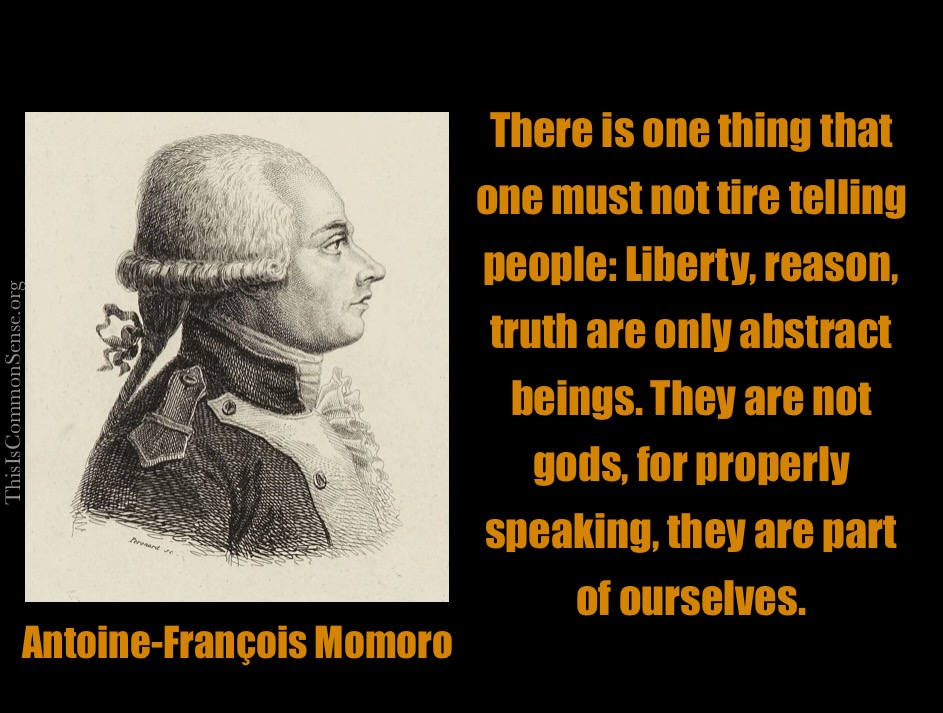
There is one thing that one must not tire telling people: Liberty, reason, truth are only abstract beings. They are not gods, for properly speaking, they are part of ourselves.
Antoine-François Momoro as quoted in Emmet Kennedy, A Cultural History of the French Revolution (1989). See also “20 Brumaire, Year II.” Momoro was guillotined on 4 Germinal, Year II (March 24, 1794).
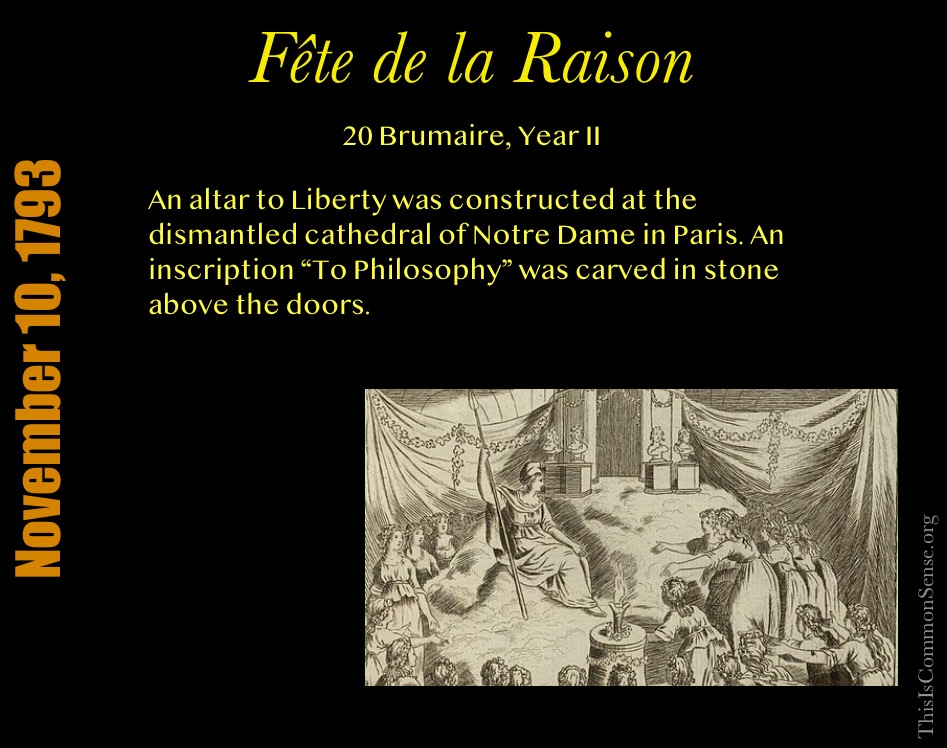
An altar to Liberty was constructed at the dismantled cathedral of Notre Dame in Paris; an inscription “To Philosophy” was carved in stone above the doors — all at “The Festival of Reason” on 20 Brumaire, Year II (November 10, 1793).
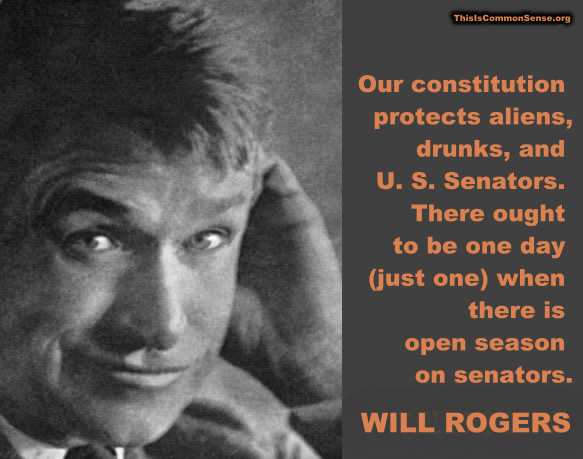
Our constitution protects aliens, drunks, and U. S. Senators. There ought to be one day (just one) when there is open season on senators.
Will Rogers, Daily Telegram number 2678 (March 6, 1935).
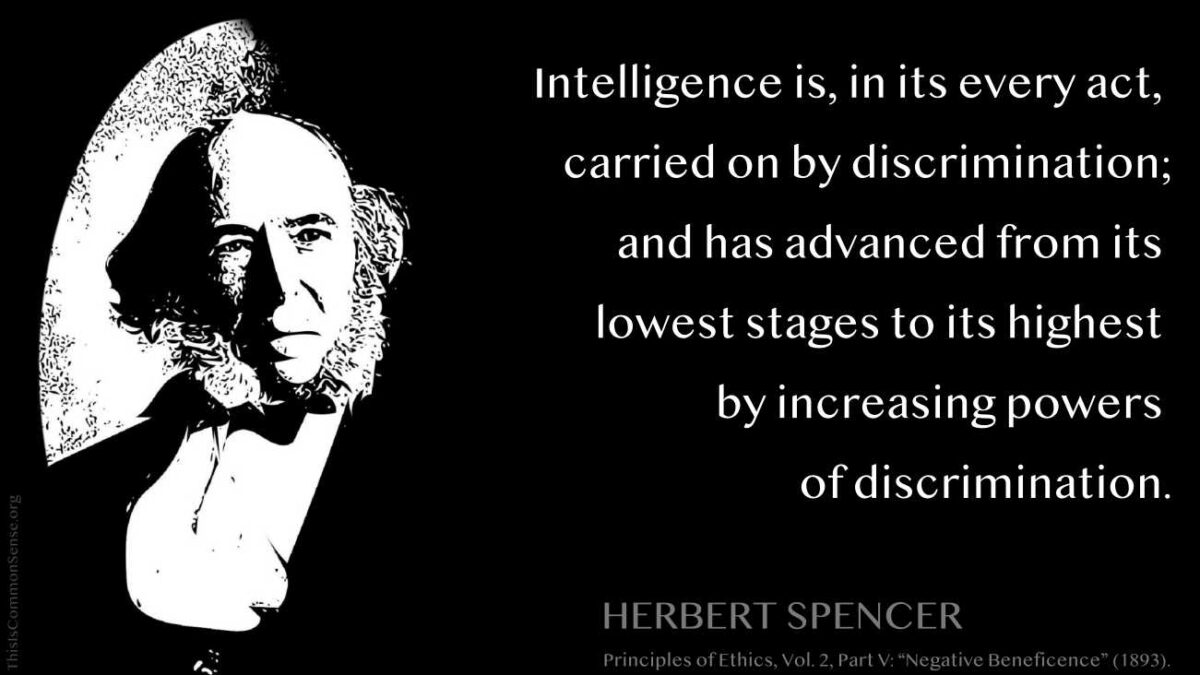
Herbert Spencer, Principles of Ethics, Vol. 2, Part V: “Negative Beneficence” (1893), Chapter 1: “The Kinds of Altruism.”
The mental action by which from moment to moment we thus, in ways commonly too rapid to observe, class the objects and acts around, and regulate our conduct accordingly, has been otherwise named by some, and especially by Professor Bain, ‘discrimination.’ Intelligence is, in its every act, carried on by discrimination; and has advanced from its lowest stages to its highest by increasing powers of discrimination. It has done this for the sufficient reason that during the evolution of life under all its forms, increase of it has been furthered by practice or habit as well as by survival of the fittest; since good discrimination has been a means of saving life, and lack of it a cause of losing life.
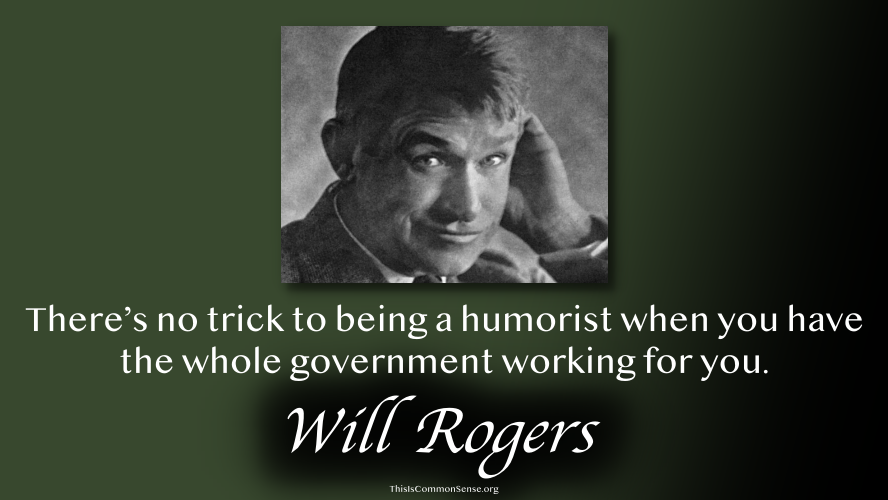
There’s no trick to being a humorist when you have the whole government working for you.
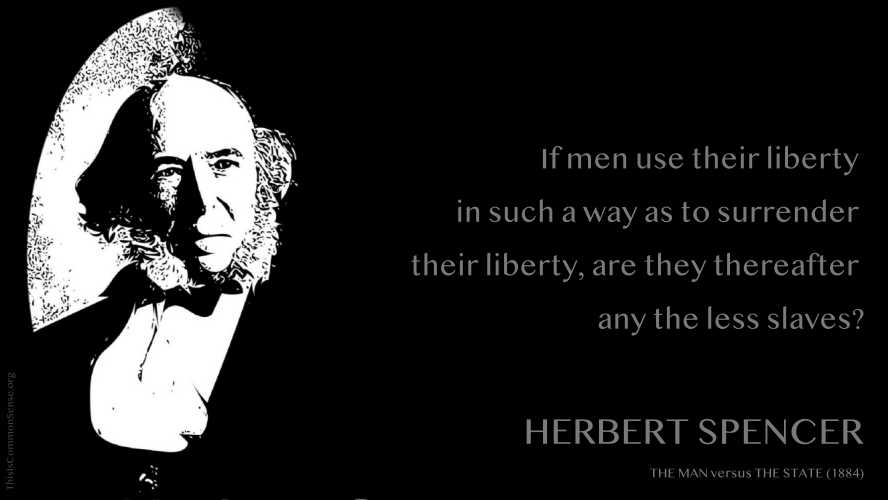
Herbert Spencer, “The New Toryism,” The Man Versus the State (1884).
If men use their liberty in such a way as to surrender their liberty, are they thereafter any the less slaves?
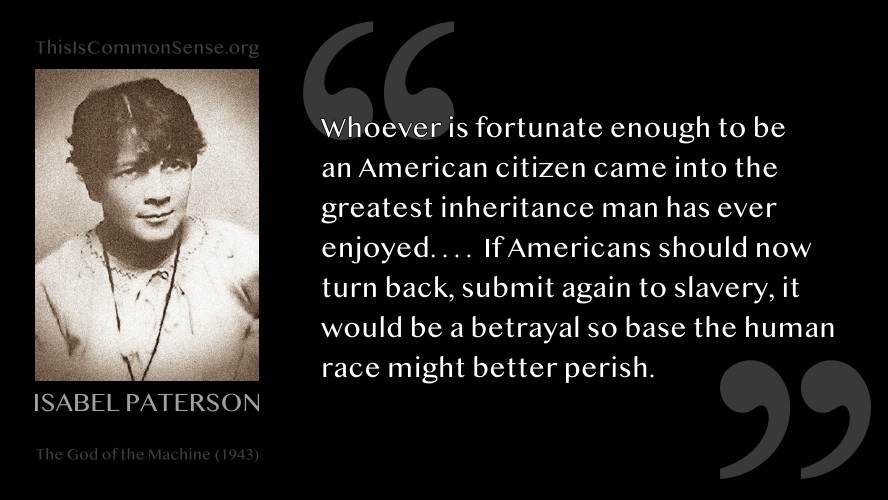
Whoever is fortunate enough to be an American citizen came into the greatest inheritance man has ever enjoyed. He has had the benefit of every heroic and intellectual effort men have made for many thousands of years, realized at last. If Americans should now turn back, submit again to slavery, it would be a betrayal so base the human race might better perish.
Isabel Paterson, The God of the Machine (1943), p. 292.
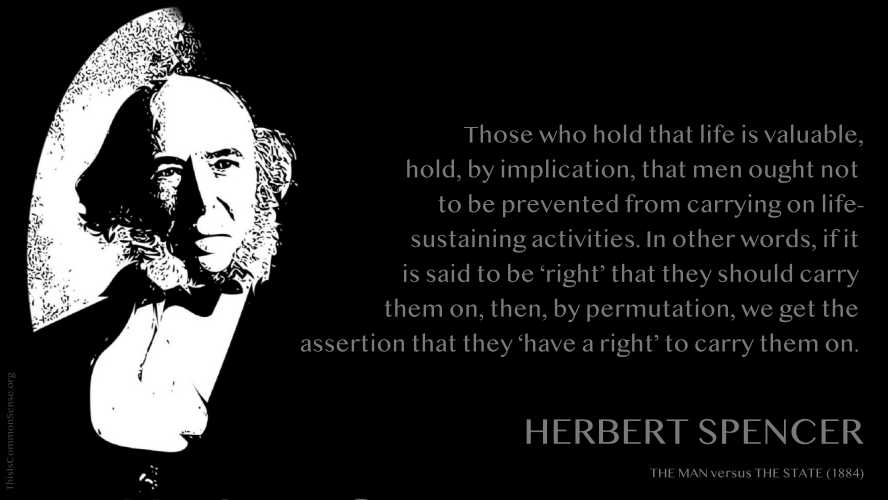
Herbert Spencer, “The Great Political Superstition,” The Man versus The State (1884).
If we adopt pessimism as a creed, and with it accept the implication that life in general being an evil should be put an end to, then there is no ethical warrant for these actions by which life is maintained: the whole question drops. But if we adopt either the optimist view or the meliorist view — if we say that life on the whole yields more pleasure than pain; or that it is on the way to become such that it will yield more pleasure than pain; then these actions by which life is maintained are justified, and there results a warrant for the freedom to perform them. Those who hold that life is valuable, hold, by implication, that men ought not to be prevented from carrying on life-sustaining activities. In other words, if it is said to be ‘right’ that they should carry them on, then, by permutation, we get the assertion that they ‘have a right’ to carry them on. Clearly the conception of ‘natural rights’ originates in recognition of the truth that if life is justifiable, there must be a justification for the performance of acts essential to its preservation; and, therefore, a justification for those liberties and claims which make such acts possible.