Categories
Thought

Ludwig von Mises

Socialism is not in the least what it pretends to be. It is not the pioneer of a better and finer world, but the spoiler of what thousands of years of civilization have created. It does not build; it destroys. For destruction is the essence of it. It produces nothing, it only consumes what the social order based on private ownership in the means of production has created.

Ludwig von Mises, Socialism: An Economic and Sociological Analysis (1922), Part V.
Categories
Thought

Hugo Grotius

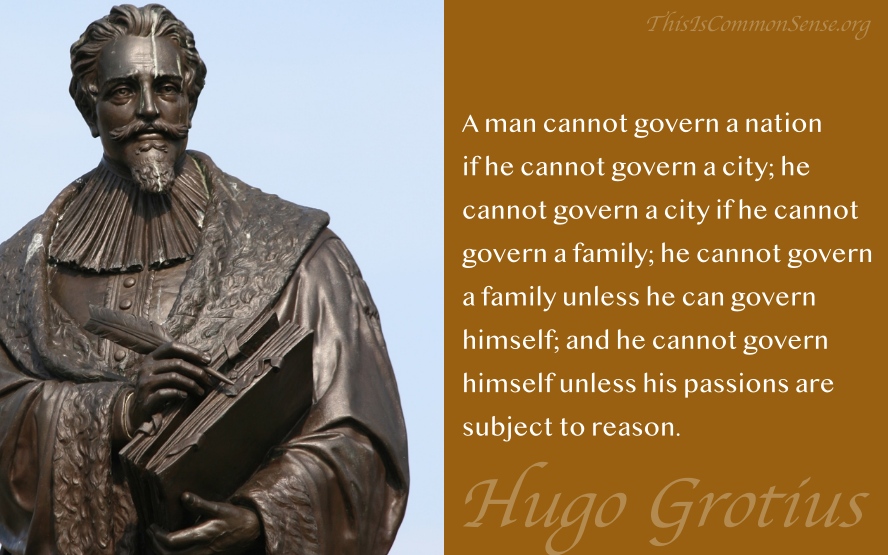
A man cannot govern a nation if he cannot govern a city; he cannot govern a city if he cannot govern a family; he cannot govern a family unless he can govern himself; and he cannot govern himself unless his passions are subject to reason.

Categories
Thought

Mary Wollstonecraft

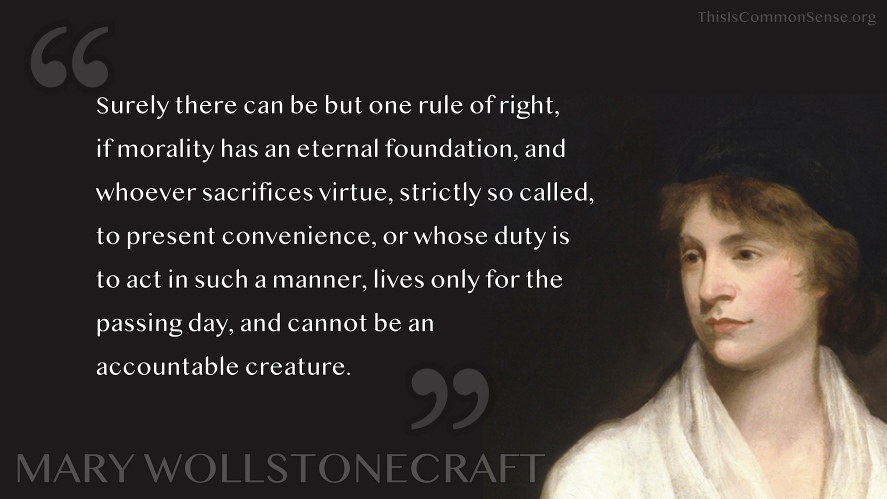
Surely there can be but one rule of right, if morality has an eternal foundation, and whoever sacrifices virtue, strictly so called, to present convenience, or whose duty is to act in such a manner, lives only for the passing day, and cannot be an accountable creature.

Mary Wollstonecraft, A Vindication of the Rights of Woman (1792).
Categories
Thought

Herbert Spencer

Sympathy which, a generation ago, was taking the shape of justice, is relapsing into the shape of generosity; and the generosity is exercised by inflicting injustice. Daily legislation betrays little anxiety that each shall have that which belongs to him, but great anxiety that he shall have that which belongs to somebody else. For while no energy is expended in so reforming our judicial administration that everyone may obtain and enjoy all he has earned, great energy is shown in providing for him and others benefits which they have not earned. Along with that miserable laissez-faire which calmly looks on while men ruin themselves in trying to enforce by law their equitable claims, there goes activity in supplying them, at other men’s cost, with gratis novel-reading!

Herbert Spencer, Principles of Ethics, Vol. 2, Part IV: “Justice” (1891), Chapter 5, “The Idea of Justice.”
Categories
Thought

Herbert Spencer

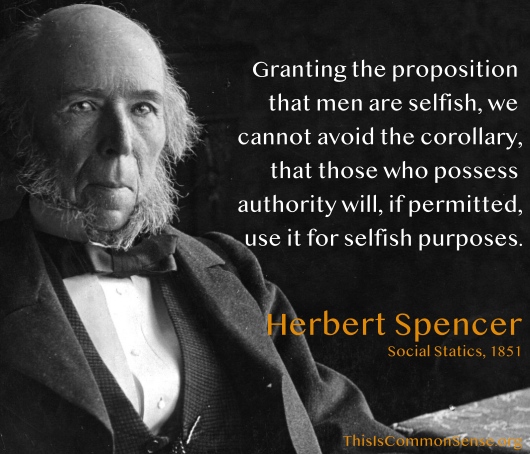
It is a tolerably well-ascertained fact that men are still selfish. And that beings answering to this epithet will employ the power placed in their hands for their own advantage is self-evident. Directly or indirectly, either by hook or by crook, if not openly, then in secret, their private ends will be served. Granting the proposition that men are selfish, we cannot avoid the corollary, that those who possess authority will, if permitted, use it for selfish purposes.

Herbert Spencer, “The Constitution of the State,” Part 1, Chapter XX, §2 of Social Statics: or, The Conditions essential to Happiness specified, and the First of them Developed, (London: John Chapman, 1851).
Categories
Thought

Mary Wollstonecraft

Rousseau exerts himself to prove that all was right originally: a crowd of authors that all is now right: and I, that all will be right.

Mary Wollstonecraft, A Vindication of the Rights of Woman (1792), chapter one.
Categories
Thought

Theodore W. Schultz

Whereas the governments of some low-income countries are improving their economics policies, in the United States the proliferation of political movements that view economics with disdain, along with apparent general public support for government market interventions, are in considerable measure contributing to the decline in the performance of the U.S. economy.

Theodore W. Schultz, Investing in People: The Economics of Population Quality (1981), p. 143-4.
Categories
Thought

Mary Wollstonecraft

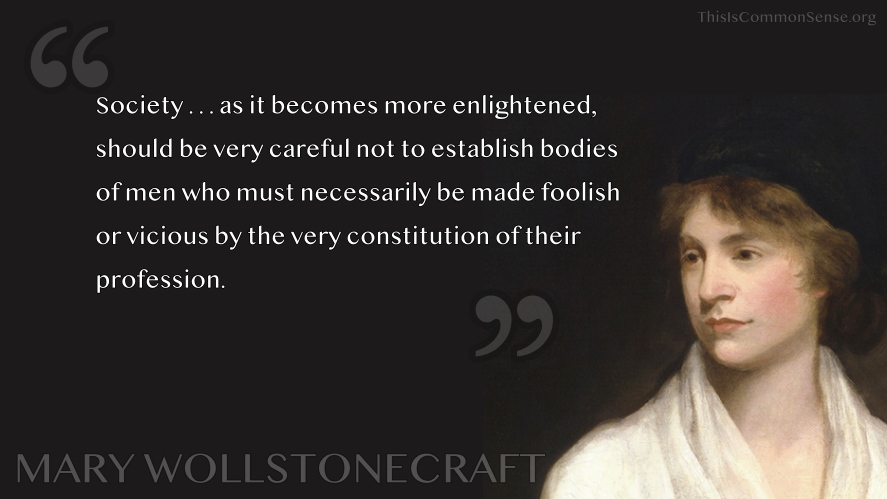
Society . . . as it becomes more enlightened, should be very careful not to establish bodies of men who must necessarily be made foolish or vicious by the very constitution of their profession.

Mary Wollstonecraft, A Vindication of the Rights of Woman (1792), chapter one.
Categories
Thought

Mary Wollstonecraft

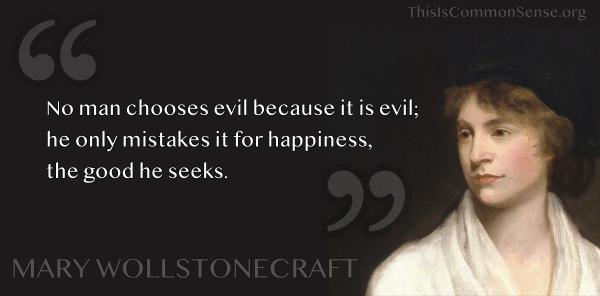
No man chooses evil because it is evil; he only mistakes it for happiness, the good he seeks.

Mary Wollstonecraft, A Vindication of the Rights of Men (1790).
Categories
Thought

Immanuel Kant

Freedom is the alone unoriginated birthright of man, and belongs to him by force of his humanity; and is independence on the will and co-action of every other in so far as this consists with every other person’s freedom.

Immanuel Kant, The Metaphysics of Ethics, trans. J.W. Semple, ed. with Iintroduction by Rev. Henry Calderwood (Edinburgh: T. & T. Clark, 1886) (3rd edition).