They must find it hard to take Truth for authority who have so long mistaken Authority for Truth.
Gerald Massey, “A Retort,” from Gerald Massey’s Lectures (c.1900).
Categories
Gerald Massey
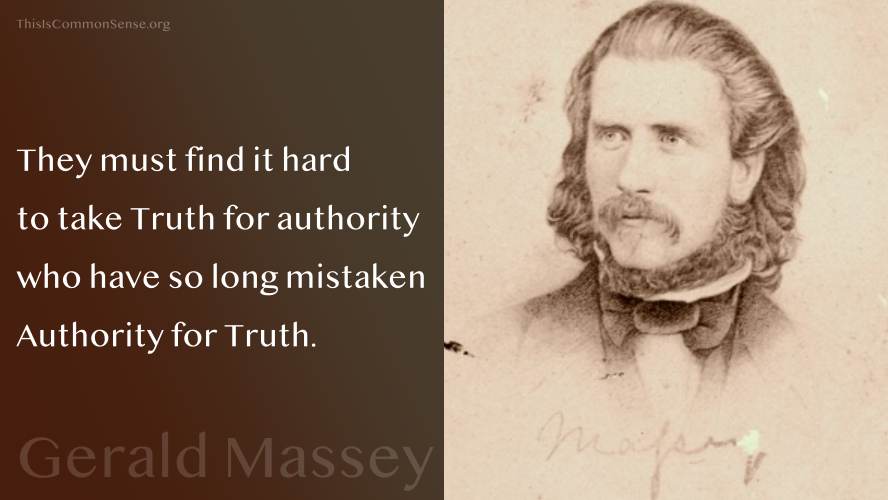
They must find it hard to take Truth for authority who have so long mistaken Authority for Truth.
Gerald Massey, “A Retort,” from Gerald Massey’s Lectures (c.1900).

A sane being wished for peace and serenity, not to be the mortar in which the ingredients of destiny are finely ground.
David Brin, The Uplift War (1987).

There is only one way to read, which is to browse in libraries and bookshops, picking up books that attract you, reading only those, dropping them when they bore you, skipping the parts that drag — and never, never reading anything because you feel you ought, or because it is part of a trend or a movement. Remember that the book which bores you when you are twenty or thirty will open doors for you when you are forty or fifty — and vice versa. Don’t read a book out of its right time for you.
Doris Lessing, Introduction to The Golden Notebook (1962).
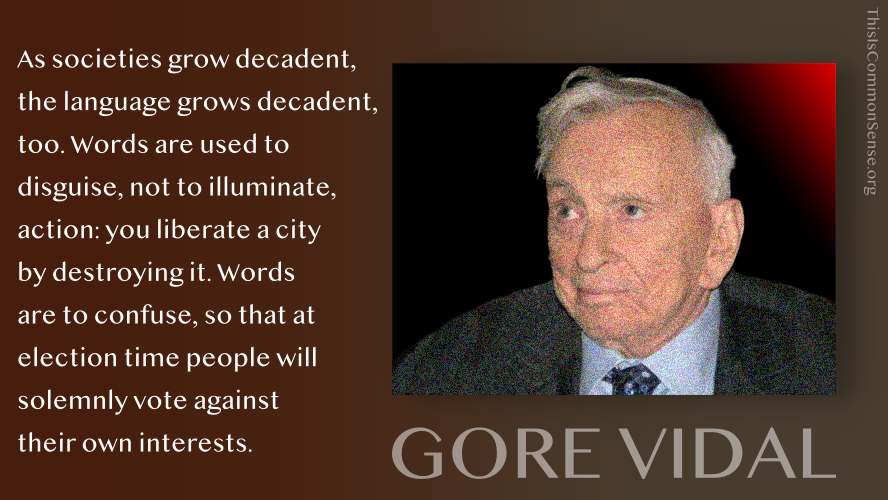
As societies grow decadent, the language grows decadent, too. Words are used to disguise, not to illuminate, action: you liberate a city by destroying it. Words are to confuse, so that at election time people will solemnly vote against their own interests.
Gore Vidal, The Decline and Fall of the American Empire (1992).

Political correctness is the natural continuum from the party line. What we are seeing once again is a self-appointed group of vigilantes imposing their views on others. It is a heritage of communism, but they don’t seem to see this.
Doris Lessing, The Sunday Times (London, May 10, 1992).
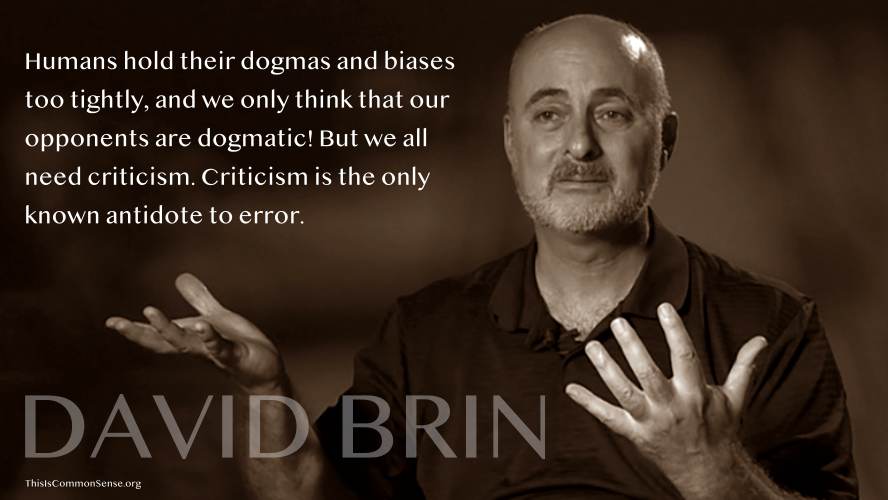
Humans hold their dogmas and biases too tightly, and we only think that our opponents are dogmatic! But we all need criticism. Criticism is the only known antidote to error.
“Interview de David Brin” at ActuSF.com (March 2008).

If you cannot or will not imagine the results of your actions, there’s no way you can act morally or responsibly. Little kids can’t do it; babies are morally monsters — completely greedy. Their imagination has to be trained into foresight and empathy.
Ursula K. Le Guin, “The Magician,” an interview with The Guardian (2005).
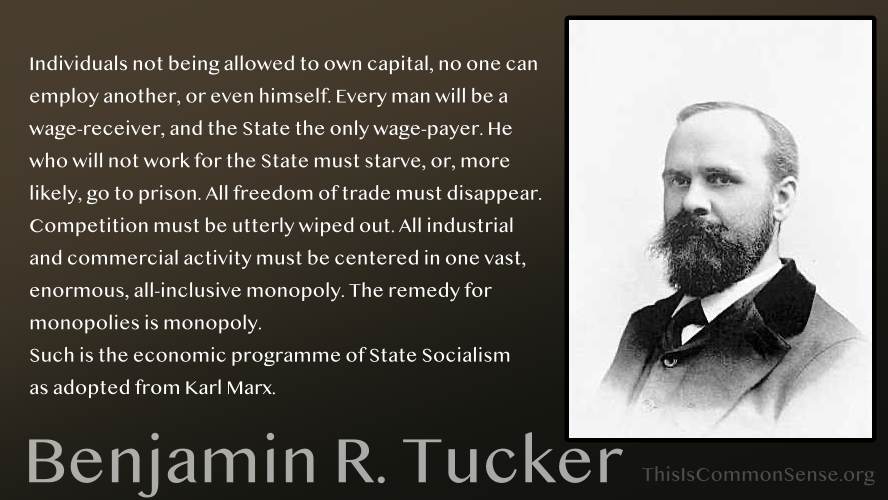
First, then, State Socialism, which may be described as the doctrine that all the affairs of men should be managed by the government, regardless of individual choice. Marx, its founder, concluded that the only way to abolish the class monopolies was to centralize and consolidate all industrial and commercial interests, all productive and distributive agencies, in one vast monopoly in the hands of the State. The government must become banker, manufacturer, farmer, carrier, and merchant, and in these capacities must suffer no competition. Land, tools, and all instruments of production must be wrested from individual hands, and made the property of the collectivity. To the individual can belong only the products to be consumed, not the means of producing them. A man may own his clothes and his food, but not the sewing-machine which makes his shirts or the spade which digs his potatoes. Product and capital are essentially different things; the former belongs to individuals, the latter to society. Society must seize the capital which belongs to it, by the ballot if it can, by revolution if it must. Once in possession of it, it must administer it on the majority principle, though its organ, the State, utilize it in production and distribution, fix all prices by the amount of labor involved, and employ the whole people in its workshops, farms, stores, etc. The nation must be transformed into a vast bureaucracy, and every individual into a State official. Everything must be done on the cost principle, the people having no motive to make a profit out of themselves. Individuals not being allowed to own capital, no one can employ another, or even himself. Every man will be a wage-receiver, and the State the only wage-payer. He who will not work for the State must starve, or, more likely, go to prison. All freedom of trade must disappear. Competition must be utterly wiped out. All industrial and commercial activity must be centered in one vast, enormous, all-inclusive monopoly. The remedy for monopolies is monopoly.
Benjamin R. Tucker, Liberty 5.16, no. 120 (March 10, 1888), pp. 2-3, 6.
Such is the economic programme of State Socialism as adopted from Karl Marx.
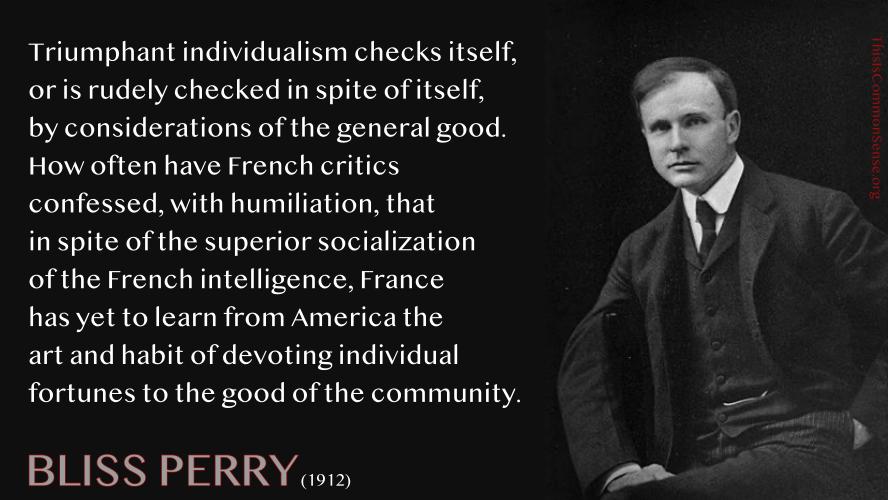
Triumphant individualism checks itself, or is rudely checked in spite of itself, by considerations of the general good. How often have French critics confessed, with humiliation, that in spite of the superior socialization of the French intelligence, France has yet to learn from America the art and habit of devoting individual fortunes to the good of the community.
Bliss Perry, The American Mind (1912), pp. 81-82.
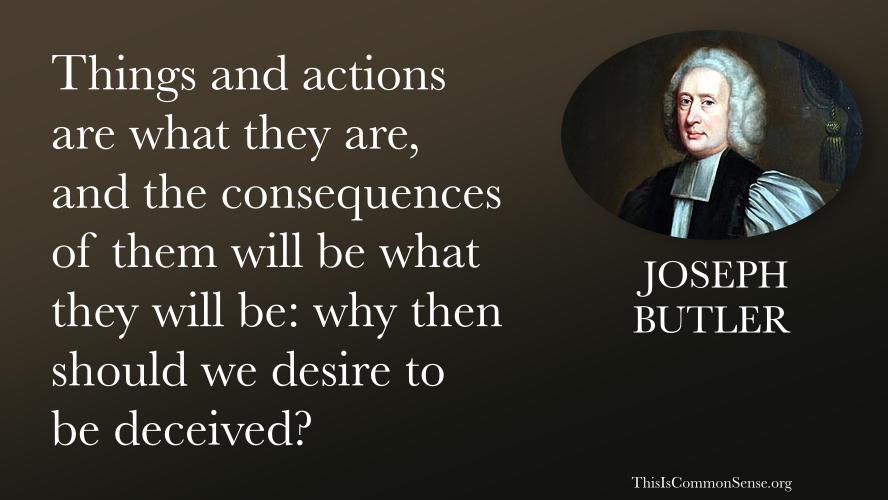
Things and actions are what they are, and the consequences of them will be what they will be: why then should we desire to be deceived?
Bishop Butler, epigraph for The Moral Economy (1909) by Ralph Barton Perry.