The first years of man must make provision for the last.
Samuel Johnson, The History of Rasselas, Prince of Abissinia (1759), Chapter 27.
The first years of man must make provision for the last.
Samuel Johnson, The History of Rasselas, Prince of Abissinia (1759), Chapter 27.
Integrity without knowledge is weak and useless, and knowledge without integrity is dangerous and dreadful.
Samuel Johnson, The History of Rasselas, Prince of Abissinia (1759), Chapter 41.
Many things difficult to design prove easy to performance.
Samuel Johnson, The History of Rasselas, Prince of Abissinia (1759), Chapter 26.

“I don’t believe that there has been in Latin America any case of a system of dictatorship which has so efficiently recruited the intellectual milieu, bribing it with great subtlety. . . . Mexico is the perfect dictatorship. The perfect dictatorship is not communism, not the USSR, not Fidel Castro; the perfect dictatorship is Mexico. Because it is a camouflaged dictatorship.”
Mario Vargas Llosa, from a televised conference in Mexico, “The 20th Century: The Experience of Freedom,” August 30, 1990.
Nothing . . . will ever be attempted, if all possible objections must be first overcome.
Samuel Johnson, The History of Rasselas, Prince of Abissinia (1759), Chapter 6.

Although scientific and technical progress change the world before our very eyes, it is, in fact, based on a very narrow social foundation. The more significant scientific successes become, the sharper will be the contrast between those who achieve and exploit them and the rest of the world. Soviet rockets have reached Venus, while in the village where I live potatoes are still dug by hand.
Andrei Amalrik, Will the Soviet Union Survive Until 1984?, 1970, p. 66.
Among the calamities of war may be justly numbered the diminution of the love of truth, by the falsehoods which interest dictates and credulity encourages.
Dr. Johnson, The Idler, No. 30 (November 11, 1758).

Why is it that people never change their mind — until they do?
Douglass North, as quoted by Mike Munger on EconTalk, “Munger on Slavery and Racism,” August 22, 2016.
Only humans can set aims and achieve them by their activities if they know the laws of nature and set up various processes based on them and organise them purposively.
Rein Vihalemm, “Chemistry as an Interesting Subject for the Philosophy of Science,” Estonian Studies in the History and Philosophy of Science, Rein Vihalemm, ed., Dordrecht / Boston / London: Kluwer Academic Publishers, 2001, p. 192.
Every other sin hath some pleasure annexed to it, or will admit of an excuse; envy alone wants both. Other sins last but for awhile; the gut may be satisfied, anger remits, hatred hath an end, envy never ceaseth.
Robert Burton, The Anatomy of Melancholy, Part I, Section 2, member 3, subsection 7, Envy, Malice, Hatred, Causes (1621).
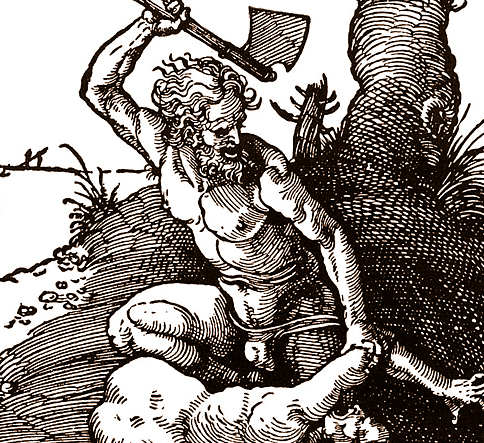
Image: Albrecht Dürer, Cain Killing Abel (1511), detail.