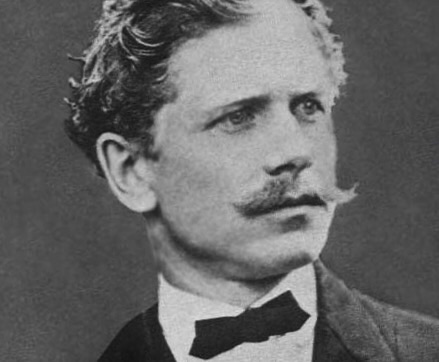
When someone has behaved like an animal, he says: ‘I’m only human!’ But when he is treated like an animal, he says: ‘I’m human, too!’
Karl Kraus
When someone has behaved like an animal, he says: ‘I’m only human!’ But when he is treated like an animal, he says: ‘I’m human, too!’
Tell me to what you pay attention and I will tell you who you are.
José Ortega y Gasset, Man and Crisis (1962), p. 94.
Knowledge is the conformity of the object and the intellect.
Arthur Latham Perry, Principles of Political Economy (1891).
Suppose for a moment, that all taxes of every name could be abolished instantaneously, and the Governments, like the Israelites, live on manna for forty years. What harm would ensue? What industry would decline? Who would be impoverished? What stimulus to work and save and grow rich would be weakened thereby? Would not wages, and profits, and rents, all be lifted thereby, with no damage to anybody? A child can see that Taxes from their very nature are a burden, are a subtraction from income, are a minus and not a plus. Who, then, except from sinister motives, can imagine and represent, that Taxes are a good in themselves, a positive blessing, a spur to the progress of Society?
[T]he mass-man sees in the State an anonymous power, and feeling himself, like it, anonymous, he believes that the State is something of his own. Suppose that in the public life of a country some difficulty, conflict, or problem presents itself, the mass-man will tend to demand that the State intervene immediately and undertake a solution directly with its immense and unassailable resources. This is the gravest danger that to-day threatens civilisation: State intervention; the absorption of all spontaneous social effort by the State.
José Ortega y Gasset, Chapter XIII: The Greatest Danger, The State, The Revolt of the Masses, 1929.
The tragedy of fascism and Nazism should have taught us that totalitarianism establishes itself through banal men, and the true antidote is a religion that prevents one from adoring men who pretend to be gods, for it teaches us to love instead the inner God of moral conscience, and to defend liberty with absolute devotion.
Maurizio Viroli, As If God Existed: Religion and Liberty in the History of Italy (Princeton University Press, 2012).
Happily common sense, though she is by nature the gentlest creature living, when she feels the knife at her throat, is apt to develop unexpected powers of resistance, and to send doctrinaires flying, even when they have bound her down and think they have her at their mercy.
Samuel Butler, Erewhon (1872), chapter 26.
Strictly speaking, the mass, as a psychological fact, can be defined without waiting for individuals to appear in mass formation. In the presence of one individual we can decide whether he is ‘mass’ or not. The mass is all that which sets no value on itself — good or ill — based on specific grounds, but which feels itself ‘just like everybody,’ and nevertheless is not concerned about it; is, in fact, quite happy to feel itself as one with everybody else.
José Ortega y Gasset, The Revolt of the Masses, 1929.
Samuel Butler, describing the residents of the imagined southern hemispheric utopians in his satirical novel, Erewhon, 1872.
The main feature in their system is the prominence which they give to a study which I can only translate by the word ‘hypothetics.’ They argue thus — that to teach a boy merely the nature of the things which exist in the world around him, and about which he will have to be conversant during his whole life, would be giving him but a narrow and shallow conception of the universe, which it is urged might contain all manner of things which are not now to be found therein. To open his eyes to these possibilities, and so to prepare him for all sorts of emergencies, is the object of this system of hypothetics. To imagine a set of utterly strange and impossible contingencies, and require the youths to give intelligent answers to the questions that arise therefrom, is reckoned the fittest conceivable way of preparing them for the actual conduct of their affairs in after life.
Truth is the enfant terrible of the Virtues.
William J. Locke, The Morals of Marcus Ordeyne (1905), p. 50.