Ancient Rome declined because it had a Senate; now what’s going to happen to us with both a Senate and a House?
Categories
Will Rogers

Ancient Rome declined because it had a Senate; now what’s going to happen to us with both a Senate and a House?

“There is no real paradox in the claim that satisfaction is open only to the man who stands prepared to give up pleasures. This only means, again, that satisfaction as a human goal is not an abstract ideal of limitless good, but presupposes a determinate human nature set to work out its destiny in determinate surroundings. That at which a sensible, human being aims is no unimaginable state of the intensest possible pleasure unaccompanied by pain, but the realization that he is making the very most of life that it is possible for him, with his particular interests and limitations, to make, considering the means at his disposal. If one is not willing to accept these qualifications, he is not yet prepared to set out intelligently to secure satisfaction.”
Arthur Kenyon Rogers, The Theory of Ethics (New York: The Macmillan Company, 1922).
Be thankful we’re not getting all the government we’re paying for.

I am persuaded that the rights of woman, like the rights of slaves, need only be examined to be understood and asserted.

[N]o one, no government agency, has jurisdiction over the truth.
FBI Agent Fox Mulder, played by actor David Duchovny, in The X-Files, “Fallen Angel,” November 19, 1993; writing for this episode is credited to Howard Gordon and Alex Gans.
When I first encountered him, on the sidewalk in front of the Hicks brothers law office, the trial was yet to begin, and so he was still expansive and amiable. I had printed in the Nation, a week or so before, an article arguing that the anti-evolution law, whatever its unwisdom, was at least constitutional — that policing school teachers was certainly not putting down free speech. The old boy professed to be delighted with the argument, and gave the gaping bystanders to understand that I was a talented publicist. In turn I admired the curious shirt he wore — sleeveless and with the neck cut very low. We parted in the manner of two Spanish ambassadors.
But that was the last touch of affability that I was destined to see in Bryan. The next day the battle joined and his face became hard. By the end of the first week he was simply a walking malignancy. Hour by hour he grew more bitter. What the Christian Scientists call malicious animal magnetism seemed to radiate from him like heat from a stove. From my place in the court-room, standing upon a table, I looked directly down upon him, sweating horribly and pumping his palm-leaf fan. His eyes fascinated me: I watched them all day long. They were blazing points of hatred. They glittered like occult and sinister gems. Now and then they wandered to me, and I got my share. It was like coming under fire.
H. L. Mencken, The Baltimore Evening Sun, July 27, 1925
I know nothing of man’s rights, or woman’s rights; human rights are all that I recognise.
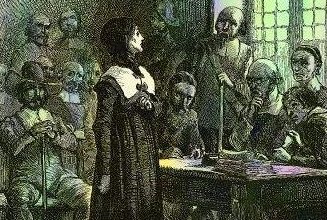
Do you think it not lawful for me to teach women and why do you call me to teach the court?
Anne Hutchinson, in response to the Massachusetts Bay Colony court calling her up for teaching women and for heresy.

Does political correctness have a good side? Yes, it does, for it makes us re-examine attitudes, and that is always useful. The trouble is that, as with all popular movements, the lunatic fringe so quickly ceases to be a fringe; the tail begins to wag the dog. For every woman or man who is quietly and sensibly using the idea to look carefully at our assumptions, there are twenty rabble-rousers whose real motive is a desire for power over others. The fact that they see themselves as antiracists or feminists or whatever does not make them any less rabble-rousers.
Doris Lessing, “Unexamined Mental Attitudes Left Behind By Communism,” in Edith Kurzweil and William Philips, editors, Our Country, Our Culture: The Politics of Political Correctness (Partisan Review Press, 1994)
Political correctness is the natural continuum from the party line. What we are seeing once again is a self-appointed group of vigilantes imposing their views on others. It is a heritage of communism, but they don’t seem to see this.
Doris Lessing, The Sunday Times, London (10 May 10, 1992)