What is essential to the idea of a slave? We primarily think of him as one who is owned by another. To be more than nominal, however, the ownership must be shown by control of the slave’s actions — a control which is habitually for the benefit of the controller. That which fundamentally distinguishes the slave is that he labours under coercion to satisfy another’s desires. The relation admits of sundry gradations. Remembering that originally the slave is a prisoner whose life is at the mercy of his captor, it suffices here to note that there is a harsh form of slavery in which, treated as an animal, he has to expend his entire effort for his owner’s advantage. Under a system less harsh, though occupied chiefly in working for his owner, he is allowed a short time in which to work for himself, and some ground on which to grow extra food. A further amelioration gives him power to sell the produce of his plot and keep the proceeds. Then we come to the still more moderated form which commonly arises where, having been a free man working on his own land, conquest turns him into what we distinguish as a serf; and he has to give to his owner each year a fixed amount of labour or produce, or both: retaining the rest himself. Finally, in some cases, as in Russia before serfdom was abolished, he is allowed to leave his owner’s estate and work or trade for himself elsewhere, under the condition that he shall pay an annual sum. What is it which, in these cases, leads us to qualify our conception of the slavery as more or less severe? Evidently the greater or smaller extent to which effort is compulsorily expended for the benefit of another instead of for self-benefit. If all the slave’s labour is for his owner the slavery is heavy, and if but little it is light. Take now a further step. Suppose an owner dies, and his estate with its slaves comes into the hands of trustees; or suppose the estate and everything on it to be bought by a company; is the condition of the slave any the better if the amount of his compulsory labour remains the same? Suppose that for a company we substitute the community; does it make any difference to the slave if the time he has to work for others is as great, and the time left for himself is as small, as before? The essential question is — How much is he compelled to labour for other benefit than his own, and how much can he labour for his own benefit? The degree of his slavery varies according to the ratio between that which he is forced to yield up and that which he is allowed to retain; and it matters not whether his master is a single person or a society. If, without option, he has to labour for the society, and receives from the general stock such portion as the society awards him, he becomes a slave to the society.
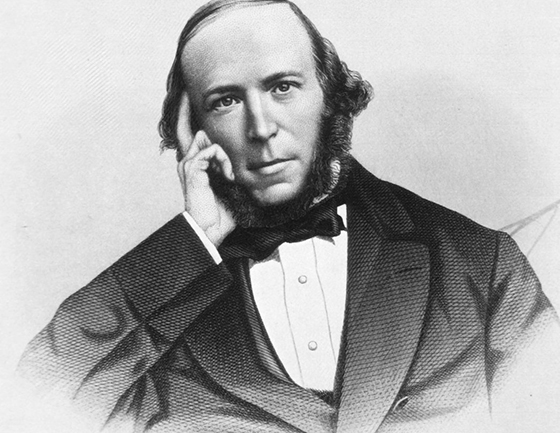
Herbert Spencer, “The Coming Slavery,” The Contemporary Review (April 1884), p. 474. See also The Man versus the State (1884).