Categories
Thought

John Stuart Mill

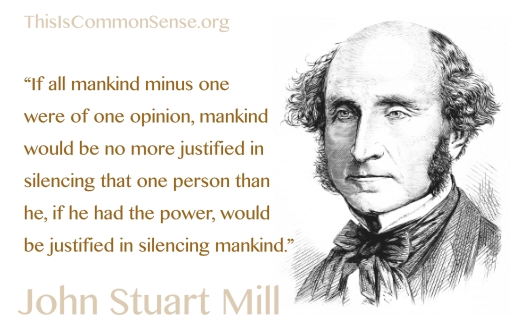
If all mankind minus one were of one opinion, mankind would be no more justified in silencing that one person than he, if he had the power, would be justified in silencing mankind.

J. S. Mill, On Liberty (1859), Chapter Two: “Of the Liberty of Thought and Discussion.”
Categories
Thought

Alexis de Tocqueville

AFTER the general idea of virtue, I know no higher principle than that of right; or rather these two ideas are united in one. The idea of right is simply that of virtue introduced into the political world. It was the idea of right that enabled men to define anarchy and tyranny, and that taught them how to be independent without arrogance, and to obey without servility. The man who submits to violence is debased by his compliance; but when he submits to that right of authority that he acknowledges in a fellow creature, he rises in some measure above the person who gives the command.

Alexis de Tocqueville, Democracy in America, Volume 1.

Categories
Thought

Aldous Huxley

Today we are faced, I think, with the approach of what may be called the ultimate revolution, the final revolution, where man can act directly on the mind-body of his fellows. Well needless to say some kind of direct action on human mind-bodies has been going on since the beginning of time. But this has generally been of a violent nature. The techniques of terrorism have been known from time immemorial and people have employed them with more or less ingenuity sometimes with the utmost cruelty, sometimes with a good deal of skill acquired by a process of trial and error finding out what the best ways of using torture, imprisonment, constraints of various kinds.

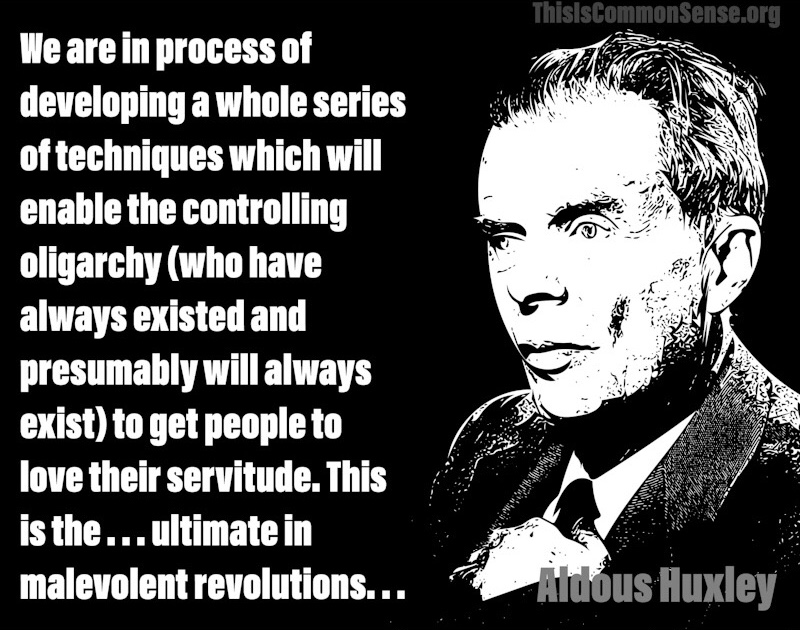
But, as I think it was Metternich said many years ago, ‘you can do everything with bayonets except sit on them.’ If you are going to control any population for any length of time, you must have some measure of consent, its exceedingly difficult to see how pure terrorism can function indefinitely. It can function for a fairly long time, but I think sooner or later you have to bring in an element of persuasion an element of getting people to consent to what is happening to them. It seems to me that the nature of the ultimate revolution with which we are now faced is precisely this: That we are in process of developing a whole series of techniques which will enable the controlling oligarchy (who have always existed and presumably will always exist) to get people to love their servitude. This is the . . . ultimate in malevolent revolutions….

Aldous Huxley, speech,“The Ultimate Revolution,” March 20, 1962.

Categories
Thought

George Orwell

All the war-propaganda, all the screaming and lies and hatred, comes invariably from people who are not fighting.

Categories
Thought

President Merkin Muffley

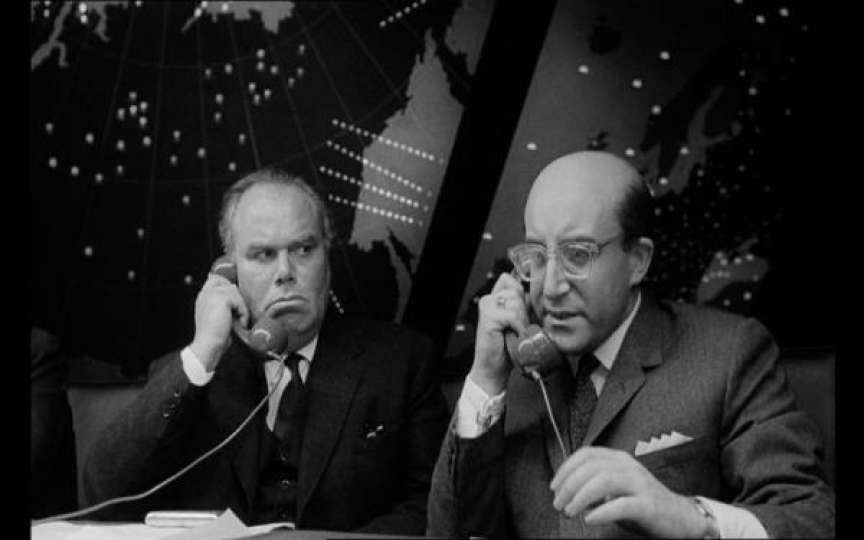
Hello? Uh, hello? Hello, Dmitri? Listen, I can’t hear too well, do you suppose you could turn the music down just a little? [pause] Oh, that’s much better. . . . Now then, Dmitri, you know how we’ve always talked about the possibility of something going wrong with the bomb. [pause] The BOMB, Dmitri! The hydrogen bomb! Well now, what happened is, uh, one of our base commanders, he had a sort of, well, he went a little funny in the head. You know. Just a little . . . funny. And uh, he went and did a silly thing. Well, I’ll tell you what he did, he ordered his planes . . . to attack your country. Well, let me finish, Dmitri. Let me finish, Dmitri. Well, listen, how do you think I feel about it? Can you imagine how I feel about it, Dmitri? . . . I’m just calling up to tell you something terrible has happened. It’s a friendly call. Of course it’s a friendly call. Listen, if it wasn’t friendly, you probably wouldn’t have even got it. They will not reach their targets for at least another hour. [pause] I’m sorry too, Dmitri. I’m very sorry. All right! You’re sorrier than I am! But I am sorry as well. I am as sorry as you are Dmitri. Don’t say that you are more sorry than I am, because I am capable of being just as sorry as you are. So we’re both sorry, all right? All right.

President Merkin Muffley, as played by Peter Sellers, speaking to the Soviet premier in Stanley Kubrick’s classic dark comedy, Dr. Strangelove or: How I Learned to Stop Worrying and Love the Bomb (1964), written by Terry Southern and Stanley Kubrick, based on the novel Red Alert (1958) by Peter George.
Categories
Thought

Joseph Hiam Levy

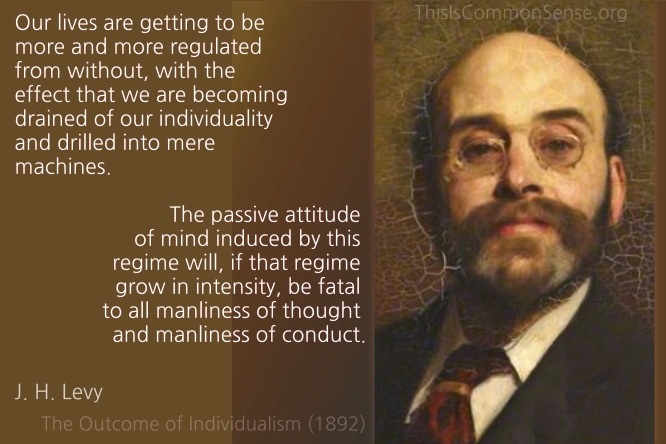
Our lives are getting to be more and more regulated from without, with the effect that we are becoming drained of our individuality and drilled into mere machines. The passive attitude of mind induced by this regime will, if that regime grow in intensity, be fatal to all manliness of thought and manliness of conduct. Discrimination, as any competent psychologist will tell you, is the most fundamental of our mental faculties. Our intellectual and moral natures come into play only when we discriminate and decide for ourselves.

Joseph Hiam Levy, The Outcome of Individualism (Third Edition, 1892), Conclusion.
Categories
Thought

Jeremy Bentham

Stretching his hand up to reach the stars, too often man forgets the flowers at his feet.

Categories
Thought

S. I. Hayakawa

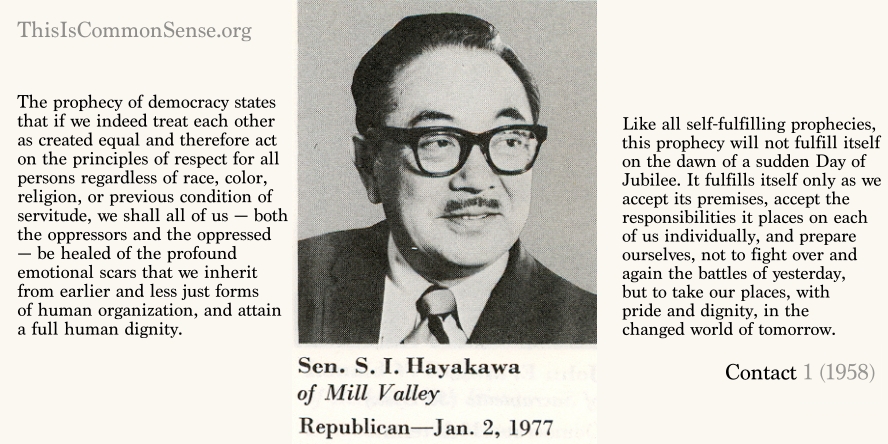
The prophecy of democracy states that if we indeed treat each other as created equal and therefore act on the principles of respect for all persons regardless of race, color, religion, or previous condition of servitude, we shall all of us — both the oppressors and the oppressed — be healed of the profound emotional scars that we inherit from earlier and less just forms of human organization, and attain a full human dignity. Like all self-fulfilling prophecies, this prophecy will not fulfill itself on the dawn of a sudden Day of Jubilee. It fulfills itself only as we accept its premises, accept the responsibilities it places on each of us individually, and prepare ourselves, not to fight over and again the battles of yesterday, but to take our places, with pride and dignity, in the changed world of tomorrow.

S. I. Hayakawa, “How to Be Sane Though Negro” (Contact 1, 1958), conclusion.
Categories
Thought

Theages

Universally therefore, virtue is a certain co-adaptation of the irrational parts of the soul to the rational part. Virtue however, is produced through pleasure and pain receiving the boundary of that which is fit. For true virtue is nothing else than the habit of that which is fit. But the fit, or the decorous, is that which ought to be; and the unfit, or indecorous, is that which ought not to be. Of the indecorous however, there are two species, viz. excess and defect. And excess indeed, is more than is fit; but defect is less than is fit. But since the fit is that which ought to be, it is both a summit and a middle. It is a summit indeed, because it neither requires ablation, nor addition; but it is a middle, because it subsists between excess and defect.

Theages, Treatise on the Virtues, found in Iamblichus, Iamblichus’ ‘Life of Pythagoras,’ or ‘Pythagoric Life’ / Accompanied by Fragments of the Ethical Writings of certain Pythagoreans in the Doric dialect; and a collection of Pythagoric Sentences from Stobaeus and others, which are omitted by Gale in his ‘Opuscula Mythologica,’ and have not been noticed by any editor (Thomas Taylor, translator, 1818).

Categories
Thought

Joseph Hiam Levy

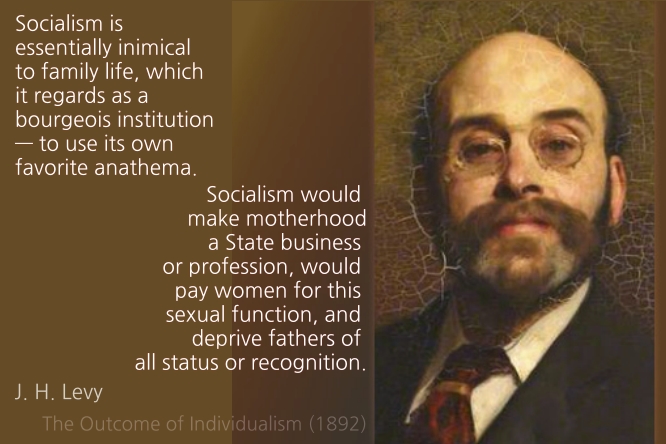
Socialism is essentially inimical to family life, which it regards as a bourgeois institution — to use its own favorite anathema. Socialism would make motherhood a State business or profession, would pay women for this sexual function, and deprive fathers of all status or recognition. It would no longer be necessary for a woman to know who was the father of her child. Her children — up to a certain number — would be supported by the state, which would be supreme over their education.

Joseph Hiam Levy, The Outcome of Individualism (Third Edition, 1892), Chapter XII, “Economics and Ethics of Individualism.”