Some circumstantial evidence is very strong, as when you find a trout in the milk.
Henry David Thoreau, Journals (November 11, 1854).
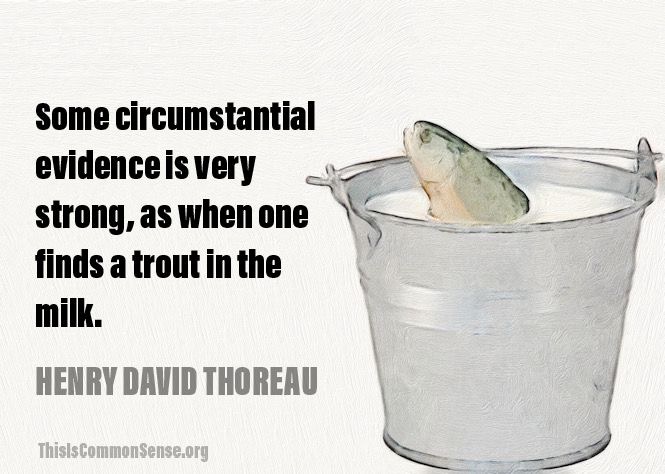
Some circumstantial evidence is very strong, as when you find a trout in the milk.
Henry David Thoreau, Journals (November 11, 1854).

Was the government to prescribe to us our medicine and diet, our bodies would be in such keeping as our souls are now. Thus in France the emetic was once forbidden as a medicine, and the potatoe as an article of food.
Thomas Jefferson, Notes on the State of Virginia (1781-1783), Query XVII, pp. 169–170.
“The subjects of every state,” says Dr. Smith, “ought to contribute [490] towards the support of the government as nearly as possible in proportion to their respective abilities; that is, in proportion to the revenue which they respectively enjoy under the protection of the state.”
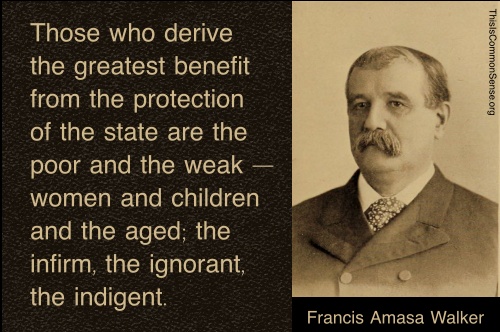
This maxim, though it sounds fairly, will not bear examination. What mean those last words, “under the protection of the state”? They are either irrelevant, or else they mean that the protection enjoyed affords the measure of the duty to contribute. But the doctrine that the members of the community ought to contribute in proportion to the benefits they derive from the protection of the state, or according as the services performed in their behalf cost less or cost more to the state, involves the grossest practical absurdities. Those who derive the greatest benefit from the protection of the state are the poor and the weak—women and children and the aged; the infirm, the ignorant, the indigent.
Even as among the well-to-do and wealthy classes of the community, does the protection enjoyed furnish a measure of the duty to contribute? If so, the richer the subject or citizen is, the less, proportionally, should he pay. A man who buys protection in large quantities should get it at wholesale prices, like the man who buys flour and meat by the car-load. Moreover, it costs the state less to collect a given amount from one taxpayer than from many.
Returning to the maxim of Dr. Smith, I ask, does it put forward ability to contribute, or protection enjoyed, as affording the true basis of taxation? Which? If both, on what principles and by what means are the two to be combined in practice?
Francis Amasa Walker, “The Social Dividend Theory of Taxation,” in Political Economy (Third Edition, Revised and Enlarged: 1888), pp. 489-490.
It is wasteful for the government to commandeer resources from the private sector during good times, and it’s even more harmful when the government kicks the economy during a recession.
Robert P. Murphy, Ph.D., Contra Krugman: Smashing the Errors of America’s Most Famous Keynesian (2018), p. 18.
The legitimate powers of government extend to such acts only as are injurious to others. But it does me no injury for my neighbour to say there are twenty gods, or no god. It neither picks my pocket nor breaks my leg.
Thomas Jefferson, Notes on the State of Virginia (1781-1783), Query XVII, p. 169.
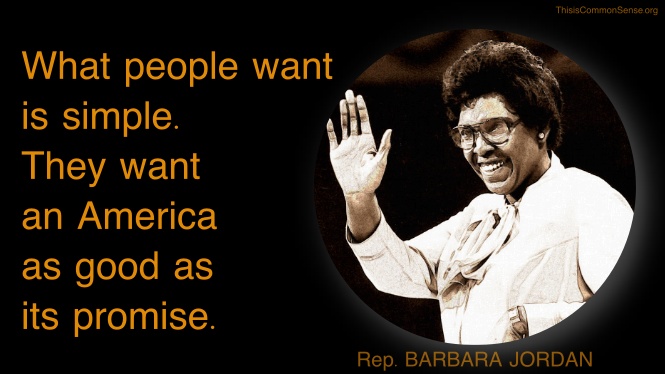
What people want is simple. They want an America as good as its promise.
Barbara Jordan, Commencement Address, Harvard University (June 16, 1977), as cited in Let me tell you what I’ve learned: Texas Wisewomen Speak, PJ Pierce, University of Texas Press (2010), p. 16.
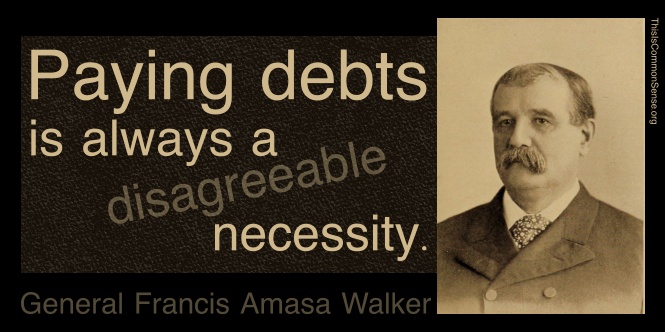
Francis Amasa Walker, Money in Its Relation to Trade and Industry (1889).
Paying debts is always a disagreeable necessity.
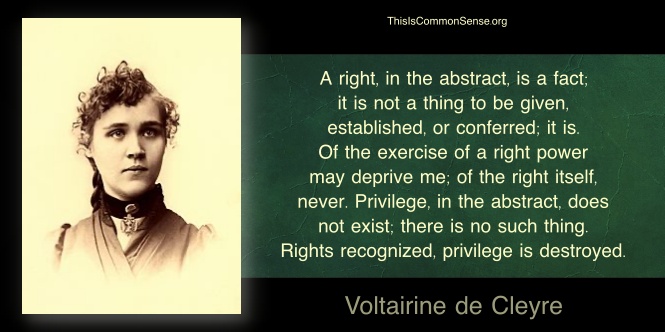
Note the difference between a right and a privilege. A right, in the abstract, is a fact; it is not a thing to be given, established, or conferred; it is. Of the exercise of a right power may deprive me; of the right itself, never. Privilege, in the abstract, does not exist; there is no such thing. Rights recognized, privilege is destroyed.
Voltairine De Cleyre, “The Economic Tendency of Freethought,” in Liberty Vol. XI, #25 (February 15, 1890).

I do not believe that the kind of society I describe necessarily will arrive, but I believe (allowing of course for the fact that the book is a satire) that something resembling it could arrive. I believe also that totalitarian ideas have taken root in the minds of intellectuals everywhere, and I have tried to draw these ideas out to their logical consequences.
George Orwell on his novel Nineteen Eighty-Four (1949), Collected Essays, Journalism and Letters, Vol. 4 p. 564.
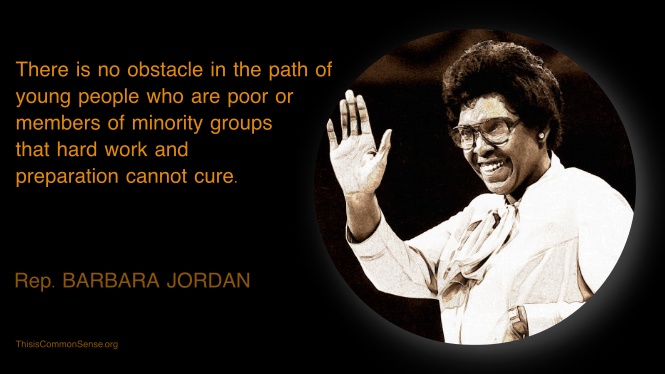
There is no obstacle in the path of young people who are poor or members of minority groups that hard work and preparation cannot cure.
Barbara Jordan, as quoted in Wisdom For the Soul of Black Folk, ed. Larry Chang & Roderick Terry, Gnosophia Publishers (2007), p. 117.