Categories
Thought

Benjamin Constant

The representative system is nothing but an organization by means of which a nation charges a few individuals to do what it cannot or does not wish to do herself. Poor men look after their own business; rich men hire stewards. This is the history of ancient and modern nations. The representative system is a proxy given to a certain number of men by the mass of the people who wish their interests to be defended and who nevertheless do not have the time to defend them themselves.
But, unless they are idiots, rich men who employ stewards keep a close watch on whether these stewards are doing their duty, lest they should prove negligent, corruptible, or incapable; and, in order to judge the management of these proxies, the landowners, if they are prudent, keep themselves well informed about affairs, the management of which they entrust to them. Similarly, the people who, in order to enjoy the liberty that suits them, resort to the representative system, must exercise an active and constant surveillance over their representatives, and reserve for themselves, at times that should not be separated by too lengthy intervals, the right to discard them if they betray their trust, and to revoke the powers they might have abused.

Benjamin Constant, On the Liberty of the Ancients Compared to that of the Moderns (“De la Liberté des Anciens Comparée à celle des Modernes,”1819).
Categories
Thought

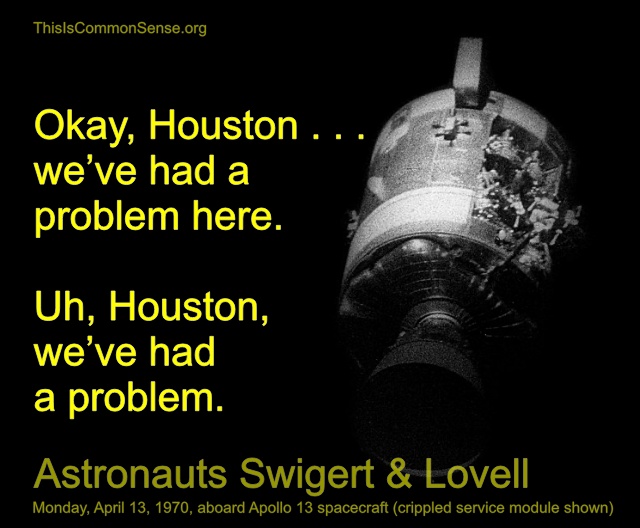
Jack Swigert & Jim Lovell

Houston, we have a problem.

Astronaut Jim Lovell, in the movie Apollo 13 (1995), William Broyles Jr., screenwriter.

The actual conversation went like this:

55:55:19 Swigert: Okay, Houston…

55:55:19 Lovell: [Garbled]

55:55:20 Swigert: . . . we’ve had a problem here.

55:55:28 Lousma: This is Houston. Say again, please.

55:55:35 Lovell: Uh, Houston, we’ve had a problem. We’ve had a Main B Bus Undervolt.

Jack Swigert, Jim Lovell, and CAPCOM Jack R. Lousma, Apollo 13 Flight Journal for April 13, 1970. In the movie, a reconstruction of the declaration in the present tense was spoken by actor Tom Hanks, portraying Jim Lovell. This statement is listed as #50 in the American Film Institute’s AFI’s 100 Years… 100 Movie Quotes, June 21, 2005.
Categories
Thought

Martial

Ride, si sapis.

Laugh if you are wise.

Marcus Valerius Martialis (Martial), Epigrammata, II, 41.

Categories
Thought

Ovid

Sic tempora verti
cernimus atque illas adsumere robora gentes,
concidere has.

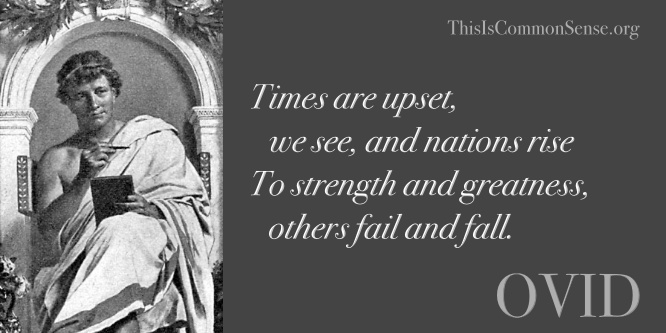
Times are upset, we see, and nations rise
To strength and greatness, others fail and fall.

Ovid (Publius Ovidius Naso), The Metamorphoses, Book XV, lines 420–422 (trans. A. D. Melville).

Categories
Thought

Ovid

Fas est et ab hoste doceri.

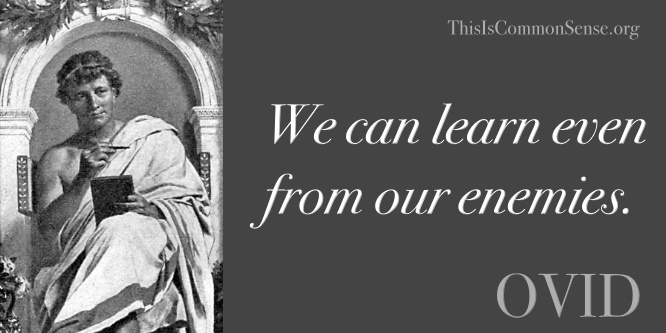
We can learn even from our enemies.

Ovid (Publius Ovidius Naso), The Metamorphoses, Book IV, 428.
Categories
Thought

Ovid

Ut ameris, amabilis esto.

If you want to be loved, be lovable.

Ovid (Publius Ovidius Naso), The Art of Love, Book II, line 107.
Categories
Thought

Robert A. Heinlein

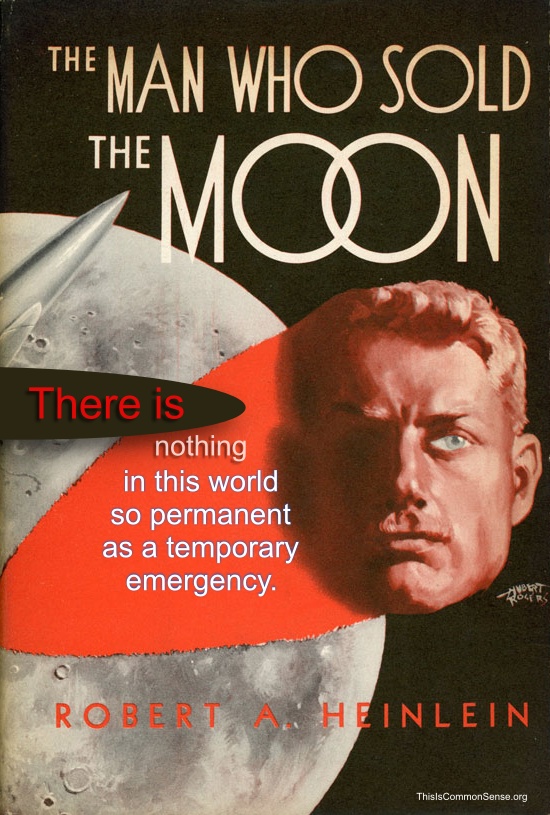
There is nothing in this world so permanent as a temporary emergency.

Robert A. Heinlein, The Man Who Sold the Moon (1951), p. 100.
Categories
Thought

Robert A. Heinlein

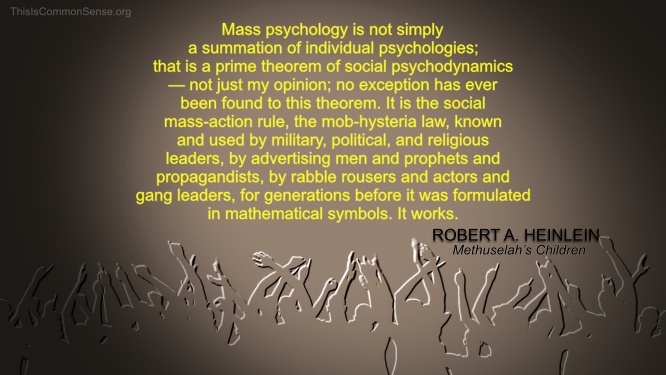
Mass psychology is not simply a summation of individual psychologies; that is a prime theorem of social psychodynamics—not just my opinion; no exception has ever been found to this theorem. It is the social mass-action rule, the mob-hysteria law, known and used by military, political, and religious leaders, by advertising men and prophets and propagandists, by rabble rousers and actors and gang leaders, for generations before it was formulated in mathematical symbols. It works.

Robert A. Heinlein, Methuselah’s Children (1941; 1958).
Categories
Thought

Lysander Spooner

Vices are those acts by which a man harms himself or his property. Crimes are those acts by which one man harms the person or property of another. Vices are simply the errors which a man makes in his search after his own happiness. Unlike crimes, they imply no malice toward others, and no interference with their persons or property. In vices, the very essence of crime — that is, the design to injure the person or property of another — is wanting. It is a maxim of the law that there can be no crime without criminal intent; that is, without the intent to invade the person or property of another. But no one ever practices a vice with any such criminal intent. He practices his vice for his own happiness solely, and not from any malice toward others. Unless this clear distinction between vices and crimes be made and recognized by the laws, there can be on earth no such thing as individual right, liberty, or property, and the corresponding coequal rights of another man to the control of his own person and property.

Categories
Thought

Edmund Husserl

. . . bloße Erfahrung ist keine Wissenschaft.

Experience by itself is not science.

Edmund Husserl, Pure Phenomenology: Its Method and Its Field of Investigation; Inaugural Lecture at Freiburg im Breisgau (May 3, 1917); Die reine Phänomenologie, ihr Forschungsgebiet und ihre Methode.