Take heed, therefore, wicked prelates, blind leaders of the blind; indurate and obstinate hypocrites, take heed. . . .
William Tyndale, Preface to The Practice of Prelates (1531).
Categories
William Tyndale
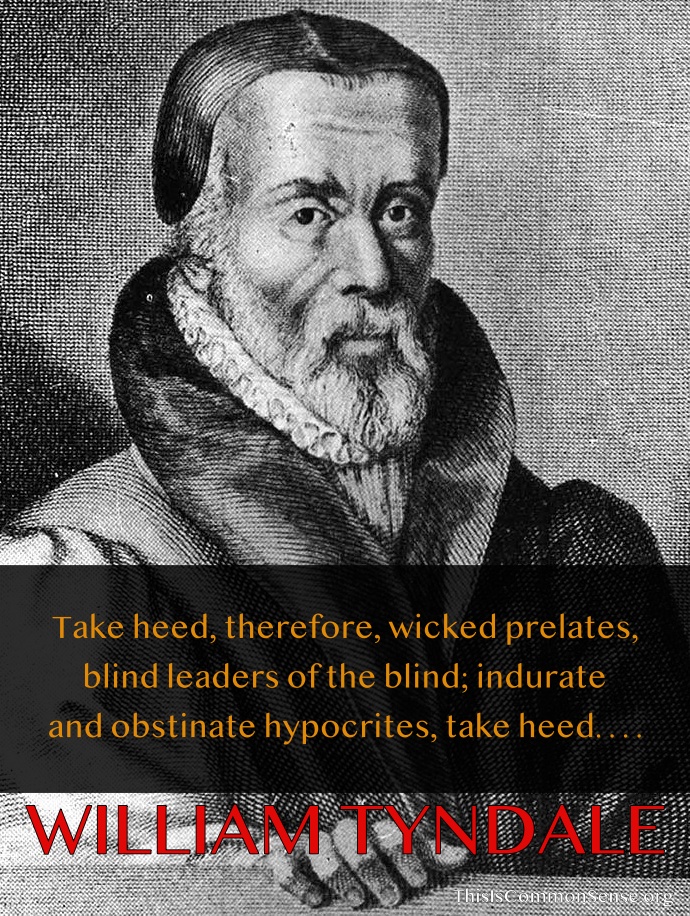
Take heed, therefore, wicked prelates, blind leaders of the blind; indurate and obstinate hypocrites, take heed. . . .
William Tyndale, Preface to The Practice of Prelates (1531).
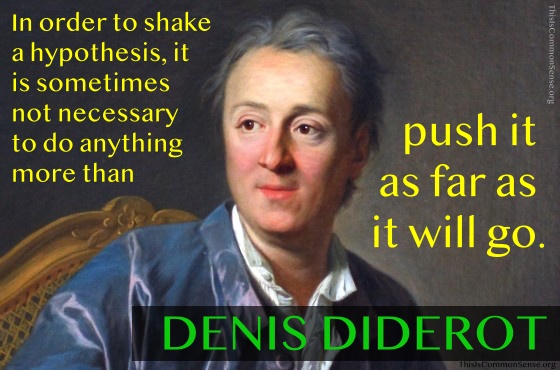
In order to shake a hypothesis, it is sometimes not necessary to do anything more than push it as far as it will go.
Denis Diderot, On the Interpretation of Nature (1753, as quoted in Selected Writings [1966] edited by Lester G. Crocker).
It is a mark of insincerity of purpose to spend one’s time in looking for the sacred Emperor in the low-class tea shops.
Ernest Bramah, “The Transmutation of Ling,” in The Wallet of Kai Lung (1900).
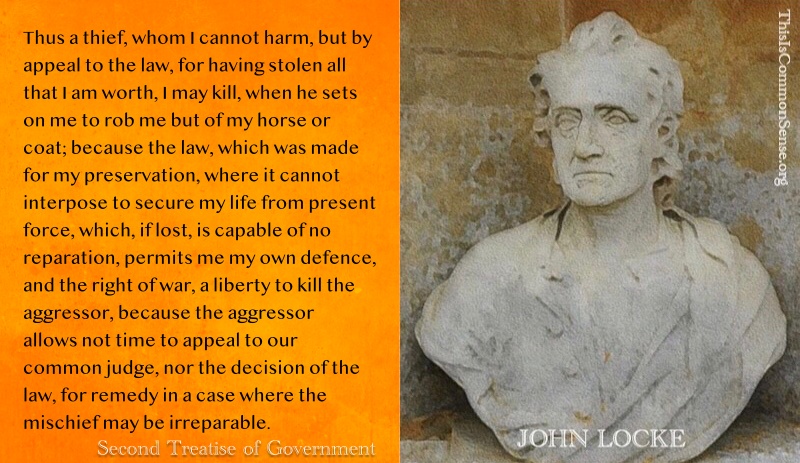
Men living together according to reason, without a common superior on earth, with authority to judge between them, is properly the state of nature. But force, or a declared design of force, upon the person of another, where there is no common superior on earth to appeal to for relief, is the state of war: and it is the want of such an appeal gives a man the right of war even against an aggressor, tho’ he be in society and a fellow subject. Thus a thief, whom I cannot harm, but by appeal to the law, for having stolen all that I am worth, I may kill, when he sets on me to rob me but of my horse or coat; because the law, which was made for my preservation, where it cannot interpose to secure my life from present force, which, if lost, is capable of no reparation, permits me my own defence, and the right of war, a liberty to kill the aggressor, because the aggressor allows not time to appeal to our common judge, nor the decision of the law, for remedy in a case where the mischief may be irreparable. Want of a common judge with authority, puts all men in a state of nature: force without right, upon a man’s person, makes a state of war, both where there is, and is not, a common judge.
John Locke, from the Second Treatise on Civil Government (Thomas Hollis Edition. [London: A. Millar et. al.] 1764), Chapter Three: “Of the State of War.”
No man has received from nature the right to give orders to others. Freedom is a gift from heaven, and every individual of the same species has the right to enjoy it as soon as he is in enjoyment of his reason.
Denis Diderot, “Political Authority” (as quoted in Selected Writings [1966] edited by Lester G. Crocker), L’Encyclopédie (Volume 1, 1751).
Appearances aren’t always what they seem.
Eric Frank Russell, “Basic Rights,” Astounding Science Fiction (April 1958).
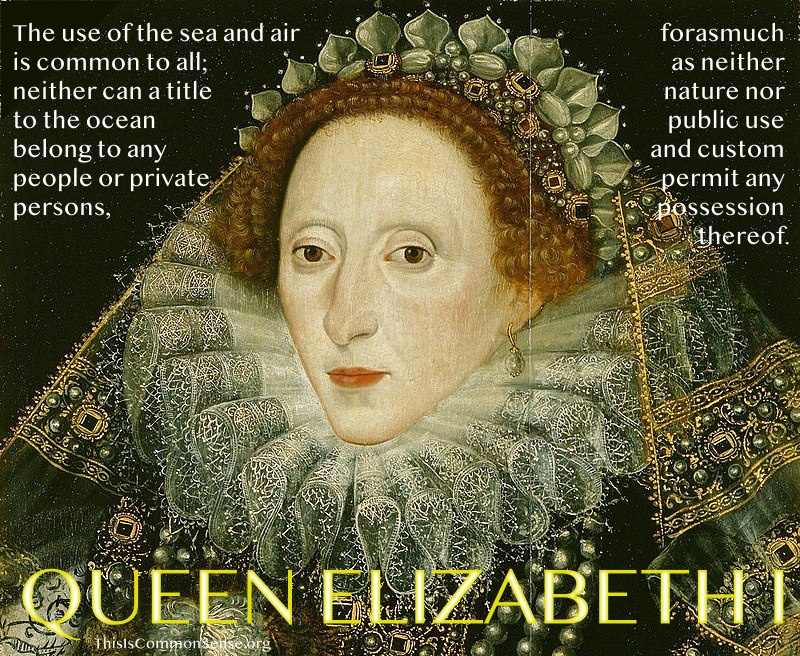
The use of the sea and air is common to all; neither can a title to the ocean belong to any people or private persons, forasmuch as neither nature nor public use and custom permit any possession thereof.
Elizabeth I, Queen of England, to the Spanish Ambassador (1580).

People now have more information, and they are smarter, overall, as a consequence — even in those ways they choose to be dumb.
Thomas M. Disch, The Dreams Our Stuff Is Made Of: How Science Fiction Conquered the World (1998), p. 226.

Only the strong know there is but one cause of war. All the other multitudinous reasons recorded in the history books were not real reasons at all. They were nothing but plausible pretexts. There was but one root-cause that persisted right back to the dim days of the jungle. When two monkeys want the same banana, that is war.
Eric Frank Russell, ”I Am Nothing,” Astounding Science Fiction (July 1952).

Man’s society is an ecology that forces adaptation to it.
Philip K. Dick, “The Variable Man” (1952), The Collected Short Stories of Philip K. Dick, v.1: The Short Happy Life of the Brown Oxford (1987).